
To read the full report, please download the PDF above.
Middle East Daily
SOOJIN KIM
Research Analyst
DIFC Branch – Dubai
T: +44(4)387 5031
E: soojin.kim@ae.mufg.jp
MUFG Bank, Ltd. and MUFG Securities plc
A member of MUFG, a global financial group
Middle East Daily
COMMODITIES / ENERGY
Oil holds gains amid ceasefire extension and ongoing blockade. Oil prices held recent gains, with Brent below USD99/b and WTI near USD90/b, after President Trump extended a ceasefire with Iran while maintaining a naval blockade in the Strait of Hormuz. Despite the temporary pause in military escalation, peace talks have faltered, and tensions remain high as both sides continue to clash over shipping access and broader geopolitical issues. The blockade has effectively halted most traffic through Hormuz, normally responsible for about one-fifth of global oil flows, driving extreme market volatility and keeping supply constrained. Conflicting signals around negotiations, including cancelled talks and renewed threats, have added to uncertainty, while the US continues to tighten pressure on Iran’s oil exports. With key disputes unresolved, including nuclear concerns and regional conflicts, the oil market remains highly sensitive to geopolitical developments, with prices supported by ongoing supply disruptions despite the fragile ceasefire.
Gold rebounds on ceasefire extension despite ongoing tensions. Gold prices recovered modestly, rising about 0.8% to above USD4,755/oz, after President Trump extended the ceasefire with Iran and signalled more time for renewed peace talks. The rebound followed recent losses, supported by a weaker US dollar, though tensions remain elevated as the Strait of Hormuz stays closed amid continued US and Iranian blockades. While the conflict, now in its eighth week, continues to disrupt energy supplies and fuel inflation risks, expectations that central banks will keep interest rates elevated remain a key headwind for bullion. Additional pressure comes from a more hawkish outlook for US monetary policy, as Fed leadership signals caution on rate cuts, limiting gold’s upside despite ongoing geopolitical uncertainty.
MIDDLE EAST - CREDIT TRADING
End of day comment – 21 April 2026. We were kind of hoping we had moved past interpreting the comments of a late stage septuagenarian who has a social media habit, but as one of my old bosses used to say, "hope doesn't pay the bonuses." So, we had a moderately solid morning but Trump's early afternoon comments about bombing Iran again, nestled into pitches on what a great deal he was going to get, pushed spreads a bit wider into the close. Volumes remain muted but the market is collectively realising we've gone almost back to spread levels we had before the conflict and yet ships are still not going through the Strait. This hasn't hastened sellers to the fore front as yet, but it is clearly putting a damper on being able to move bonds that do come out. Supply was mostly restricted to the Turkey quasi space, and we had some two ways in Saudi banks as the T2 supply is being digested.
MIDDLE EAST - MACRO / MARKETS
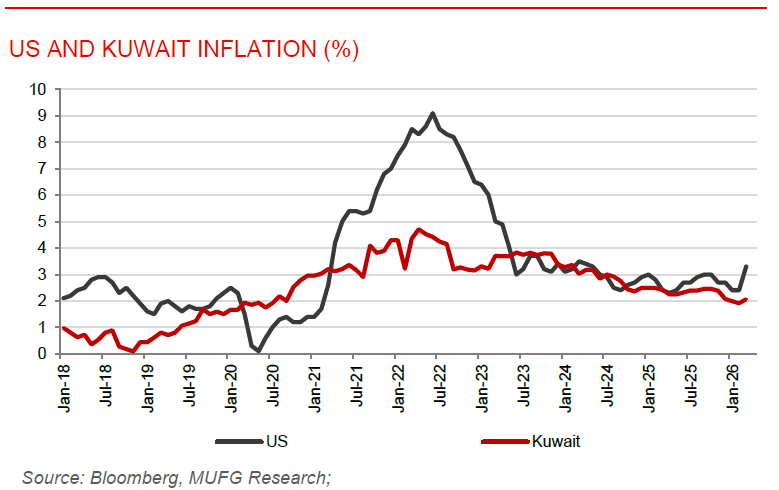
Kuwait inflation ticks up amid regional energy shock. Kuwait’s inflation rose to 2.1% y/y in March, slightly above February’s 1.9% y/y. The acceleration was more pronounced on a monthly basis, with the CPI rising 0.43% m/m in March, a notable step up from February’s 0.14% m/m. While the headline annual rate remains relatively contained by regional standards, the sequential pick-up in monthly momentum aligns with the broader inflationary impulse sweeping the Gulf following the near-closure of the Strait of Hormuz in late February. Kuwait is structurally one of the most exposed GCC economies to Hormuz disruptions, as Bahrain, Kuwait, Qatar, and the UAE rely on the Strait for above 50% of their imports, making them more vulnerable to higher transport costs and supply disruptions. Unlike Saudi Arabia or Oman, Kuwait has no viable alternative export or import corridor, meaning sustained logistics disruptions feed directly into domestic input and consumer prices. Policymakers and market participants will be watching closely whether the March acceleration marks the beginning of a sustained inflationary climb, particularly if ceasefire fragility prolongs shipping insurance costs and supply chain detours through the first half of 2026.
US considers currency swap with UAE amid war fallout. President Trump said the US is considering a potential currency swap arrangement with the United Arab Emirates as the Gulf state explores contingency measures to cushion the economic impact of the Iran war. The proposal, under which the Federal Reserve would provide dollar liquidity to the UAE central bank in exchange for dirhams, would act as a precautionary buffer to support financial stability if conditions worsen. The discussions come despite the UAE’s strong fiscal position and vast sovereign wealth assets, reflecting heightened caution as the conflict disrupts regional economies, particularly through the closure of the Strait of Hormuz and its impact on energy flows and trade. While US officials, including the National Economic Council, have indicated openness to supporting a key ally, they also suggested such assistance may not ultimately be necessary, underscoring the move as a proactive safeguard amid ongoing geopolitical uncertainty and volatile market conditions.