
To read the full report, please download the PDF above.
Middle East Daily
EDWARD BELL
Head of Research
DIFC Branch – Dubai
T: +971 (4)387 5033
E: edward.bell@ae.mufg.jp
SOOJIN KIM
Research Analyst
DIFC Branch – Dubai
T: +971 (4)387 5031
E: soojin.kim@ae.mufg.jp
MUFG Bank, Ltd. and MUFG Securities plc
A member of MUFG, a global financial group
Middle East Daily
COMMODITIES / ENERGY
Oil holds near highs as geopolitical risks sustain market premium. Oil markets have held onto their recent gains, shaking off headlines on the diplomatic stance between Iran and the US. Brent is trading at close to USD 110.40/b while WTI is just under USD 100/b with both benchmarks seeing choppy trading overnight. Iranian state media reported that a tanker hit a mine in the Strait of Hormuz but the incident has not been confirmed by either the UK MTO or the IMO. In the US, the API reported a draw in commercial stockpiles of 4.9m bbl last week along with draws in gasoline and distillate inventories. Official data from the EIA will be released later today with stockpiles already below seasonal norms for mid-October. European natural gas prices hit a four-year high of EUR 90/MWh overnight before retreating but gas will likely trade in a similar pattern to spot oil in response to geopolitical headlines.
Gold extends decline as rising yields and Fed expectations weigh. Gold is continuing its downward trend as oil prices push higher. Spot gold is trading close to USD 4,120/troy oz after a 0.4% decline overnight. Treasury yields are pushing higher – marginally – as market anxiety over the inflation outlook builds. Markets have again firmed up pricing for a December rate hike from the Fed with an additional 12.5bps priced in for another hike in January. Spot prices in the rest of the precious metals complex are lower with palladium down by nearly 1% in early trade.
MIDDLE EAST - CREDIT TRADING
End of day comment – 20 October 2026. Even with the turn in oil and the swings into the close around a rumoured and denied agreement between US/ Iran, spreads throughout the session were wider and bonds feeling heavy. New KUWIB 10y issuing at T+105bp continued to reprice the IG space. Newer issues suffered most. The street was trying to sell ADGB 4.75 36s pp which closed -0.25pt/+6bp. Also, QATAR 36s was under pressure closing -0.375pt/+7bp. Away from these ADGB/ QATAR curves were about 3/4bp wider with cash slightly lower and long end again outperforming the belly. New TAQAUH were active today with different fortunes. 36s was bid from the get-go as it looked like the pricing, and issue size didn't leave much free float. Sellers only stepped in once 100 was reached and the day’s range was 99.625/100.00, close 99.80/100.00 (+0.625pt/-3bp/reoffer 99.271). Against this new 32s never attracted interest and once the risk off mood took hold got sold, range was 99.50/99.875 closing 99.60/75 (-0.125pt/+7bp/reoffer 99.759). A new risk is that new issues price cheap and reprice the market lower. (Source: Dominik Roth, Credit Trader)
MIDDLE EAST - MACRO / MARKETS
Syria advances reconstruction financing plans with World Bank. Syria and the World Bank agreed to establish a multi-donor recovery and reconstruction trust fund aimed at mobilising international financing and supporting economic rehabilitation. The proposed Syria Recovery and Reconstruction Trust Fund (START) would provide concessional financing, investment guarantees and technical assistance, with a focus on infrastructure, public services and private-sector development. Separately, Syrian authorities held discussions with international financial advisers on sovereign debt management, potential restructuring and public financial management reforms. No funding commitments, implementation timetable or formal debt advisory agreements have yet been announced. The initiatives mark a step toward restoring Syria’s access to international financial support and rebuilding economic institutions, though progress will depend on donor commitments, stronger governance and the conversion of discussions into concrete financing arrangements.
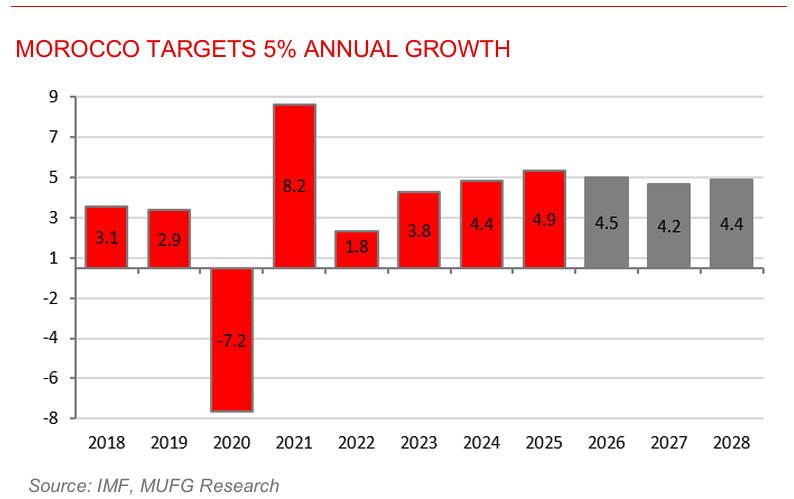
Morocco targets 5% annual growth under 2027-2031 economic programme. Morocco’s government unveiled a new five-year economic programme targeting average annual GDP growth of 5% between 2027 and 2031, alongside measures to strengthen fiscal sustainability and maintain price stability. The growth objective applies to the overall five-year period, reflecting the administration’s ambition to accelerate economic activity while supporting longer-term development priorities. The government also aims to contain annual inflation at around 2%, helping preserve household purchasing power amid ongoing external uncertainties. On the fiscal front, authorities intend to maintain the budget deficit at approximately 3% of GDP while gradually reducing Treasury debt to 62% of GDP by 2031. The programme seeks to balance fiscal consolidation with continued public investment and social spending commitments, while strengthening the economy’s resilience to external shocks.