
To read the full report, please download the PDF above.
Middle East Daily
SOOJIN KIM
Research Analyst
DIFC Branch – Dubai
T: +44(4)387 5031
E: soojin.kim@ae.mufg.jp
MUFG Bank, Ltd. and MUFG Securities plc
A member of MUFG, a global financial group
Middle East Daily
COMMODITIES / ENERGY
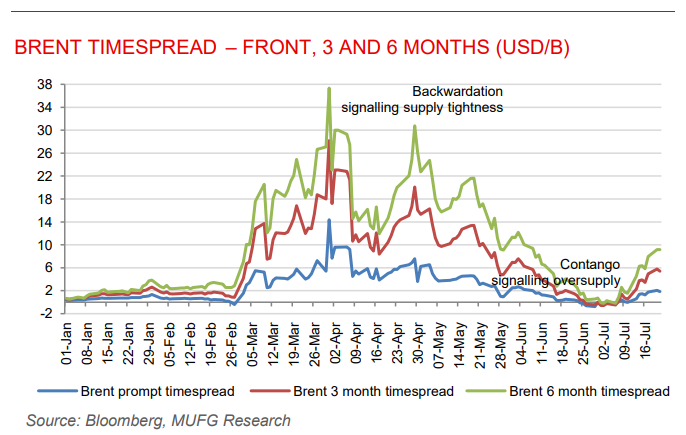
Oil eases as ceasefire hopes offset supply disruption risks. Brent crude fell toward USD88/b, while WTI slipped to around USD83/b, as tentative ceasefire efforts between the US and Iran tempered concerns over escalating supply disruptions. Despite continued US airstrikes on Iran and Iranian missile and drone attacks on Kuwait, markets were encouraged by reports of renewed diplomatic proposals, including a potential 10-day pause in hostilities. However, risks to regional energy supplies remain elevated as attacks on vessels in the Strait of Hormuz disrupted shipping traffic, while Yemen’s Houthi movement threatened Saudi maritime exports through the Red Sea, placing up to 2.5mb/d of export capacity at risk despite increased shipments from the Yanbu terminal. The latest price pullback suggest market are assigning greater weight to diplomatic developments, although oil is likely to remain highly volatile as maritime security risks continue to threaten key regional export routes.
Gold rises on dip buying despite rate hike concerns. Gold edged higher to trade around USD4,000/oz as investors bought on price weakness while assessing the inflationary impact of the escalating US-Iran conflict. Although renewed US strikes on Iran and Houthi threats to disrupt Saudi Shipping in the Red Sea kept geopolitical risks elevated, reports of ongoing ceasefire negotiations helped ease concerns over a prolonged escalation, contributing to softer oil prices. Markets continue to balance the inflationary impact of higher energy costs against weaker US economic data, with expectations that persistent inflation could prompt the Fed to maintain a tighter monetary policy stance. Gold’s ability to hold above the key USD4,000/oz level suggests continued safe-haven demand, although expectations of higher for longer interest rates are likely to cap further gains in the near term.
MIDDLE EAST - CREDIT TRADING
End of day comment – 20 July 2026. GCC bonds continue to trade heavy, especially in the UAE space. Whilst spreads were broadly unchanged today, spreads remain a function of UST moves. UST down=spreads flat, UST up=spreads wider, the widening trend is still playing out. Flows were mixed, the ETFs were balanced today, whilst RM remained net seller of bonds. Overall volumes remain low. In the morning OMAN sovgn (+1/2bp) and quasis saw some selling. Especially ENEDEV weakened with 31s closing -0.5pt/+4bp. Another underperformer was SHJGOV where mostly 36s changed hands closing -0.625pt/+2bp. Against these spreads in QATAR and ADGB sovgn remained stable with cash adjusting to the left in line with the UST move. Macro markets took some relief as mediation efforts were confirmed, equally the Houthi announcement of a naval blockade against Saudi was taken -vely. Technicals in GCC bond markets remain -ve, hence it will take some very good news and subsequent turn in flows to reverse the widening trend. (Source: Dominik Roth, Credit Trader)
MIDDLE EAST - MACRO / MARKETS
Kuwait and Jordan inflation remains contained despite regional pressures. Inflation remained subdued across both Kuwait and Jordan in June, highlighting the resilience of price stability despite ongoing regional geopolitical tensions. Kuwait’s annual inflation eased to 2.2% y/y from 2.5% in May, with the monthly consumer price index unchanged, as higher food (5.6% y/y) and transport costs were offset by subdued underlying price pressures. Meanwhile, Jordan’s inflation held broadly stable at 2.8% y/y, supported by softer food prices, although services inflation, particularly recreation and culture, remained relatively firm. Both economies continue to record inflation well below global averages and significantly lower than regional high-inflation economies such as Egypt and Turkey, underscoring the effectiveness of their macroeconomic policy frameworks. While the Iran conflict has raised food and transport costs, the latest data suggest that its pass-through to consumer prices has remained contained so far, although sustained disruptions to regional energy and trade routes could pose upside risks to inflation in the second half of the year.
Fitch affirms Turkey at ‘BB-’ with stable outlook. Fitch affirmed Turkey’s ‘BB-’ sovereign rating with a Stable Outlook, citing continued orthodox policies, low public debt and a resilient banking sector, while highlighting high inflation, weak external liquidity and policy credibility risks as key constraints. Fitch expects inflation to fall from 32.0% in June to 29.5% by end-2026 and 18.0% by end-2028, though it will remain the highest among Fitch-rated sovereigns. GDP growth is forecast to slow to 2.8% in 2026 before recovering to 4.4% in 2027, while the current account deficit is projected to widen to 3.0% of GDP due to weaker energy and tourism balances. Although tighter monetary policy has helped stabilise the lira and rebuild reserves, external financing needs remain high, and reserve levels are expected to stay below the ‘BB’ peer median. Fitch stressed that maintaining policy discipline and strengthening external buffers will be critical to preserving macroeconomic stability, warning that premature easing ahead of elections could reignite inflation and external pressures.