
To read the full report, please download the PDF above.
Middle East Daily
EDWARD BELL
Head of Research
DIFC Branch – Dubai
T: +971 (4)387 5033
E: edward.bell@ae.mufg.jp
SOOJIN KIM
Research Analyst
DIFC Branch – Dubai
T: +971 (4)387 5031
E: soojin.kim@ae.mufg.jp
MUFG Bank, Ltd. and MUFG Securities plc
A member of MUFG, a global financial group
Middle East Daily
COMMODITIES / ENERGY
Oil holds near recent highs as Hormuz risks keep markets one edge. Oil prices are holding close to recent highs with December Brent futures at close to USD 110/b while WTI November futures are holding near USD 104/b. Iranian officials said they had “no choice” but to enforce control over the Strait of Hormuz, risking further attacks to ships making use of the waterway. At the same time, production levels from the region have continued to recover with Iraq exporting more than 3.4m b/d so far in October, close to the 3.7m b/d exported in February and a sharp improvement from subdued levels in Q2 and Q3. Fraught geopolitics in the Middle East will keep the risk for oil prices skewed to the upside with market attention focusing on the risk of resumed hostilities around the upcoming US midterm elections.
Gold holding levels even as energy inflation remains in focus. Spot gold is holding to recent moderate losses, trading below USD 4,140/troy oz. The recent uptick in oil prices is threatening the near-term inflation outlook and keeping the bias for policy rates higher. A broader sell-off in bond markets is also pushing yields higher: the 2yr UST added more than 6bps to 4.7719% overnight. Prices are modestly higher across the rest of the precious metals complex with silver up 0.3% as of early trading.
MIDDLE EAST - CREDIT TRADING
End of day comment – 19 October 2026. The market was very quiet in the morning, but activity picked up in the afternoon induced by UST weakness and late morning new issue announcements. Flows remained two ways throughout by both ETFs and RM, but bonds are getting technical. What was strong were duration bonds, there was simply no sellers until late afternoon in ADGB 54s, but spreads still closed broadly -3/4bp in the main sovgn long end curves with cash only 0.125/0.25pt lower. That was a bit different in the belly since KUWAIT (3y/10y) and TAQAUH (long 5y/10y) announced new deals. As for TAQAUH at +98bp for the long 5y and T+108bp for the 10y the new issue premium is about 10bp which weighed on secondary price action of outstanding bonds/ peers. One dealer offered QATAR 26s down closing -0.625pt/+4bp on the back of the new KUWIB without any pushback from the market. That could become a trend to see credit curves flatten since most issuers will target the 5/10y area and every bond being issued commands a premium to outstanding bonds. As for more illiquid corners there is no appetite to bid AT1s, market still hasn't found clearing levels and today MASQUH 6.625 perp got offered down another 0.5pt/+7bp. (Source: Dominik Roth, Credit Trader)
MIDDLE EAST - MACRO / MARKETS
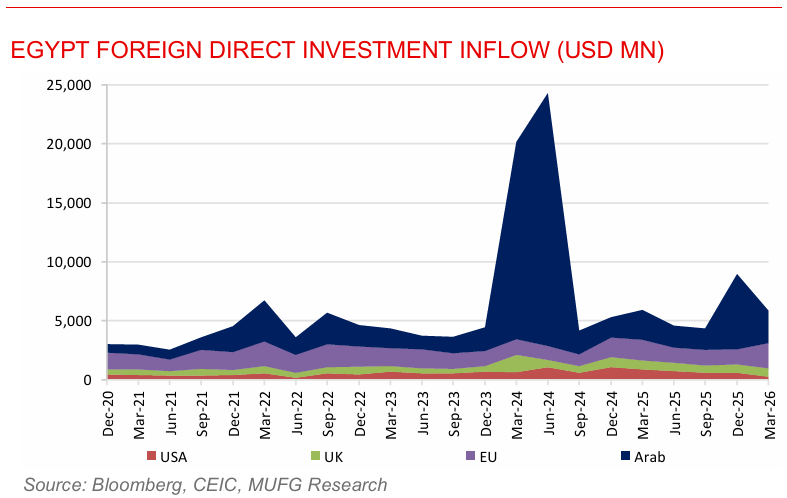
Egypt launches USD 29.7bn Qatari investment zone. Egypt inaugurated a 20 sq km investment zone around the Alam El Roum development on the Mediterranean North Coast, advancing a USD 29.7bn Qatari-backed real estate project. The development includes USD 3.5bn paid to the Egyptian government in 2025 and USD 26.2bn in planned investment, with the first phase estimated at USD 4.5bn. Foreign buyers have accounted for more than 30% of initial sales, exceeding the 20% target. Following Egypt's reported USD 18bn in FDI inflows during FY2025/26, the project is expected to support capital inflows, construction activity and tourism investment, although its longer-term impact will depend on execution and sustained foreign demand.
Iraq’s oil exports near prewar level as deep discount attract buyers. Iraq’s crude oil exports have recovered to more than 3.4mb/d in October, approaching prewar levels of 3.7mb/d in February, supported by aggressive pricing discounts and diversified shipping routes. Shipments increased from 2.4mb/d in August to 3.0mb/d in September, reflecting improving export capacity despite persistent disruptions around the Strait of Hormuz. To attract buyers amid elevated shipping risks, Iraq has offered substantial discounts on November cargoes, with Basrah Medium priced USD 35/b and Basrah Heavy USD 37/b below regional benchmarks. Exports are currently moving through southern Gulf terminals, the northern pipeline connecting the Kurdish region and overland trucking routes to Syria. However, Iraq’s limited tanker fleet continues to constrain its ability to independently transport crude through Hormuz, increasing reliance on international traders and shipping operators. While recovering export volumes should support government revenues, steep price discounts and elevated transportation costs could limit the fiscal benefits, highlighting Iraq’s continued vulnerability to regional shipping disruptions.