
To read the full report, please download the PDF above.
Middle East Daily
SOOJIN KIM
Research Analyst
DIFC Branch – Dubai
T: +44(4)387 5031
E: soojin.kim@ae.mufg.jp
MUFG Bank, Ltd. and MUFG Securities plc
A member of MUFG, a global financial group
Middle East Daily
COMMODITIES / ENERGY
Oil surges as US-Iran escalation intensifies supply risks. Brent crude rose nearly 4% to around USD90/b, while WTI climbed to around USD84/b, after the US and Iran sharply escalated hostilities, heightening concerns over disruptions to Middle East oil supplies. The latest developments included continued US strikes on Iranian military targets, Iranian attacks on shipping near the Strait of Hormuz, damage to a major Kuwaiti oil facility, and renewed Houthi threats against Saudi energy infrastructure. Shipping risks also intensified as vessel traffic through Hormuz declined, with Iran intercepting several vessels and reports of a ship fire near Oman adding to market uncertainty. With global oil inventories already at historically low levels outside China, markets remain highly sensitive to any further disruption to Gulf exports. The latest escalation underscores that geopolitical risks are increasingly affecting both energy infrastructure and maritime transport, leaving oil prices biased to the upside.
Gold holds near USD4,000/oz amid geopolitical risks and rate hike concerns. Gold traded near USD4,010/oz after falling more than 2% last week, as investors balanced heightened geopolitical tensions against growing expectations that the Fed could raise interest rates if higher energy prices fuel inflation. The renewed escalation between the US and Iran, which pushed Brent crude above USD90/b following attacks on energy infrastructure and shipping around the Strait of Hormuz, has reinforced inflation concerns despite softer US economic data. At the same time, several Fed officials have warned that inflation risks remain elevated, with markets now pricing in at least one rate hike by year-end. The recent price action suggests that concerns over higher-for-longer interest rates are offsetting gold’s traditional safe-haven appeal, leaving gold largely range-bound despite escalating geopolitical risks.
MIDDLE EAST - CREDIT TRADING
End of day comment – 17 July 2026. We opened surprisingly strong given Asia equity performance but slowly widened out as there was little else to do other than stare at the Nikkei and then Nasdaq futures and the market got a little twitchy allowing spreads to widen 5-10 bps across IG names. The rates rally drove broad based widening to levels we haven't seen for a while. The new issues didn't trade much and seem to be placed ok with limited amount of flipping. For KSA and Kuwait, conventional sovereign bonds are 4-6bps wider but the 10yr sector of KSA sukuks is unchanged with one dealer trying to absorb bonds in the street. We traded the KSA 4.875 35s and the SRCSUK 36s two way left with better interest to buy the SRCSUK 36s. Aramco was +5bps but PIFKSA underperformed across the curve but especially 56s which were +10bps. There were net sellers of KSA corps and T2 with RJHIAB 5.651 36s printing something like +15bps wider on the day. (Source: Matthew Dunker, Credit Trader)
MIDDLE EAST - MACRO / MARKETS
IMF sees UAE economy remaining resilient despite regional conflict. The IMF concluded its staff visit to the UAE ahead of the 2026 Article IV consultation, reaffirming that the economy has remained resilient despite the ongoing Middle East conflict, supported by strong fiscal and external buffers, timely policy measures, and the rerouting of oil and trade flows. While disruptions to the Strait of Hormuz and elevated geopolitical uncertainty are expected to weigh on non-oil sectors such as tourism, trade, transportation and real estate in 2026, the Fund expects growth to strengthen in the second half of the year as oil exports recover and hydrocarbon production increases following the UAE's exit from OPEC. The IMF also expects fiscal and current account balances to remain in surplus, supported by higher oil prices, conservative budgeting and low public debt, while banks remain well-capitalized and liquid despite moderating credit and real estate activity. The Fund emphasised that continued structural reforms, deeper trade integration and sustained investment in technology and human capital will be key to reinforcing non-oil growth.
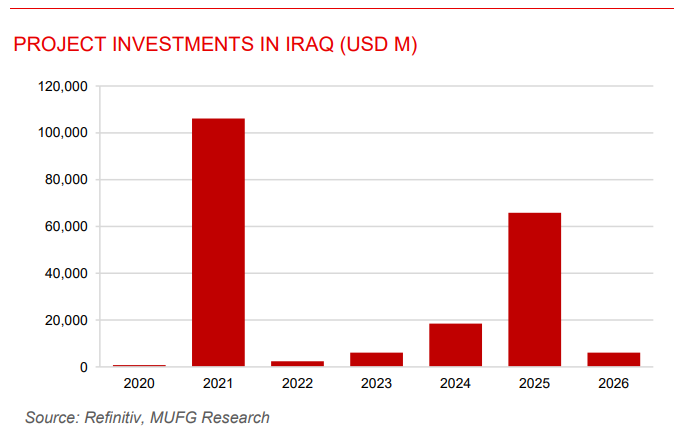
Iraq secures USD60bn in US investment deals to rebuild energy sector. Iraqi Prime Minister Ali Al-Zaidi concluded his first official visit to Washington by securing more than USD60bn in agreements and MoU across energy, infrastructure, technology and healthcare, underscoring Iraq’s push to attract long-term foreign investment and deepen economic ties with the US. The package includes 48 agreements, with the energy sector at its core, including preliminary deals for Chevron to negotiate investments in the West Qurna-2 and Nasiriyah oil fields and participate in plans to revive the Kirkuk-Baniyas pipeline, creating a strategic export route to the Mediterranean that would reduce Iraq’s dependence on the Strait of Hormuz. Additional agreements were signed with major US energy firms including ExxonMobil, Shell, Halliburton, KBR and GE Vernova, alongside a formal licensing agreement with Starlink. The investment drive comes after the regional conflict severely disrupted Iraq’s oil exports and public finances, highlighting the need to diversify export routes and restore production capacity.