
To read the full report, please download the PDF above.
Middle East Daily
SOOJIN KIM
Research Analyst
DIFC Branch – Dubai
T: +44(4)387 5031
E: soojin.kim@ae.mufg.jp
MUFG Bank, Ltd. and MUFG Securities plc
A member of MUFG, a global financial group
Middle East Daily
COMMODITIES / ENERGY
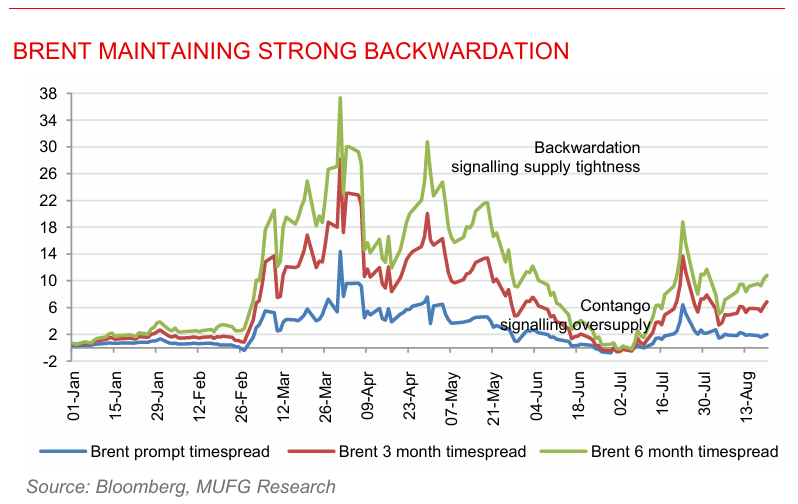
Oil extends gains as US intensifies economic pressure on Iran. Oil rose for a fifth consecutive session, with Brent approaching USD92/b as the US announced sweeping new measures aimed at further isolating Iran economically. President Trump described the package as economic warfare on an “unprecedented scale,” warning countries and institutions against facilitating Iranian trade, finance, transport or sanctions evasion. The move marks a continued shift from military action toward economic pressure, aimed at forcing Iran back into negotiations over the war, its nuclear program and the Strait of Hormuz. The measures could also complicate Iran’s oil trade with China, its largest crude buyer, while the UAE’s decision to cut economic ties with Iran adds to Iran’s isolation. Physical oil markets remain tight, with Brent maintaining strong backwardation and US distillate inventories declining despite higher crude stocks.
Gold holds near USD4,500/oz after biggest gain in six months. Gold holds near USD4,500/oz after surging more than 4% in the previous session, its largest gain in six months, following the US Treasury’s surprise decision to at least double buybacks of long-dated government debt. The move, aimed at supporting Treasury market liquidity after long-term yielding reached multi-decade highs, helped ease borrowing costs pressures, and increased the appeal of non-yielding gold. However, upside risks to inflation remain as elevated oil prices and continued US-Iran tensions complicate the monetary outlook. Minutes from the Fed’s July meeting also showed broader support for potentially raising rates if inflation remains persistent. Going forward, the Fed’s outlook and energy-driven inflations stemming from Middle East tensions will be key drivers of gold prices.
MIDDLE EAST - CREDIT TRADING
End of day comment – 19 August 2026. Another day driven by the rates market. We were broadly sideways if inching wider until the UST announcement in the early afternoon. The punchy move lower in UST yields, somewhat surprisingly, dragged our spreads somewhat tighter to close out only marginally wider to unchanged on the day. Aside from the standard number of accounts trying to catch dealers sleeping (a good day to try) true demand for risk didn't materialize on any level that we saw. We saw notable supply of shorter dated KSA bonds and in sukuks specifically. We have had offered side sellers in a variety of issues over the past few days suggesting shariah accounts are making room for the somewhat predictable KSA sukuk issuance expected in September. KSA 4.274 29s, KSA 2.969 29s, and KSA 4.25 30s have all been available to buy this week if at not very compelling levels. Focus on ARAMCO long end lightened up a bit but we have had consistent demand from Asian based accounts. (Source: Matthew Dunker, Credit Trader)
MIDDLE EAST - MACRO / MARKETS
PIF reports strong profit growth amid asset target shortfalls. Saudi Arabia’s PIF posted strong profitability in 2025 but fell short of its asset growth target. Assets under management declined 1.1% y/y to USD906bn, below the USD1.07 trillion target, while total revenue rose 9% to USD120bn and net profit surged 152% to USD17.4bn. As reported by Global SWF, weak Saudi equity markets, including a 12.8% decline in the Tadawul Index, lower oil prices, and a 15% fall in Saudi Aramco’s share price, weighed on PIF’s domestic listed portfolio and offset gains from international investments. Global SWF also highlighted USD11.7bn in project and infrastructure impairments and the transfer of USD20.5bn on of assets to the Ministry of Finance, reflecting challenges around giga-project economics, delays, and cost inflation. Despite the profit increase, PIF recorded USD29.4bn in valuation losses through other comprehensive income and saw non-banking borrowings rise 40.5% to USD88.8bn. These developments support the fund’s new 2026-2030 strategy, which prioritizes value realization, efficiency, and sustainable returns over rapid asset accumulation. Financial results and strategic objectives are based on PIF’s 2025 Annual Report
Egypt’s risk premium falls to lowest since 2014. Egypt’s sovereign risk premium has fallen to its lowest level since 2014, supported by record FX reserves, stronger external inflows and renewed IMF backing. The spread on Egypt’s dollar bonds over US Treasuries fell to 322bp last week, around 150bp lower than in March, while five-year CDS declined to 269bp. Investor confidence strengthened after the IMF completed its latest program review in July, unlocking about USD1.8bn, alongside a EUR1.5bn EU disbursement. Meanwhile, remittances, tourism and improved Suez Canal revenues have supported foreign-currency liquidity, pushing reserves to a record USD56.3bn in July, while greater exchange-rate flexibility has helped absorb external shocks. Egyptian bonds have returned more than 10% since end-March, significantly outperforming broader emerging markets. Going forward, however, high financing needs and slow privatisation remain key vulnerabilities.