
To read the full report, please download the PDF above.
Middle East Daily
SOOJIN KIM
Research Analyst
DIFC Branch – Dubai
T: +44(4)387 5031
E: soojin.kim@ae.mufg.jp
MUFG Bank, Ltd. and MUFG Securities plc
A member of MUFG, a global financial group
Middle East Daily
COMMODITIES / ENERGY
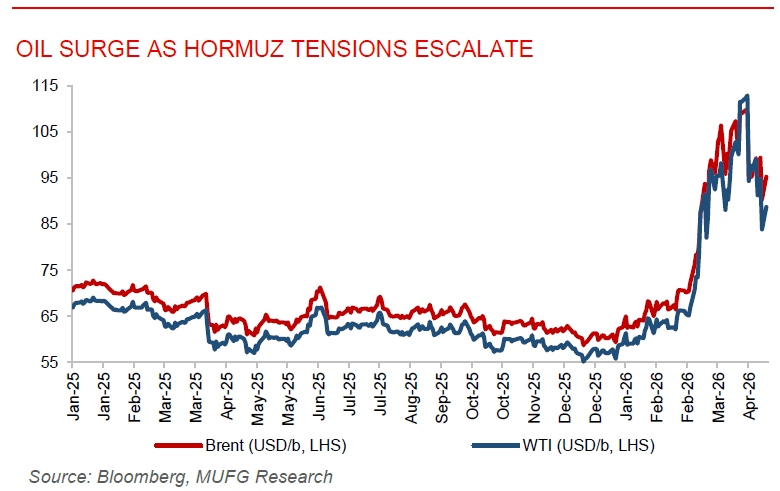
Oil and gas surge as Hormuz tensions escalate. Oil and natural gas prices spiked sharply, with Brent rising nearly 8% and European gas up over 10% after a major escalation involving the US navy seizing an Iranian vessel and renewed clashes in the Strait of Hormuz. The incident, amid a fragile ceasefire and stalled diplomacy between the US and Iran, led Iran to reimpose restrictions on the key chokepoint, halting most shipping and forcing tankers to turn back, severely disrupting global energy flows. President Trump maintained optimism about potential talks, though Iran signalled little progress, highlighting ongoing uncertainty. The standoff threatens to deepen the global energy crisis, as Hormuz, responsible for about a fifth of global oil and LNG trade, remains effectively closed, amplifying supply shocks, fuelling inflation, and raising risks to global growth.
Gold drops as Middle East tensions rekindle inflation concerns. Gold prices declined, falling as much as 1.9% to around USD4,800/oz, as renewed tensions in the Middle East heightened inflation fears and undermined prospects for a diplomatic resolution to the conflict. The escalation, triggered by the US seizure of an Iranian vessel and fresh threats around the Strait of Hormuz, disrupted shipping and cast doubt over ongoing peace talks, adding to market uncertainty. President Trump signalled both openness to negotiations and potential further escalation, while Iran dismissed the likelihood of progress. Surging oil and gas prices, alongside a stronger US dollar, added pressure on gold by reinforcing expectations that central banks will keep interest rates elevated. With gold down about 9% since the conflict began, prices are expected to remain volatile amid persistent geopolitical and inflation risks.
MIDDLE EAST - CREDIT TRADING
End of day comment – 17 April 2026. It was a quiet Friday until Trump started announcing that an agreement with Iran is as good as reached. The market certainly reacted more to the news that Iran had opened the Strait of Hormuz on the back of the Israel/ Lebanon ceasefire. There wasn't a great deal of visibility in the last couple of trading hours, but ETFS immediately became sizeable buyers given the general risk on tone and inflows into risk assets. We close most names 3/7bp tighter. The risk on mood is shown in strong long end bond bids, like QATAR 50s going out +0.875pt/-5bp and also High beta bonds getting bid up like SHJGOV 51s closing +1pt/-7bp. The market will eagerly await the weekend and if there are negotiations and if all that Trump has tweeted in the past hour is confirmed. But for now, the opening of the straight seems to be the biggest risk driver as seen in oil prices.
MIDDLE EAST - MACRO / MARKETS
Regional credit ratings face pressure amid Middle East conflict. Recent rating actions highlight growing credit risks across the region as the Middle East conflict weighs on economic stability. Moody’s affirmed Iraq’s ratings at Caa1 but revised the outlook to negative, citing heightened risks to energy flows and security, alongside structural weaknesses in governance and fiscal policy. Similarly, Bahrain’s B2 rating was affirmed but its outlook turned negative due to concerns that the conflict will further weaken already strained credit fundamentals. In contrast, Jordan’s Ba3 rating outlook remains stable, supported by strong policy frameworks, international backing, and access to domestic financing. Meanwhile, S&P Global Ratings maintained Turkey’s BB-rating with a stable outlook, noting that while higher energy prices are pressuring growth, inflation, and external balances, the impact is expected to be contained if the conflict de-escalates and prudent policies continue. Overall, the developments reflect a divergence in resilience across countries, with more vulnerable economies facing increasing downside risks while stronger policy frameworks help anchor stability elsewhere.
IEA proposes Basra-Ceyhan pipeline to bypass Hormuz risks. The International Energy Agency (IEA) Executive Director Faith Birol has proposed a major oil pipeline linking Iraq’s Basra fields to Turkey’s Ceyhan terminal as a strategic alternative to the increasingly unstable Strait of Hormuz. The initiative comes as renewed Iranian restrictions on maritime traffic have disrupted energy flows, forcing tankers to reroute and highlighting the risks of relying on a single chokepoint that handles a significant share of global oil and LNG trade. Iraq, which exports around 90% of its oil through the Gulf, would gain a critical diversification route, while Turkey would strengthen its position as a key energy transit hub connecting the Middle East to Europe. The project is also seen as enhancing Europe’s energy security amid rising geopolitical tensions and stalled alternative corridors, with Birol suggesting that both political agreement between Iraq and Turkey and financing, potentially backed by European partners, are achievable. The proposal aligns with broader regional efforts to develop new trade and energy routes as instability continues to reshape global supply chains.
.