
To read the full report, please download the PDF above.
Middle East Daily
EDWARD BELL
Head of Research
DIFC Branch – Dubai
T: +971 (4)387 5033
E: edward.bell@ae.mufg.jp
SOOJIN KIM
Research Analyst
DIFC Branch – Dubai
T: +971 (4)387 5031
E: soojin.kim@ae.mufg.jp
MUFG Bank, Ltd. and MUFG Securities plc
A member of MUFG, a global financial group
Middle East Daily
COMMODITIES / ENERGY
Oil eases from multi-month highs as Hormuz flows recover. Oil prices have pulled back from hitting their highest levels since May with Brent trading close to USD 107/b and WTI close to USD 99/b. US secretary of energy Chris Wright said over the last few days that oil flows through the Strait of Hormuz had recovered to 80% of pre-conflict levels though ships continue to report being attacked in the critical waterway. Time spreads are holding steady at close to a USD 3/b backwardation in Brent front months while Dec 26-27 spreads are close to USD 22/b. Investors added net long positions in Brent futures and options last week, the first increase since mid-September. For WTI net managed money positions were lower with net longs cut for three weeks in a row.
Gold edges higher as fed hike expectations ease. Gold is pushing up slightly in early trade to around USD 4,180/troy oz. Stronger than expected inflation prints in the US helped to push gold lower last week though the selling pressure was tempered by a seemingly reticent Kevin Warsh at the IMF meetings. There will be few major data catalysts for gold this week with prices likely to track movements in the Treasury curve. Markets have pulled back on their December rate hike pricing to an 87% probability.
MIDDLE EAST - CREDIT TRADING
End of day comment – 16 October 2026. Very subdued Friday. After all that volatility this week the market took a day off. We had some UST strength overnight and some volatility in UST during the day, prices in my GCC space though were mostly flattish. That puts spread 2/3bp wider. It has to be said though that GCC bonds have weathered the week well against the global credit market weakness. What is missing though are volumes/ market activity, so it always feels like a marginal flow could push the market 3/4bp either way. That is especially true for more illiquid corners of the market and indeed some financial bonds and AT1 had again some aggressive offers today. (Source: Dominik Roth, Credit Trader)
MIDDLE EAST - MACRO / MARKETS
Moody’s upgrades Egypt to B3 with positive outlook on fiscal improvements. Moody’s upgraded Egypt’s sovereign credit rating by one notch to ‘B3’ from ‘Caa1’, maintaining a positive outlook amid progress in fiscal consolidation, structural reforms and external resilience. The upgrade reflects stronger revenue collection and expenditure restraint, which have placed government debt and interest burdens on a declining trajectory, albeit from elevated levels. The agency also highlighted the adoption of a flexible exchange rate and tighter monetary policy, which have strengthened foreign-currency buffers and improved Egypt’s ability to withstand external shocks, including higher oil prices and disruptions from the Middle East conflict. The decision comes as Egypt approaches the conclusion of its US$8bn IMF financing programme, with the final review targeted for December. Meanwhile, the central bank maintained its benchmark deposit rate at 19% in September, balancing inflation risks against the need to support economic recovery. Foreign portfolio inflows have also resumed following earlier conflict-related outflows, signalling improving investor confidence. The positive outlook indicates scope for further rating improvements, provided fiscal consolidation, debt reduction and structural reforms remain on track despite persistent geopolitical and inflationary risks.
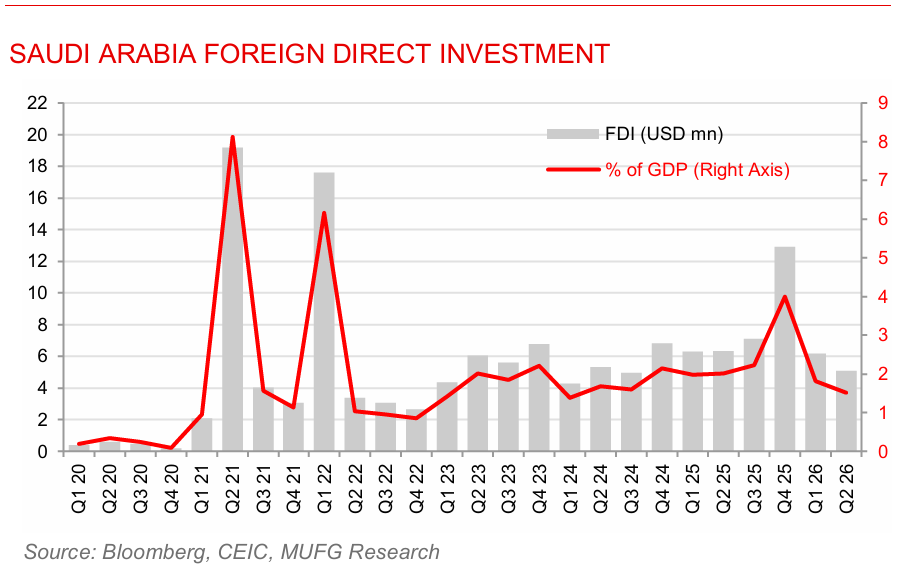
KSA’s FDI inflows surge 33.5% in 2025, led by construction and manufacturing. Saudi Arabia’s foreign direct investment (FDI) inflows increased 33.5% y/y to SAR 159.1bn (USD 42bn) in 2025, supported by regulatory reforms and continued investment in non-oil sectors. Construction attracted the largest share at SAR 34.5bn (21.7%), followed by manufacturing at SAR 33.4bn (21%) and administrative services at SAR 22.4bn. However, FDI outflows nearly doubled to SAR 77.7bn, limiting net FDI growth to just 1.7% y/y at SAR 81.4bn (USD 21.7bn). The accumulated FDI stock rose 8.3% to SAR 1.06tn, with the UAE, Luxembourg and the US among the largest investors. Gross inflows reached approximately 42% of Saudi Arabia’s Vision 2030 annual FDI target of USD 100bn, highlighting progress toward attracting international capital. While stronger inflows signal continued investor interest in the Kingdom’s diversification agenda, elevated outward investment and regional uncertainty could constrain net capital accumulation and the pace of progress toward longer-term investment targets.