
To read the full report, please download the PDF above.
Middle East Daily
EDWARD BELL
Head of Research
DIFC Branch – Dubai
T: +971 (4)387 5033
E: edward.bell@ae.mufg.jp
SOOJIN KIM
Research Analyst
DIFC Branch – Dubai
T: +971 (4)387 5031
E: soojin.kim@ae.mufg.jp
MUFG Bank, Ltd. and MUFG Securities plc
A member of MUFG, a global financial group
Middle East Daily
COMMODITIES / ENERGY
Oil stabilizes with market focus back on Middle East geopolitics. Oil prices are steadying after some recent losses as markets turn their attention back to geopolitical risk in the Middle East. News reports that US President Donald Trump is reportedly considering a new wave of strikes against Iran has put a floor under the selloff with Brent trading at around USD 92/b and WTI at USD 83/b. Time spreads remain supported with the 1-2 month spread at USD 2.74/b in Brent markets. Natural gas prices sold off sharply last night, down 5% to EUR 80.85/MWh, their lowest level since early October. Weekly EIA data showed a 3.4m bbl build in commercial crude stocks though that was largely offset by a 3.2m bbl draw in SPR inventories. SPR draws in November have accelerated after two months of much more modest declines. Gasoline inventories showed a large build of 5.2m bbl while distillate stockpiles were also higher. US oil production edged higher to slightly more than 14m b/d while crude exports increased by 1m b/d last week to 4.5m b/d. Slightly lowering the geopolitical temperature in the region, one of the US aircraft carrier groups in the Middle East has now left the region, likely sailing to Asia according to media reports.
Gold sells off on FOMC minutes. Gold continues to push lower with a 0.7% selloff overnight to USD 3,856/troy oz extending into early trade today. Minutes from the October FOMC showed strong alignment from Fed officials on the need for additional rate hikes. More generally, commodities have seen a wide-ranging selloff, particularly in metals as volatility in AI valuations raises doubts about longer-term demand for copper or other datacentre capital inputs.
MIDDLE EAST - CREDIT TRADING
End of day comment – 18 November 2026. Stabilising but wider into the close. The morning had a bit of NVIDIA relief although it was still a wobbly start for GCC bonds given the bond overhang in the market from ydays selling. But mid morning/mid day flows became more two way and ETFs actually flipped to being net buyers and cash prices started to move higher. Then came the afternoon where RM resumed selling and stocks sold off into the London close. Coupled with flight to safety flows into UST, spreads are closing broadly +1/3bp in IG sovgn. ADGB had most flows in long end where 54s closed +0.5pt/+1bp. QATAR 36s today found its feet after ydays selling closing +0.25pt/+1bp. In higher beta sovgn OMAN long end was less responsive to UST moves, 51s going out +0.125pt/+4bp. Quasi sovgn were quiet today with most names +3/5bp as cash lagged the underlying rates move. In fins new ADCBUH AT1 had a very quiet start but held around its 100 reoffer level with some local retail interest to buy. No major news in geopolitics/Iran leaves the GCC market looking at global macro for direction which remains risk off. The RM and ETF selling lately though gets slowly countered by local buying interest. (Source: Dominik Roth, Credit Trader)
MIDDLE EAST - MACRO / MARKETS
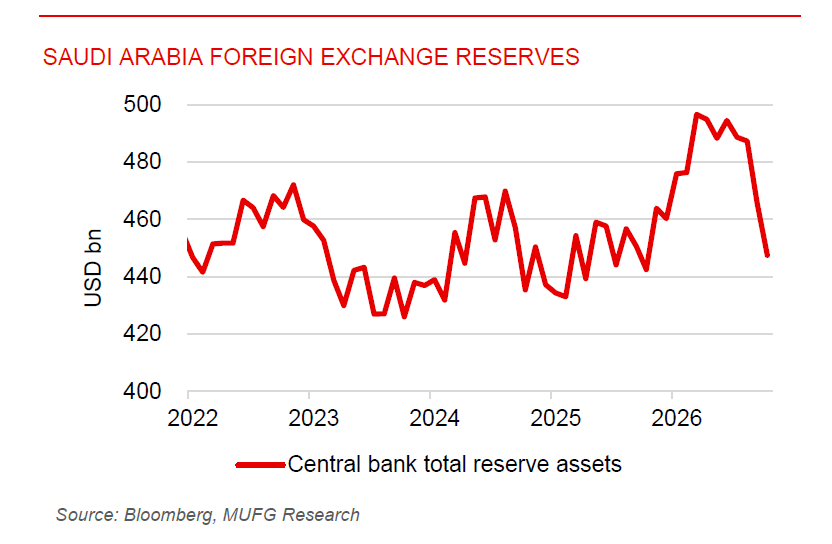
Saudi Arabia reports drop in foreign exchange reserves in October. Central bank foreign exchange reserves dropped 3.9% m/m in Saudi Arabia last month to USD 447bn, their lowest level since October last year and down nearly 10% from a peak level of almost 500bn recorded in March when oil prices surged and Saudi Arabia was able to shift exports to the Red Sea, offsetting the impact of attacks on shipping in the Strait of Hormuz. Despite the monthly decline, Saudi Arabia’s foreign exchange reserves are robust, estimated at more than two years of import cover based on September import values.
Egypt and IMF reach staff-level agreement on USD 2.3bn disbursement. Egypt and the IMF reached a staff-level agreement on review of Egypt’s two IMF programmes, an extended fund facility and resilience and sustainability facility. Based on the successful IMF board approval of the programmes, Egypt will receive a disbursement of USD 1.5bn under the EFF and USD 0.8bn in the RSF which will bring total finance from the Fund to Egypt to about USD 10bn. The IMF noted that Egypt has successfully implemented its reform programme and that “proactive response” this year has helped to stabilize the local economy despite a volatile international backdrop.
IMF projects strong recovery in the UAE in 2027 with upside risk based on productivity gains. The IMF carried out its Article IV visit to the UAE and noted the economy’s “strong resilience” to the regional conflict and the country’s “substantial fiscal and external buffers” as helping to insulate the impact of the conflict. The IMF projects that the UAE economy will manage to expand by 0.2% in 2026 before a strong recovery in 2027 thanks to higher oil production (estimated at 13% growth next year). Like the economies across the rest of the region, the fund noted that the outlook was contingent on the geopolitical dynamics in the Middle East but also noted how strong productivity gains in the UAE in particular could allow it to recover even faster in an upside scenario.