
To read the full report, please download the PDF above.
Middle East Daily
SOOJIN KIM
Research Analyst
DIFC Branch – Dubai
T: +44(4)387 5031
E: soojin.kim@ae.mufg.jp
MUFG Bank, Ltd. and MUFG Securities plc
A member of MUFG, a global financial group
Middle East Daily
COMMODITIES / ENERGY
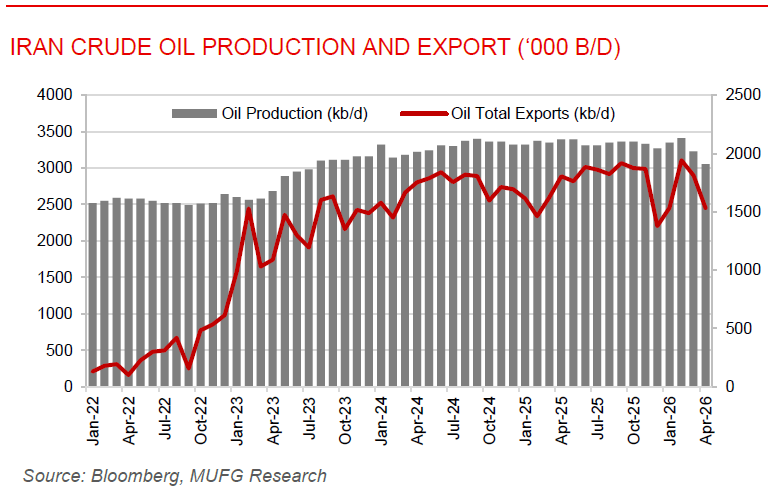
Oil retreats as Trump delays planned strike on Iran. Oil prices fell after President Trump said he had postponed a planned US military strike on Iran following appeals from Saudi Arabia, Qatar, and the UAE, raising hopes for renewed negotiations. Brent slipped below USD110/b after rising 2.6% the previous session, while WTI dropped below USD103/b. Trump said Gulf leaders requested a delay as “serious negotiations” with Iran were underway, though he warned the US remains prepared to act militarily if no acceptable agreement is reached. Markets remain highly sensitive to developments around the Strait of Hormuz, where ongoing disruptions and a US naval blockade have severely constrained regional oil flows and effectively shut down Iran’s Kharg Island export terminal for more than a week. The uncertainty surrounding talks, sanctions policy, and the duration of supply disruptions continues to keep energy markets volatile despite the temporary easing in geopolitical tensions.
Gold gains as hopes for Iran deal ease inflation concerns. Gold extended its advance as renewed hopes for a US-Iran diplomatic breakthrough slightly eased inflation concerns linked to the Middle East conflict. Gold rose toward USD4,585/oz following comments from President Trump that he had delayed a planned new wave of attacks on Iran after request from Gulf countries to allow more time for negotiations. While Treasury yields remained near multiyear highs due to still-elevated energy prices, optimism surrounding a potential ceasefire and nuclear agreement provided some support for gold prices. The metal had traded within a relatively narrow range in recent weeks as investors balance inflation risks and higher-rate expectations against concerns over slowing global growth and the possibility of future monetary easing. Despite the latest rebound, gold remains down more than 13% since the conflict began.
MIDDLE EAST - CREDIT TRADING
End of day comment – 18 May 2026. Another mixed session, but the weak undertone remains. We had a bit of a morning wobble on the back of weekend headlines and subsequent oil higher/ yields higher move. That stabilised in the course of the morning and once the headline hit the tape that the US is/may be giving Iran an oil waiver risk traded higher. ETF flows turned to buyers on that headline, but it never felt like the market is buying it. Indeed, into the close there are headlines that the US rejects the latest proposal. At EOD UST yields are higher as well with a steepening bias. Cash bonds in my universe were all day lower and close anywhere from -0.125pt/-0.5pt. In spread terms the market is unch in the long end and up to 3/4bp wider in short end/belly bonds. Sovgn had little activity in ADGB and OMAN belly. In Quasis QPETRO 41s was the most active bond. Fins showed more activity with selling flows finding willing yield buyers in EBIUH and FABUH. Corps still feel weakest. ALDAR hybrids closed another 0.375pt lower and DPWDU continued to widen another 2/3bp.
MIDDLE EAST - MACRO / MARKETS
Egypt reopens international debt markets with strong USD1bn social bond sale. Egypt successfully raised USD1bn through an eight-year USD-denominated social bond in May 2026, with the issuance attracting strong investor demand as the order book reached nearly USD3.9bn, around four times oversubscribed. The bond priced at a yield of 7.625%, tighter than initial guidance and significantly below the roughly 9.45% yield Egypt paid on a comparable 2025 issuance, highlighting a notable improvement in investor sentiment despite ongoing regional tensions linked to the Iran war. The transaction marks Egypt’s first major international bond sale since the conflict began in late February, expanding Egypt’s sustainable financing framework alongside its existing green, sukuk, Panda, and Samurai bond programmes. Proceeds will be directed toward financing and refinancing social development projects, and the deal forms part of Egypt’s broader USD2bn international issuance programme for FY2025/26. Looking ahead, the successful placement reinforces confidence in Egypt’s macroeconomic stabilisation efforts, supported by a stronger external position, relative FX stability, rising reserves, continued IMF engagement, and improving market sentiment reflected in both local equities and sovereign debt demand.
KSA and IMF expand strategic partnership to support economic resilience. Saudi Arabia and the IMF held their second high-level strategic dialogue in Riyadh. The partnership, launched in 2024 and valued at USD279 million over ten years, makes Saudi Arabia the IMF’s third-largest contributor to capacity development initiatives. Discussions focused on strengthening economic resilience and supporting member countries amid rising global uncertainty and the ongoing Middle East conflict. The cooperation supports IMF regional and global programs through multiple channels, including the IMF Regional Office in Riyadh and thematic global funds. During fiscal year 2026, the Riyadh office supported 31 capacity-development activities involving ~800 participants across the MENA and beyond, reinforcing KSA’s growing role in promoting regional economic stability, policy coordination, and institutional reform.