
To read the full report, please download the PDF above.
Middle East Daily
SOOJIN KIM
Research Analyst
DIFC Branch – Dubai
T: +44(4)387 5031
E: soojin.kim@ae.mufg.jp
MUFG Bank, Ltd. and MUFG Securities plc
A member of MUFG, a global financial group
Middle East Daily
COMMODITIES / ENERGY
Oil extends gains as US-Iran standoff persists. Oil rose for a fourth consecutive session as prospects for resolving the nearly six-month US-Iran conflict remained limited. Brent climbed toward UDS92/b, after gaining 4.5% over the previous three sessions, while WTI traded near USD86/b. president Trump said no negotiations with Iran were underway, leaving the Strait of Hormuz contested and traffic through the critical export route severely constrained. The US is instead preparing additional economic measures against Iran while maintaining its port blockade, while the UAE announced a suspension of trade and financial transactions with Iran amid escalating regional tensions. Supply pressures are also being reinforced by disruptions to Russian refining and exports, with global diesel markets particularly tight and refining margins surging. Meanwhile, preliminary US data pointed to declines in crude absence of US-Iran negotiations, continued restrictions on Hormuz flows and tightening global diesel supplies are likely to keep upward pressure and volatility in energy prices.
Gold rebounds as US Treasury selloff eases. Gold recovered above USD4,360/oz, as US Treasuries stabilised following a sharp bond market selloff. Gold has recovered toward USD4,400/oz in recent weeks, supported by renewed investor demand and continued central bank buying, particularly from China. However, the outlook remains constrained by the US-Iran conflict. President Trump said no negotiations with Iran were underway, while the expiration of the June agreement has left the Strait of Hormuz dispute unresolved and supported higher oil prices. Energy-driven inflation could reinforce expectations for tighter Fed policy, limiting gold’s upside. Going forward, the Fed’s July meeting minutes and Chairman Kevin Warsh’s Jackson Hold speech will be key for the interest rate outlook and direction of gold.
MIDDLE EAST - CREDIT TRADING
End of day comment – 18 August 2026. The rates move took centre stage again with the morning macro weakness pushing spreads wider, but the rates turn later in the day was pretty supportive on cash price which held spreads at the morning levels for the most part. For KSA/KUWIB, the sovereign curves were well off hitting +5-7 bps wider before the rates turn and then settled down there. Supply was hard to find though with no single bond printing above 6mm on TRAX. SRCSUK clawed back slightly towards the KSA sukuk curve driven more by supply in KSA sukuks I think than buyers of SRCSUK. ARAMCO long end was supported in the street, and we had Asia based sellers of PIFKSA long end while the shorter sukuks seem to trade the silly bid in the 33s and 36s has gone quiet so far this week. Immune to the widening was sub debt which is getting jammed by local bids for sukuk AT1s and a few buyers of T2 paper. (Source: Matthew Dunker, Credit Trader)
MIDDLE EAST - MACRO / MARKETS
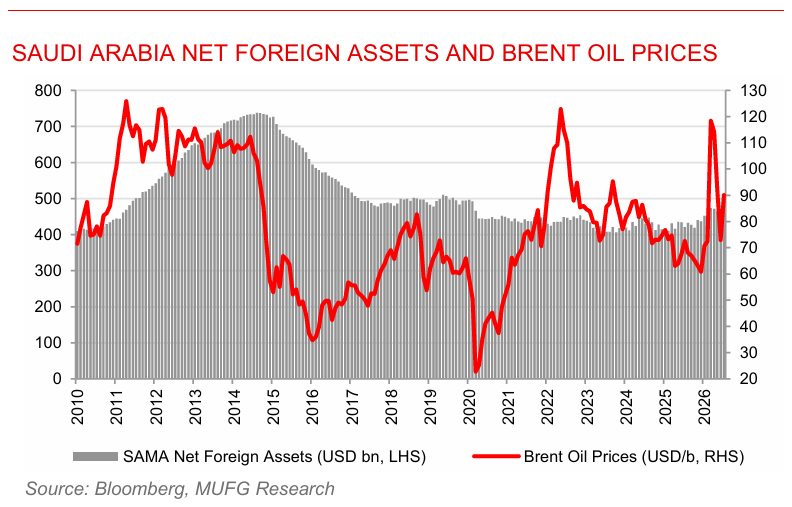
Saudi Arabia raises US Treasury holdings in June. Saudi Arabia increased its holdings of US Treasury securities by 1.6% m/m to USD142.5bn in June, up from USD140.3bn in May and 9.2% higher than a year earlier, despite an overall decline in foreign Treasury holdings. The Kingdom remained the 17th-largest foreign holder globally and the largest in the Middle East, ahead of the UAE's USD114.8bn. Around 76% of Saudi holdings were invested in long-term securities, with the remaining 24% held in short-term instruments. The increase comes alongside a relatively strong external position, with SAMA's net foreign assets rising to USD465.6bn, providing a buffer against softer oil revenues and fiscal pressures. The monthly increase appears consistent with active reserve management rather than a major shift in asset allocation, particularly given the riyal's peg to the US dollar. More broadly, the rise in Treasury holdings underscores Saudi policymakers' preference for maintaining liquidity and external buffers amid softer oil revenues, while the future path of holdings will likely depend on the balance between fiscal financing needs, reserve accumulation, and overseas investment diversification.
Saudi Arabia–Japan Economic Partnership Deepens Beyond Oil. Saudi Arabia and Japan are deepening their economic relationship, with bilateral trade reaching approximately USD41bn and cooperation increasingly extending beyond oil into clean energy, artificial intelligence, digital technologies, space, finance, and advanced manufacturing. Japanese direct investment in Saudi Arabia has reached SAR49bn (USD13bn), while both countries continue to expand collaboration under the Saudi-Japanese Vision 2030 framework. Although energy remains central, with oil and mineral products accounting for the bulk of Japan's imports from the Kingdom, recent agreements and investments in hydrogen, ammonia, carbon capture, technology, and infrastructure point to a broader, more diversified partnership. Ongoing discussions on a potential GCC-Japan free trade agreement could further strengthen trade, investment flows, and supply-chain integration, supporting Saudi Arabia's economic diversification goals and Japan's long-term growth and energy-security objectives.