
To read the full report, please download the PDF above.
Middle East Daily
SOOJIN KIM
Research Analyst
DIFC Branch – Dubai
T: +44(4)387 5031
E: soojin.kim@ae.mufg.jp
MUFG Bank, Ltd. and MUFG Securities plc
A member of MUFG, a global financial group
Middle East Daily
COMMODITIES / ENERGY
Oil extends decline as Saudi supply risks ease. Oil fell for a third consecutive session, with Brent approaching USD 104/b, while WTI traded near USD 101/b. Supply concerns have eased as Saudi Arabia works to restore its damaged East-West pipeline, targeting around half of capacity within days, while some limited tanker traffic continues through the Strait of Hormuz. Attention is also shifting toward diplomacy, with US President Trump expected to meet Gulf leaders next week as the US considers its next steps toward Iran, while China and other partners have reportedly urged Iran to restrain Houthi attacks near Bab el-Mandeb. Nevertheless, shipping risks remain elevated, with reports of another tanker strike in Hormuz and uncertainty over actual flows through the Strait, estimated at between 8-11mb/d. The recent decline in spot oil prices largely reflects a perception of moderating geopolitical risks, but continued threats to both Hormuz and Red Sea routes should keep Brent above pre-war levels and volatility elevated. Time spreads in the Brent market continue to imply more medium-term supply anxieties.
Gold holds near USD 4,350/oz as oil and Treasury yields ease. Gold held near USD 4,350/oz after gaining almost 2% yesterday, recovering much if its earlier three-day decline as lower Treasury yields and easing oil prices provided support. Yields retreated following an initial spike after the Fed’s widely expected 25bp rate hike, its first since 2023, reducing pressure on non-interest-bearing gold. Gold has moved back above its 100-day moving average, while gold-backed ETFs have continued to attract inflows. However, Fed Chair Kevin Warsh’s inflation-focused guidance has strengthened expectations for at least one additional rate hike this year, with further tightening also possible in 2027.
MIDDLE EAST - CREDIT TRADING
End of day comment – 17 September 2026. Market had a strong performance today in my GCC universe. The FED meeting and subsequent bear flattening of the UST curve didnt had much impact in the morning on cash prices. High absolute yields and these months spread widening provided a 'cushion'. Throughout the day cash prices firmed up as UST rallied. Flows also were constructive as international RM and ETF were both net buying. Spreads were anywhere from 3/5bp tighter with cash up to 0.5pt higher. There is still a clear preference for low cash price long duration bonds. In the case of ADGB, 51s again led the way closing +0.5pt/-3bp. SHJGOV 50s cleared at 62 (+0.5pt/-4bp). Quasi sovgn long end caught up with ADNOCM 54s and ADQABU 54s both +0.5pt/-2bp. Recent new issues also caught a better bid, seen DPWDU buyers in both new tranches and short covering in old bonds. The EUR 32s (-7bp from new issue spread) tranche still is better bid than the USD 36s (-2bp from new issue spread). With both spreads and yields lower throughout the week primary markets should soon get going again, in the absence of any long end issuance duration bonds should outperform in the secondary. (Source: Dominik Roth, Credit Trader)
MIDDLE EAST - MACRO / MARKETS
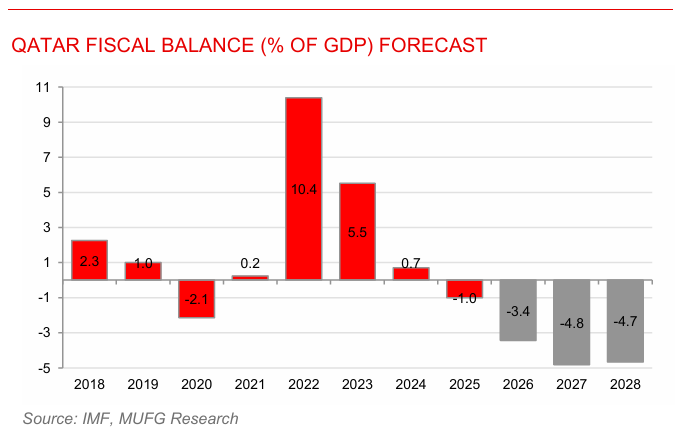
Qatar’s H1 budget deficit exceeds full-year target as LNG revenues slump. Qatar recorded a QAR 31.5bn (USD 8.7bn) budget deficit in H1 2026, already exceeding the government’s QAR 21.8bn full-year projection, as the conflict sharply disrupted LNG exports and hydrocarbon revenues. Fiscal pressures have intensified following damage to Ras Laffan, which removed around 17% of LNG capacity and is expected to constrain production for several years. The widening deficit comes as Qatar continues to fund the North Field expansion and broader diversification investments, increasing the potential need for reserve drawdowns and debt issuance. Similar pressures are emerging across the GCC, with Saudi Arabia’s H1 deficit reaching SAR160bn, close to its original full-year target, as hydrocarbon disruptions coincide with higher security and infrastructure spending. For Qatar, the pace of LNG capacity restoration and normalisation of export flows will be critical to fiscal recovery.
Egypt and Senegal advance direct maritime link to boost African trade. Egypt and Senegal are advancing plans for a direct maritime shipping line between Alexandria and Dakar to expand Egypt’s access to West African markets and diversify trade routes. The proposed corridor could improve access for Egyptian manufactured goods, chemicals, pharmaceuticals, and food products, supporting Cairo’s export-led growth strategy. Egypt has allocated around USD 1.7bn in FY2026/27 to support exports and entrepreneurship, while the initiative also aligns with efforts to deepen intra-African trade under the AfCFTA and strengthen Egypt’s position as a regional logistics hub. With Egypt’s merchandise trade deficit reaching USD 7.5bn in June, greater access to under-served African markets could support export growth and external rebalancing, although the corridor’s impact will depend on trade volumes and commercial viability.