
To read the full report, please download the PDF above.
Middle East Daily
SOOJIN KIM
Research Analyst
DIFC Branch – Dubai
T: +44(4)387 5031
E: soojin.kim@ae.mufg.jp
MUFG Bank, Ltd. and MUFG Securities plc
A member of MUFG, a global financial group
Middle East Daily
COMMODITIES / ENERGY
Oil extends rally as Trump escalates pressure on Iran. Oil rose for a third consecutive session as President Trump intensified pressure on Iran to reach a deal to end the ongoing conflict and reopen the Strait of Hormuz. Brent climbed above USD111/oz, while WTI approached USD108/oz, extending gains after oil surged nearly 8% last week and more than 50% since the war began in late February. Supply concerns remain elevated as flows through Hormuz stay heavily disrupted, while the expiration of a US waiver for Russian crude sales added further pressure to global markets. Weekend attacks on energy infrastructure in the Gulf, including a drone strike that caused a fire at a UAE nuclear facility, also highlighted the fragility of the ceasefire. Trump signalled that negotiations with Iran remain unresolved and warned Iran to move quickly toward an agreement or face renewed military action, while Israeli officials indicated they are prepared to resume strikes if tensions escalate further.
Gold extended decline as inflation and rate-hike fears intensify. Gold extended its losses as persistent disruptions in the Strait of Hormuz continued to fuel inflation concerns and push global bond yields higher, weighing on demand for non-yielding gold. Gold fell toward USD4,480/oz after losing nearly 4% last week, with prices now down around 15% since the Middle East conflict began. The lack of progress toward a US-Iran agreement and renewed threats from President Trump against Iran lifted oil prices further, increasing expectations that central banks may keep interest rates elevated or even raise them. Investor concerns were also heightened after a drone attack sparked a fire at a nuclear facility, underscoring the fragility of the ceasefire. Meanwhile, markets await the release of Fed meeting minutes for further guidance on the future interest rate path.
MIDDLE EAST - CREDIT TRADING
End of day comment – 15 May 2026. Markets got a stark reminder if oil prices remain elevated, sticky inflation will have to find its way into market/bond pricing. Trump’s comments overnight (Hormuz not important) as well as Japan’s hotter PPI print triggered today's move, and let’s not start with UK politics. From the start that led to market makers being very reluctant to bid bonds. To be sure activity was again very low and there wasn't much of selling pressure either. But away from the odd bonds with short base most trades were initiated by sellers. In terms of spread performance, it was more a mixed picture. Long end bonds were again a touch wider (+1/2bp). The stickiest bonds in cash price terms on the other hand remain senior financials (-3/4bp). In quasi sovgn, QPETRO was most active with 31s and 41s having a short base, but with sellers today this is starting to get filled, closed 31s -0.5pt/+0bp and 41s -1pt/+2bp. Going out the feeling is that the market is slowly rolling over, higher yields will eventually bring buying interest, but most likely only once rates volatility ebbs.
MIDDLE EAST - MACRO / MARKETS
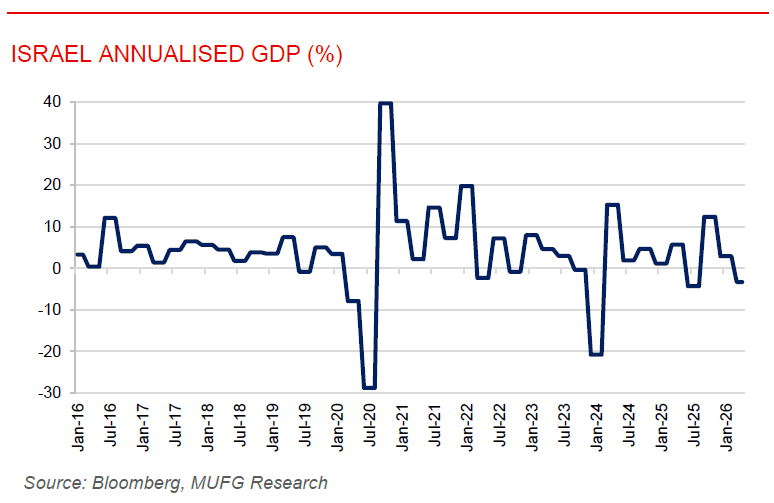
Israel’s economy contracts in Q1 as war pressures consumption. Israel’s economy contracted at an annualised rate of 3.3% in Q1 2026, marking a sharp slowdown from the stronger recovery expectations that followed the October 2025 Gaza ceasefire. The downturn reflected weaker domestic demand and ongoing geopolitical pressures, with private consumption falling 4.6%, exports down 3.7%, and government spending declining 4.8%, while fixed investment surged 12.6% driven by continued technology and energy-sector capital expenditure. Meanwhile, inflation remained relatively contained, with April CPI holding at 1.9% y/y, within the Bank of Israel (BoI)’s target range for a ninth consecutive month, despite a sharp 1.2% monthly increase reflecting war-related price pressures, particularly in food and housing. Looking ahead, attention is turning to the BoI’s May 25 policy decision, as policymakers balance slowing growth against still-elevated geopolitical risks. Despite the economic contraction, Israel financial markets have remained relatively resilient, supported by a stronger shekel, continued activity in the tech sector, and expectations that the downturn could prove temporary if regional tensions stabilise further.
Turkey’s budget deficit widens as spending outpaces revenue growth. Turkey’s central government budget deficit widened sharply to TRY338.7bn in April 2026, nearly double the level recorded a year earlier, as government spending growth continued to exceed revenue gains. Total expenditure rose 34.7% y/y, driven by higher personnel costs, transfers, and capital spending, while revenues posted solid growth, they remained below April inflation of around 32%, implying continued weakness in real fiscal revenues. The latest figures pushed the cumulative four-month deficit to around TRY759bn, adding pressure to the government’s full-year fiscal targets. Looking ahead, markets are increasingly focused on the tension between Turkey’s rising financial needs and the central bank’s tight monetary stance, with the CBRT’s 37% policy rate remaining critical for supporting the lira and maintaining investor confidence through the second half of 2026.