
To read the full report, please download the PDF above.
Middle East Daily
SOOJIN KIM
Research Analyst
DIFC Branch – Dubai
T: +44(4)387 5031
E: soojin.kim@ae.mufg.jp
MUFG Bank, Ltd. and MUFG Securities plc
A member of MUFG, a global financial group
Middle East Daily
COMMODITIES / ENERGY
Oil rises as prospects for US-Iran deal fade. Oil extended gains as prospects for a near-term resolution of the US-Iran war weakened and another vessel was attacked in the Strait of Hormuz. Brent rose above USD91/b, its third consecutive advance, while WTI traded near USD85/b. President Trump indicated little interest in extending the expired agreement with Iran, while major differences remain over Hormuz, where Iran is negotiating separately with Oman. A vessel exiting the strait was struck by an unidentified projectile, reinforcing concerns over shipping security. Despite the disruption, Gulf producers are becoming more effective at moving crude through or around Hormuz, with Saudi Arabia increasingly offering cargoes from alternative export points. Meanwhile, the US appears to be emphasising economic pressure and its blockade of Iranian ports rather than an immediate military escalation, with additional sanctions expected.
Gold holds near USD4,400/oz as Fed rate hike expectations ease. Gold steadied near USD4,400/oz, as softer US economic data weakened the dollar and reduced expectations for further Fed tightening. Markets are no longer fully pricing in another rate hike this year, although elevated long-term Treasury yields and persistent inflation concerns continue to limit gold’s upside. Middle East tensions remain an important inflation risk, with renewed fighting in Lebanon, fading prospects for extending the US-Iran truce and continued disruption to shipping through the Strait of Hormuz. Gold has nevertheless remained supported by renewed investor demand and stronger central-bank purchases, particularly from China. Going forward, the Fed’s July meeting minutes and Chairman Kevin Warsh’s Jackson Hole remarks will be key for the rate outlook, while developments in the Middle East remain important risks for gold.
MIDDLE EAST - CREDIT TRADING
End of day comment – 17 August 2026. A terrifically low volume day where even most of the street players who enjoy jamming their pet positions on illiquid days are either on holiday or not bothered with pushing bonds around. We drifted slightly tighter where we had moves today with minimal client action. PT accounts were back trying to cover their sticky shorts and kick out the sticky longs, but it’s not clear how that is working for them as it doesn't appear much is trading in their inquiries. We had a few local buyers of KSA sukuks and a few index related trades in the new SRCSUKs. There was some supply in KSA sub debt across names thought the sukuk AT1s remain well bid. PIFKSA and ARAMCO curves were broadly unchanged. For Bahrain, the curve was offered lower today but it’s not clear that was on any kind of supply as I saw little inquiry even after I missed moving my pricing down. Long-mid bonds are down ½ to ⅝ pt or 7-9bps wider. (Source: Matthew Dunker, Credit Trader)
MIDDLE EAST - MACRO / MARKETS
Turkey’s budget deficit widens sharply in July. Turkey’s central government budget swung to a TRY378.1bn (USD8bn) deficit in July, compared with just TRY23.9bn a year earlier, as spending growth significantly outpaced revenues. Revenues increased 28.8% y/y to TRY1.41tn, but expenditures surged 59.8% to TRY1.79tn, led by a 143% increase in interest payments to TRY326.8bn amid elevated borrowing costs and the CBRT’s 37% policy rate. Non-interest spending also rose 48.4%, while personnel costs increased 43.3%. As a result, the cumulative deficit reached TRY1.32tn in January-July, despite tax revenues growing a solid 37.3%. Finance Minister Mehmet Şimşek maintained that fiscal policy remains consistent with government targets, noting that some tax revenues have deliberately been forgone to support disinflation and cushion domestic demand. The figures highlight growing fiscal pressure from high debt-servicing costs even as Turkey’s external position has shown signs of improvement. The trajectory of interest expenses and the timing of CBRT rate cuts will be key to keeping the full-year deficit near its roughly 3.5% of GDP target.
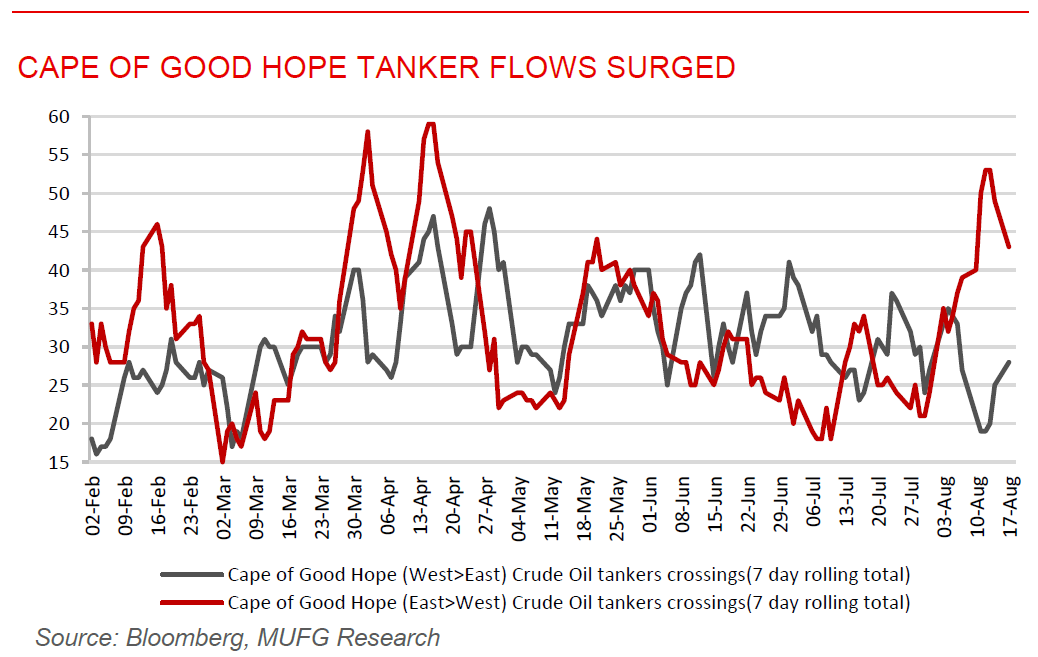
Saudi Arabia reroutes crude as Houthi threats disrupt Red Sea shipping. Saudi Arabia has largely rerouted Asia-bound crude away from the Bab el-Mandeb Strait after Houthi militants declared a blockade on Saudi shipping and began attacking tankers, adding another constraint to Gulf exports alongside disruptions in the Strait of Hormuz. Saudi crude flows from Yanbu through Bab el-Mandeb reportedly fell nearly 90% in early August, while loadings at Egypt’s Mediterranean port of Sidi Kerir surged to a record 2.17mb/d, largely supplied through the SUMED pipeline. Other cargoes are being diverted around the Cape of Good Hope, adding transit time, freight costs and pressure on tanker availability, while some vessels are operating with transponders switched off to reduce exposure to attacks. Aramco has emphasised its ability to use multiple export routes, including SUMED and the Suez Canal, to maintain deliveries. The duration of the Houthi threat, capacity constraints on alternative routes and rising shipping costs will determine how effectively Saudi Arabia can sustain exports, with potential implications for Asian crude supply and European fuel markets.