
To read the full report, please download the PDF above.
Middle East Daily
SOOJIN KIM
Research Analyst
DIFC Branch – Dubai
T: +44(4)387 5031
E: soojin.kim@ae.mufg.jp
MUFG Bank, Ltd. and MUFG Securities plc
A member of MUFG, a global financial group
Middle East Daily
COMMODITIES / ENERGY
Oil holds near USD106/b as Saudi pipeline recovery eases supply concerns. Oil held onto a sharp decline, with Brent near USD 106/b after falling 2.7% yesterday and WTI above USD 102/b, as prospects for a recovery in Saudi export capacity eased immediate supply concerns. Saudi Arabia is reportedly seeking to restore around half of the East-West pipeline’s capacity within days, with full operations targeted within six weeks after attacks damaged the critical route last week. The pipeline has become an important alternative to the Strait of Hormuz, where flows remain well below normal and estimates vary considerably, with US officials putting the seven-day average at around 11mb/d. A faster restoration of Saudi pipeline capacity could ease physical-market pressures, although constrained Hormuz flows and continued Russian supply disruption will keep crude prices elevated.
Gold rebounds as Treasury yields ease after Fed rate hike. Gold rebounded after three consecutive declines, rising as much as 1.3% to near USD 4,320/oz, as Treasury yields eased following the Fed’s first rate increase since 2023. The Fed unanimously raised rates by 25bp, a widely anticipated move after higher energy prices and stronger-than-expected underlying inflation intensified price pressures. While Treasury yields initially surged after the decision, their subsequent retreat provided some support for non-interest-bearing gold. The Fed also adopted a more hawkish outlook, raising its median end-2026 policy-rate projection to 4.1% from 3.8%, while Chair Kevin Warsh stressed that inflation remains broad-based. With the initial hike largely priced in, gold’s direction will increasingly depend on the pace of further tightening, with persistent inflation and elevated Treasury yields likely to limit upside despite continued geopolitical and safe-haven support.
MIDDLE EAST - CREDIT TRADING
End of day comment – 16 September 2026. Whilst the market is awaiting the FED meeting outcome, we saw more of the same from yesterday, today even more pronounced. There were a strong bid and good buying in long end bonds with some suddenly feeling offerless. ADGB 51s closed +0.875pt/-7bp with the average low cash price long bond about -5bp. Against this though a lot of sellers were seen in short end and belly bonds again, even in sovgn bonds, take ADGB 1.7 31s closing +0.125pt/+2bp. Quasi sovgn issues displayed the same pattern, with the like of ADNOUH 47s, ADNOCM 54, ADQABU 54 all well bid (-3/-5bp) whereas belly bonds close up to 0.25pt higher and broadly unch in spread terms. The outperformance of long bonds reverses the underperformance we had seen over the last weeks. Probably there is also some FED expectation in this down the line that the UST yield curve might flatten if 'order' is restored. In any case there hasn't been any long end bond issuance in my universe for a while, so barring any FED disaster the flattening of credit curves in GCC could be in their early innings. (Source: Domonik Roth, Credit Trader)
MIDDLE EAST - MACRO / MARKETS
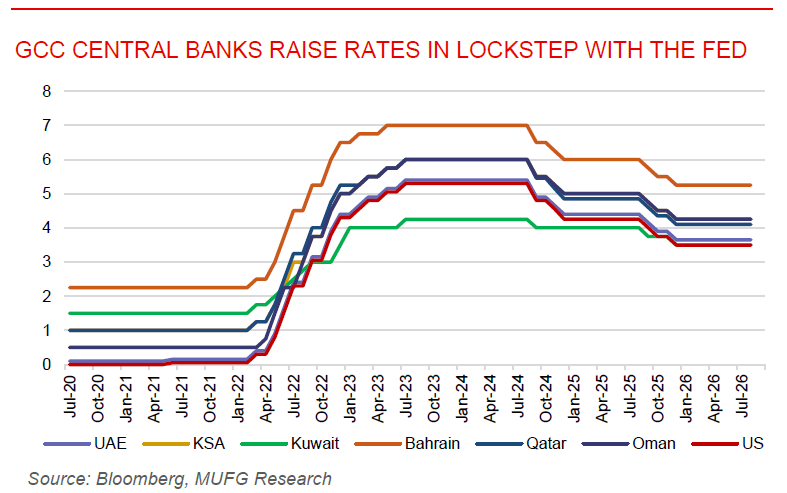
GCC central banks raise rates in lockstep with the Fed. Most GCC central banks raised policy rates by 25bp following the Fed’s first-rate increase in three years. SAMA increased its repo rate to 4.50% and reverse repo rate to 4.00%, while the UAE raised its overnight deposit base rate to 3.90%. Bahrain and Oman also lifted key rates to 4.50%, while Qatar increased its deposit, lending and repo rates by 25bp. Kuwait kept rates unchanged as the dinar’s peg to a currency basket provides greater policy flexibility. The synchronized tightening comes despite relatively subdued domestic inflation across much of the GCC, meaning higher borrowing costs are largely being imported through the currency regimes rather than driven by local price pressures. The move also coincides with elevated sovereign and corporate funding requirements amid war-related fiscal pressures and higher global bond yields. Further Fed tightening would therefore feed directly into GCC financing conditions, raising borrowing costs for households and businesses while increasing the cost of the region’s sizeable debt-issuance pipeline.
Israel’s economy rebounds strongly as inflation remains contained. Israel’s economy expanded 14.9% annualized in Q2 2026, slightly below the 15.2% consensus but marking a strong rebound from the conflict-driven contraction in Q1. The recovery was broad-based, with private consumption up 15.0%, government consumption rising 22.2% and exports increasing 25.3%, although imports grew faster at 31.0%. Meanwhile, annual inflation held at 1.5% in August, below expectations of 1.6% and comfortably within the Bank of Israel’s ± 2% target range. Monthly inflation accelerated to 0.7% from 0.3%, however, pointing to some renewed near-term price momentum. The combination of strong economic activity and contained annual inflation leaves room for further gradual monetary easing. The durability of the recovery and whether stronger monthly price pressures translate into higher annual inflation will be important in determining the pace of further Bank of Israel rate cuts.