
To read the full report, please download the PDF above.
Middle East Daily
EDWARD BELL
Head of Research
DIFC Branch – Dubai
T: +971 (4)387 5033
E: edward.bell@ae.mufg.jp
SOOJIN KIM
Research Analyst
DIFC Branch – Dubai
T: +971 (4)387 5031
E: soojin.kim@ae.mufg.jp
MUFG Bank, Ltd. and MUFG Securities plc
A member of MUFG, a global financial group
Middle East Daily
COMMODITIES / ENERGY
Oil prices extend slide on US moving away from long-term war plan. Oil prices fell sharply overnight on comments from US Vice President JD Vance on the war with Iran, noting that the US wasn’t going to “stay there forever” and that the war was not going to be a multi-year commitment. Brent futures fell 3.6% overnight to close at USD 92.44/b and are extending their move lower today while WTI fell 3.2% to USD 85.72 and are off by another 0.8% in trade today. The prompt Brent spread narrowed in line with the move in spot prices, pulling away from nearly USD 3/b hit at the end of last week. The EIA estimated that flows of oil through the Strait of Hormuz had increased by 4m b/d in Q3 relatively to the prior quarter, reaching 9.1m b/d according to the EIA though still well below levels of 21.4m b/d a year earlier. Shipping continues to be at risk, however, with Iranian media reporting another ship hitting a mine and the UKMTO noting an attack on a tanker that disabled the vessel. European gas has outpaced the moves lower in oil futures with front month prices down nearly 7% overnight to EUR 84.75/MWh.
Gold consolidates after hawkish Fed speakers. Gold prices are consolidating after overnight losses of 0.7%, bringing spot gold to USD 3,868/troy oz in early trade today. More selling pressure in US equities along with hawkish Fed commentary are dragging on gold. Markets will look to the release of the October FOMC minutes and the outcome of the upcoming meeting between the presidents of the US, China and Russia later this week and any geopolitical risk it may entail.
MIDDLE EAST - CREDIT TRADING
End of day comment – 16 November 2026. Another weak day. Macro risks remain on the back foot. Technicals remain weak, we have again seen RM selling, joined by ETFs and into the close dealers showed some urgency to get out of bonds. The main IG sovgn curves closed +2/3bp on average, in ADGB the widening was led by 49s closing -0.375pt/-4bp, in QATAR by 3.75 30s closing -0.125pt/+5bp. Higher beta sovgn underperformed, MOROC 33s widened +10bp/-0.5pt with the curve 5/10bp wider. OMAN saw sellers again mainly in front end/belly where 31s closed -0.25pt/+5bp. In quasi sovgn it was the same picture as in sovgn curves with QPETRO being the notable exception, seen buyers of 41s and even 31s found buyers, closing the QPETRO curve unch in price/spreads. Fins saw weakness mainly in UAE AT1s driven by the new issue announcement of ADCBUH (PNC 5.5 AT1). The main selling was seen in both EBIUH 6.25 perps (-0.25pt/+7bp) and MASQUH 6.25 perps closing -0.375pt/+10bp. Not many places to hide, without a trigger stopping risk off, GCC bonds will widen more given the -ve technicals. (Source: Dominik Roth, Credit Trader)
MIDDLE EAST - MACRO / MARKETS
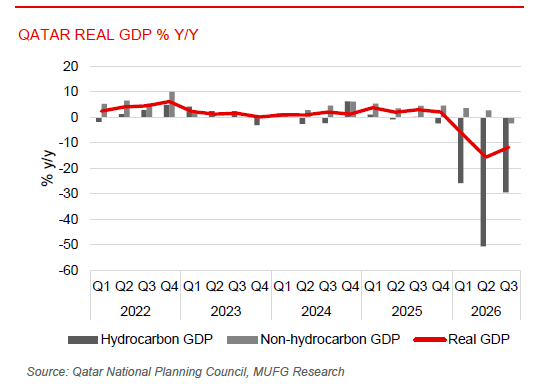
Contraction in Qatar GDP eases in Q3. Qatar’s economy contracted by 11.8% y/y in Q3 thanks to a drop of 29.5% in hydrocarbon GDP. Qatar has seen its economy disrupted by the regional conflict which has impacted LNG exports through the Strait of Hormuz. However, as shipping volumes have increased in recent months, the pace of decline in LNG exports has moderated and the Q3 contraction was smaller than the 50.7% y/y drop in hydrocarbon GDP in Q2. Based on the flash estimate of headline GDP, Qatar’s non-hydrocarbon economy is estimated to have contracted by 2.5% q/q in Q3, the first contraction since 2020. Qatar’s PMI has held below the neutral 50 mark since the start of the regional conflict with October showing a further easing to 46.3 from 47.3 in September.
Israel’s economy expands 8% q/q in Q3. Israel’s economy expanded by 8% q/q annualized in Q3, faster than market estimates for a 5% increase. Private consumption rose by 6% q/q in Q3, a notable slowdown from the 17% recorded in Q2. Fixed investment, however, accelerated to 11% q/q from 3.1% in the prior period while government spending contracted by nearly 2%. On an annual basis, real GDP expanded by 6.5% y/y, cooling from a pace of more than 7% in Q2 2026. Israel also reported an increase in unemployment to 3.1% in October. Unemployment has been reasonably steady in Israel’s economy this year, holding around 3%.
Dubai reports recovery in airport traffic in Q3. Dubai International recorded a strong recovery in Q3 with total number of aircraft movements rising by 48.5% q/q with a 45% increase in the number of passengers. Levels remain well below 2025 volumes, however, as air travel to the region, including Dubai, has been negatively impacted by the regional conflict. Tourism is a major driver of non-oil activity in the Dubai economy and the decline in flight activity in the first half of the year contributed to a drop in real GDP in H1.