
To read the full report, please download the PDF above.
Middle East Daily
EDWARD BELL
Head of Research
DIFC Branch – Dubai
T: +971 (4)387 5033
E: edward.bell@ae.mufg.jp
SOOJIN KIM
Research Analyst
DIFC Branch – Dubai
T: +971 (4)387 5031
E: soojin.kim@ae.mufg.jp
MUFG Bank, Ltd. and MUFG Securities plc
A member of MUFG, a global financial group
Middle East Daily
COMMODITIES / ENERGY
Oil market looking for surplus. Oil prices are testing higher in early trade today as markets focus on projections for 2027 which imply substantial supply growth. Brent futures reversed earlier losses to push higher by 0.6% at USD 96.40/b while WTI is up 1% at USD 89.07/b. Time spreads are also pushing higher with the 1-2 month Brent backwardation widening to USD 2.90/b, up from levels closer to USD 2/b through last week. European natural gas prices are also pushing lower, down nearly 1% at EUR 90.09/MWh. In its November oil market report, the IEA projected that oil market balances would swing to a surplus in Q4 2026 thanks to a strong recovery in production from Gulf countries. For 2027, the IEA projects a larger surplus thanks to supply growth as well as moderate demand levels. However, geopolitical risks remain high in the region. Iran has launched drone attacks against a helicopter base in Bahrain while Iranian media reported that two tankers hit mines while crossing through the Strait of Hormuz. At the same time, another US aircraft carrier has entered the Middle East regional command area though it is still unclear if it will add to forces in the region or replace a carrier group already in place.
Gold slides as rate hike expectations increase. Gold prices are extending last week’s losses with spot gold down 0.4% at USD 3,867/troy oz. Gold fell 4.6% last week, the largest weekly decline since June, as markets raise expectations for further monetary tightening from the Fed and other central banks. Markets are still pricing in slightly greater than one 25bps hike from the Fed at the December FOMC.
MIDDLE EAST - CREDIT TRADING
End of day comment – 13 November 2026. Weak. As usual in the past weeks, it was a quiet Friday in terms of activity. However we had some significant UST weakness post London close and coupled with the RM afternoon selling yesterday the market felt heavy from the start. Prices adjusted to the left quickly and long end bonds led the weakness. ETFs were sellers throughout the day. Long end ADGB closed -1pt/+2bp, also seen sellers in long end of higher beta sovs like OMAN (48s -1.25pt/+3bp) and MOROC (42s -1pt/+2bp). New MAALRA 31s had a quiet start initially trading just below reoffer before moving lower closing 99.125/375 (reoffer 99.612) but holding roughly its reoffer spread (T+110bp). All been said GCC spreads are still 5/15bp tighter on the week. But more and more spreads sellers are emerging, especially from RM side which has now flipped the technicals from +ve to -ve. Have a nice weekend (Source: Dominik Roth, Credit Trader)
MIDDLE EAST - MACRO / MARKETS
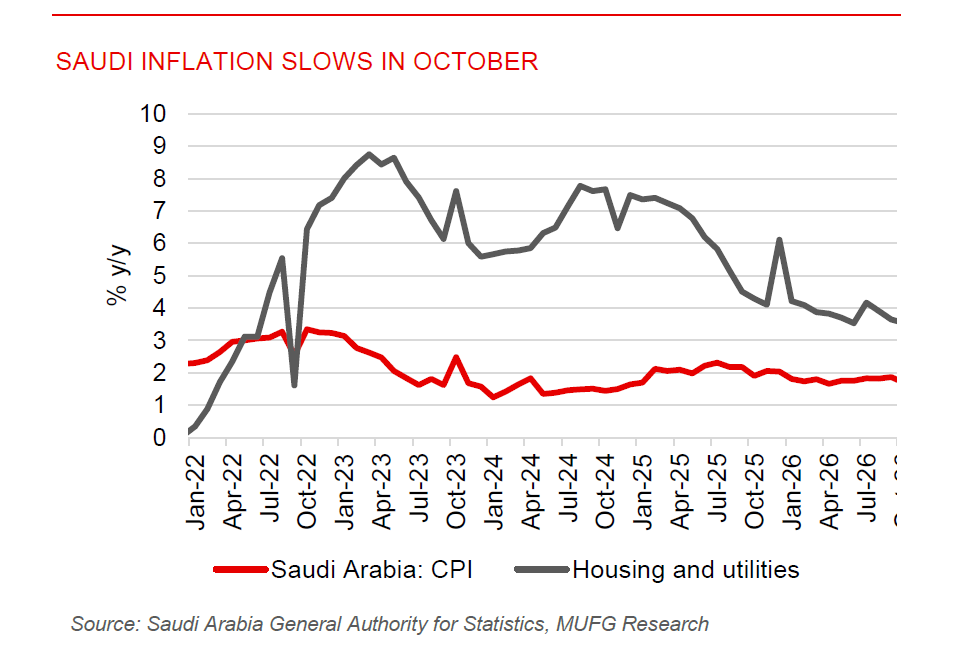
Saudi inflation slows down in October thanks to housing. Saudi Arabia reported inflation at 1.7% y/y for October. The print for last month was a notable slowdown from nearly 1.9% inflation a month earlier but maintains the soft pricing conditions reported in the Saudi economy this year. Housing and utilities showed the strongest growth last month though price pressures in the sector have moderated substantially from 2025 levels. Rental costs have increased by 4.4% on average this year as of October, down from an average of more than 8% last year. Elsewhere, insurance and financial services prices increased thanks to a rise in travel insurance costs while air transport prices were also notably higher last month. Flight activity across major airports in Saudi Arabia has been impacted by repeated attacks by the Houthi militants in Yemen.
Fitch affirmed UAE rating with a stable outlook. Fitch affirmed their ‘AA-‘ rating on the UAE and kept the outlook for the rating stable. The rating agency noted the UAE’s low debt at a consolidated level, strong external buffers and high levels of GDP per capita. Fitch also noted that the economy has still managed to perform well despite the regional conflict. However, the outlook for the economy in 2027 will be largely set by the oil sector rather than the non-oil economy which Fitch expects will show a slow recovery in 2027.
Inflation slows further in Israel. Inflation in Israel rose by 1.1% y/y in October, slowing down from 1.6% a month earlier. Several elements in Israel’s inflation basket are in outright deflation with food prices falling by 0.1% y/y last month while household furnishing and clothing prices are also falling. The Bank of Israel last cut rates at its September meeting but held them steady in October as it faced an uncertain outlook following the Israeli elections at the end of the month. The next BoI meeting is November 23 and while the low levels of inflation will give the central bank room to cut rates, the uncertainty on the political front remains high.