
To read the full report, please download the PDF above.
Middle East Daily
SOOJIN KIM
Research Analyst
DIFC Branch – Dubai
T: +44(4)387 5031
E: soojin.kim@ae.mufg.jp
MUFG Bank, Ltd. and MUFG Securities plc
A member of MUFG, a global financial group
Middle East Daily
COMMODITIES / ENERGY
Oil stabilises after three-day rally as Hormuz risks persist. Oil prices steadied, with Brent trading below USD85/b and WTI under USD80/b, after gaining around 12% over the previous three sessions as renewed US strikes on Iran and repeated attacks on shipping revived concerns over gulf supply. The US carried out another round of airstrikes and disabled an empty tanker bound for an Iranian port, while Iran maintained that the Strait of Hormuz would remain closed until US military action and the blockade of Iranian ports end. Although tanker traffic has continued with US assistance, the escalation threatens shuttle-based export routes that had helped the UAE and other Gulf producers keep crude moving during earlier disruptions. The market is now pricing a more persistent supply risk rather than a brief geopolitical spike, but the fact that vessels are still transiting Hormuz should prevent prices from rising unchecked unless attacks materially reduce export volumes or spread to major energy infrastructure.
Gold weakens as Middle East escalation revives inflation concerns. Gold prices declined, with gold falling toward USD4,025/oz, as renewed US airstrikes on Iran and escalating tensions in the Middle East lifted oil prices and reinforced concerns that inflation could remain elevated. The collapse of the interim US-Iran peace agreement has increased expectations that the Fed may need to keep interest rates higher for longer, weighing on non-yielding gold. While US producer price inflation came in softer than expected, suggesting underlying price pressures had eased before the latest conflict escalation, rising energy costs could reverse that trend. The near-erm outlook for gold will hinge on whether higher oil prices feed through into US inflation or remain a temporary geopolitical shock, with markets closely watching the Fed’s response.
MIDDLE EAST - CREDIT TRADING
End of day comment – 15 July 2026. A similar theme as yesterday with the PPI numbers putting a boost to the rates market kicking treasuries back to levels around our close from yesterday so cash prices unchanged is leading to a flat spread move between closes. Flows were generally limited with some Asian and index arb selling of recent new issues. Real money accounts appear to have net two-way interests with some adding and others cutting across the region. The market still feels long UAE names from the index roll off and the rates correlation there only seems to work on the downside. For KSA and Kuwait, we traded long end bonds two way with Asia this morning, but the rest of the curve was utterly dull with some tightening in short end bonds driven by some cash price buyers. The curve seemed more responsive to the rates move later in the day as spreads seems to stay unchanged even as rates moved lower. (Source: Matthew Dunker, Credit Trader)
MIDDLE EAST - MACRO / MARKETS
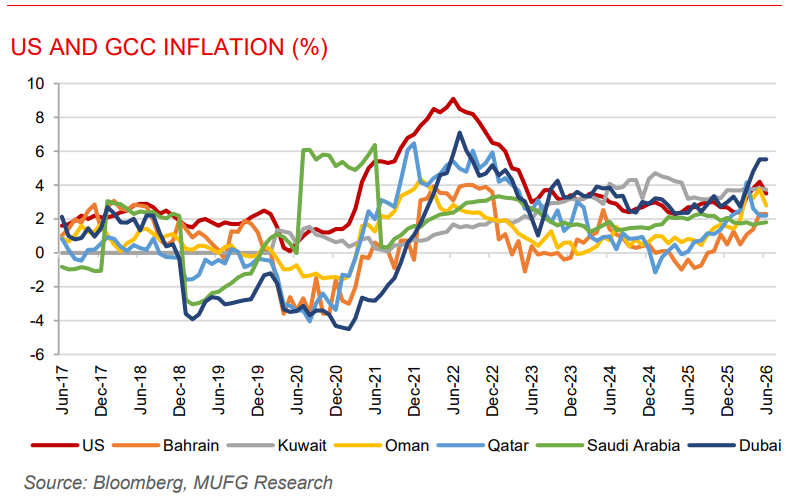
Saudi Arabia and Israel report benign inflation in June. Saudi Arabia and Israel reported subdued inflation in June, reinforcing a benign price environment across both economies. KSA’s annual CPI inflation remained unchanged at 1.8% y/y, with housing and utilities continuing to be the largest contributor despite moderating slightly, while food and transport inflation edged higher. The data suggest that domestic demand remains resilient without generating significant inflationary pressures. Meanwhile, Israel’s annual inflation slowed to 1.6% y/y from 1.9% in May, marking its lowest reading since 2021 and remaining comfortably within the Bank of Israel (Boi)’s ±2% target range. The moderation was driven by softer price increases across food, transport, communications and several service categories, reinforcing the ongoing disinflation trend. Looking ahead, the latest readings indicate that inflation remains well contained, providing central banks with greater policy flexibility. While Saudi Arabia is expected to continue broadly tracking the US Fed given the riyal’s dollar peg, easing inflation in Israel could provide further scope for the BoI to maintain an accommodative policy stance if underlying price pressures continue to moderate.
US backs new Iraq-Syria pipeline to diversify oil export routes. The US is supporting plans to revive an oil pipeline linking Iraq to Syria’s Mediterranean coast, as part of broader efforts to reduce Iraq’s dependence on the Strait of Hormuz and strengthen regional energy security. Discussions involving Iraqi and Syrian officials, alongside major energy companies including Chevron and TotalEnergies, are focused on restoring the long-idled Kirkuk-Baniyas pipeline, while alternative routes are also under consideration. During Iraqi Prime Minister Ali Al-Zaidi’s visit to Washington, President Trump signalled that major US-Iraq energy agreements would be announced soon, reinforcing efforts to expand US investment in Iraq’s oil and gas sector. If implemented, the pipeline would provide Iraq with a strategic Mediterranean export outlet, diversify its export infrastructure beyond the Gulf, and strengthen the country’s long-term energy resilience, although security risks, significant reconstruction costs, and political challenges remain key hurdles to the project’s execution.