
To read the full report, please download the PDF above.
Middle East Daily
SOOJIN KIM
Research Analyst
DIFC Branch – Dubai
T: +44(4)387 5031
E: soojin.kim@ae.mufg.jp
MUFG Bank, Ltd. and MUFG Securities plc
A member of MUFG, a global financial group
Middle East Daily
COMMODITIES / ENERGY
Oil heads for weekly gain as Hormuz disruptions persist. Oil prices moved toward a weekly gain as the Strait of Hormuz remained affectively closed, prolonging disruptions to global energy supplies and keeping markets on edge. Brent traded near USD107/b, up around 6% for the week, while WTI climbed above USD102/b. Despite a ceasefire formally remaining in place since early April, tensions between the US and Iran continue with little progress toward a lasting agreement, while a US naval blockade of Iranian ports remains active and shipping conditions in the Gulf stay highly volatile. President Trump said he does not need Hormuz reopened, although discussions with Chinese President Xi included the ongoing conflict and energy security concerns. The IEA warned this week that global oil markets could remain “severely undersupplied” until October even if the war ends next month, as flows through Hormuz have fallen sharply and only limited tanker traffic has resumed. The prolonged supply shock is also adding to inflation concerns globally as energy inventories continue to tighten.
Gold set for weekly decline as inflation and rate expectations rise. Gold headed for a modest weekly loss as stronger US inflation data reinforced expectations that interest rates may remain higher for longer amid ongoing disruptions from the Iran war. Gold fell toward USD4,615/oz pressured by a stronger dollar and rising Treasury yields after US wholesale and consumer inflation accelerated sharply in April. The continued closure of the Strait of Hormuz has kept energy prices elevated, sustaining inflation concerns as oil prices climbed toward weekly gains. Despite recent weakness, gold has largely traded within a narrow range as investors balance inflation-driven rate risks against concerns that prolonged geopolitical tensions, and weaker global growth could eventually support safe-haven demand.
MIDDLE EAST - CREDIT TRADING
End of day comment – 14 May 2026. Another day of relatively low volumes where rates took the spotlight and technical in sukuks and demand from locals drove what volumes we did see. There was a small uptick in real money trades today, but it was mostly two way and appeared to be rebalancing related rather than any actual direction. HY names are compressing to IG but I feel like that is more of a function of IG names running out of spread to rally rather than some sort of move into HY credit. While at no point in the time immediate after the US started the conflict with Iran did the market feel terrible, it definitely felt bad here and there, but I have to say this rally all the way back feels like it was super low volume. Low volume rallies tend to lead to low volume sell offs and vice versa. Sovs rode the rates roller coaster again today, but spreads are inexorably inching lower with the 10yr bucket in KSA closing in on z+100. KUWIB 35s traded here today at 97.40/z+98 which is post conflict lows having hit as low at z+90 in Jan. The frenzy of OWIC in sukuks tempered a bit with a reported tap on the SECO 36s away from us appeasing those folks for at least today
MIDDLE EAST - MACRO / MARKETS
IMF advances Egypt review process as economy shows resilience. The IMF announced that its technical mission is currently in Caio to conduct the seventh review of Egypt’s economic reform program under the Extended Fund Facility (EFF), alongside the second review under the Resilience and Sustainability Facility (RSF), with successful completion potentially unlocking around USD1.6bn in new financing. IMF Communications Director Julie Kozack said discussions with Egyptian authorities are focused on assessing the economy impact of the ongoing Middle East conflict and evaluating policy measures needed to sustain reform momentum. The IMF aims to conclude the review by June 15 with a potential staff-level agreement expected to be presented to the Fund’s executive board during the summer. Kozack noted that the economic impact of regional tensions on Egypt has so far remained “relatively limited,” supported by decisive government measures that helped contain external and financial pressures. The fund continues to expect Egypt’s economic growth to remain resilient despite geopolitical uncertainty.
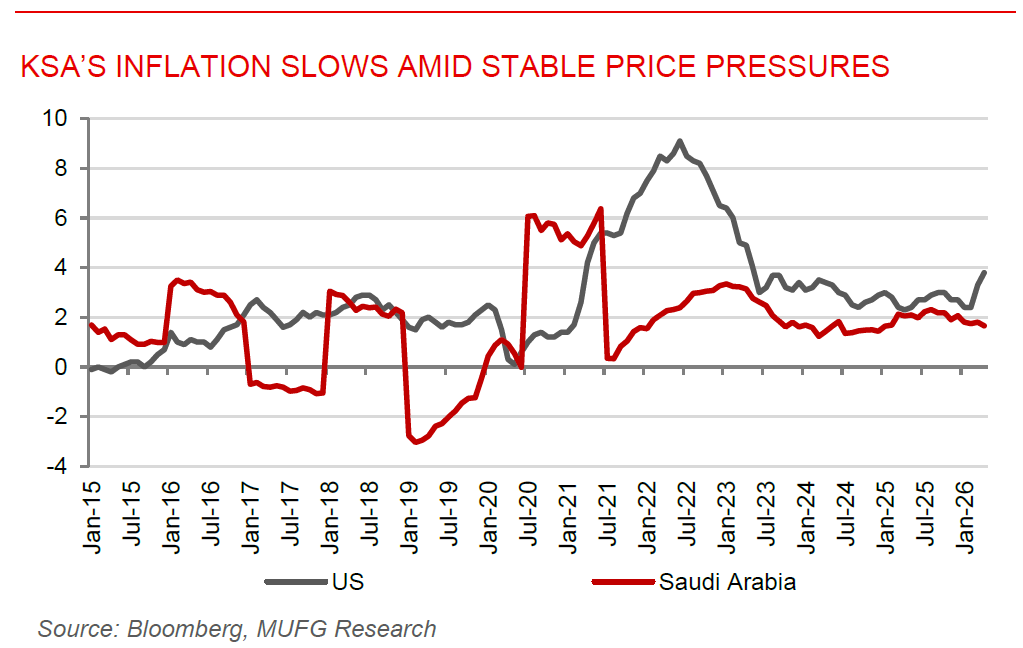
Saudi Arabia’s inflation slows to 1.7% y/y in April amid stable price pressures. Saudi Arabia’s inflation eased to 1.7% y/y in April from 1.8% y/y in March, marking the lowest level in nearly 15 months. The increase was mainly driven by a 3.8% rise in housing, water, electricity, gas, and fuel prices, supported by a 4.8% increase in residential rents, alongside a 1% rise in transportation costs and restaurant and accommodation prices. Food and beverage prices rose modestly by 0.6% annually, although monthly food inflation accelerated by 0.9% in April. On a monthly basis, the CPI increased 0.2% from March, reflecting stable but persistent domestic price pressures. Meanwhile, Saudi Arabia’s wholesale price index rose 3.3% y/y, driven by higher prices for chemicals, refined petroleum products, and metals, highlighting ongoing cost pressures within the industrial sector despite relatively contained consumer inflation.