
To read the full report, please download the PDF above.
Middle East Daily
SOOJIN KIM
Research Analyst
DIFC Branch – Dubai
T: +44(4)387 5031
E: soojin.kim@ae.mufg.jp
MUFG Bank, Ltd. and MUFG Securities plc
A member of MUFG, a global financial group
Middle East Daily
COMMODITIES / ENERGY
Oil holds near USD87/b as Hormuz flows improve despite security risks. Oil held lower, with Brent near USD87/b and WTI around USD81/b, as rising crude shipments from the Persian Gulf partly offset continued security risks and stalled diplomacy over the Strait of Hormuz. US officials estimate that as much as 9mb/d is now transiting the strait, supported by increased US military escorts, although tankers are often switching off transponders to reduce the risk of attack. Security conditions remain fragile, with two additional ADNOC vessels reportedly attacked and Iran-Oman negotiations yet to deliver an agreement to fully reopen Hormuz, while Houthi threats to Saudi energy infrastructure continue to disrupt Red Sea shipping. The IEA also expects the global supply deficit to widen this quarter, keeping the underlying market relatively tight. Going forward, rising Gulf exports could cap near-term price gains, but the lack of a durable Hormuz agreement and continued threats across both Hormuz and the Red Sea should keep a sizeable geopolitical premium embedded in oil prices.
Gold retreat on profit-taking after recent rally. Gold fell for a second consecutive session, sliding as much as 0.9% to around USD4,310/oz as profit-taking interrupted the recent recovery triggered by softer US inflation data. Bullion had reached a 10-week high earlier in the week after subdued July inflation suggested that energy-related price pressures were easing, reducing expectations for an imminent Federal Reserve rate hike. Markets currently price roughly a one-in-three probability of a September hike, with upcoming US employment data and Fed Chair Kevin Warsh’s Jackson Hole remark likely to shape expectations. While reduced tightening risks remain supportive, persistently elevated interest rates could limit gold’s upside, while renewed Middle East escalation could revive energy-driven inflation concerns.
MIDDLE EAST - CREDIT TRADING
End of day comment – 13 August 2026. Rates moves and very little inertia allowed the market to price things pretty erratically today. Dealers pushed a few pet positions through the curve here and there but there was no one around to really challenge those levels. Stop me if you've heard this this week, but overall volumes were super low and it was a generally boring day aside from moving my cash priced bonds up all day long to match the rates move. Long duration KSA bonds had a nice bounce back today after underperforming most of the week. I am taking >2046s out 3-5 tighter while the rest of the sovereign curve was mostly -1bps. The new SRCSUK bonds dragged a bit and underperformed rates coming in +2bps. ARAMCO/PIFKSA followed the sovereign. While usually sticky on cash price the sub debt complex was well bid with RJHIAB T2s coming back under the AT1s by a few bps. (Source: Matthew Dunker, Credit Trader)
MIDDLE EAST - MACRO / MARKETS
IMF completes seventh EFF review for Egypt, unlocking USD1.8bn. The IMF completed Egypt’s seventh review under the Extended Fund Facility (EFF) and second review under the Resilience and Sustainability Facility (RSF), unlocking around USD1.8bn in immediate financing and bringing total disbursements under the two arrangements to about USD7.3bn. Despite spillovers from the Middle East war, economic activity remained resilient, with real GDP growth reaching 5.0% in Q3 FY2025/26 and the IMF projecting 4.6% growth for FY2025/26, while headline inflation eased to 14.3% in June after rising to 15.2% in March. The external position also remained relatively robust, supported by record remittances, tourism receipts and recovering Suez Canal revenues, although the current account deficit is estimated at 4.5% of GDP. However, the IMF expects growth to moderate to 4.4% in FY2026/27 and inflation to rise to 16.7% in H2 2026, while warning that high public debt, large financing needs and slow progress in reducing the state’s economic footprint remain key vulnerabilities. It therefore stressed the need to maintain a tight monetary stance and exchange-rate flexibility, sustain fiscal consolidation, and accelerate divestments, implementation of the State Ownership Policy and broader reforms.
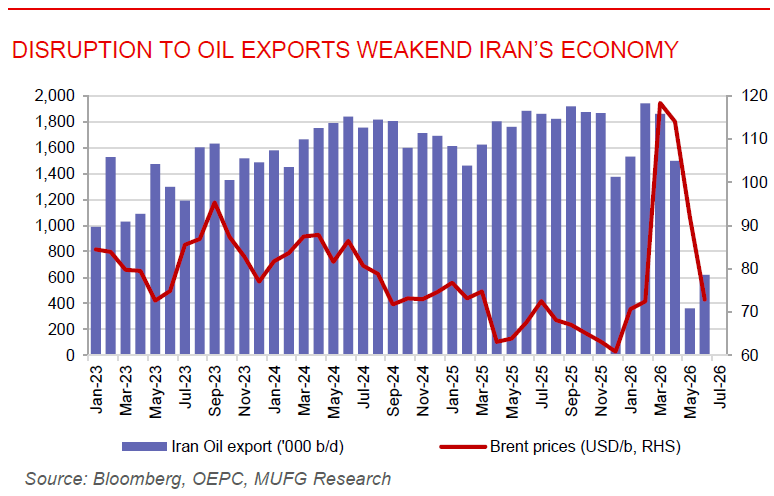
Iran’s economy slides deeper into stagflationary crisis. Iran's economy has deteriorated sharply in 2026 as war, disruption to oil exports and years of sanctions compound existing structural weaknesses. Official data show point-to-point inflation surged to 87.9% y/y in July, while 12-month average inflation reached 66.0%, unemployment rose to 9.1% in spring, 1.8ppt higher than a year earlier. The IMF's July forecast projects real GDP to contract 5.4% in 2026, indicating a severe recession despite a modest improvement from its April projection. Oil remains the critical pressure point. The renewed US blockade has brought activity at the key Kharg export terminal close to a standstill, sharply restricting Iran's principal source of foreign currency. Going forward, the outlook will hinge largely on the reopening of Hormuz and Iran's oil-export channels, alongside developments in inflation and the rial. Without relief on these fronts, Iran is likely to remain trapped in a combination of economic contraction, very high inflation and declining household purchasing power in 2026.