
To read the full report, please download the PDF above.
Middle East Daily
EDWARD BELL
Head of Research
DIFC Branch – Dubai
T: +971 (4)387 5033
E: edward.bell@ae.mufg.jp
SOOJIN KIM
Research Analyst
DIFC Branch – Dubai
T: +971 (4)387 5031
E: soojin.kim@ae.mufg.jp
MUFG Bank, Ltd. and MUFG Securities plc
A member of MUFG, a global financial group
Middle East Daily
COMMODITIES / ENERGY
Oil prices ease as Hormuz uncertainty persists. Oil prices are losing some ground in early trade today after an overnight gain followed comments from US President Donald Trump that the US didn’t need a deal with Iran. Brent futures are trading at USD 95.60/b while WTI is at USD 88.30/b, both moderately lower. Trump’s comments will leave geopolitical conditions in the Middle East in an uneasy limbo, particularly if US commitment to keeping the increased flows of oil and gas through the Strait of Hormuz begins to wane. Tankers continue to be attacked in the Strait of Hormuz which will keep the geopolitical risk premium in oil wide. Time spreads have widened slightly in recent days with the 1-2 month Brent spread moving off of a near-term floor of around USD 2/b to USD 2.40/b today. In the US, commercial inventories rose by 4.7m bbl last week along with gains in gasoline and distillate stockpiles. Oil production was steady at 14m b/d while crude exports pulled back by 220k b/d to 3.46m b/d. European gas prices have also pushed higher, trading back above EUR 94/MWh following three days of gains in a row.
Gold falls amid rising US Treasury yields and hawkish Fed outlook. Gold prices pushed substantially lower overnight to trade near USD 3,850/troy oz, its lowest levels since October last year. A sharp push higher in US Treasury yields helped to keep downward pressure on gold though prices have recovered this morning to around USD 3,920/troy oz. Gold prices are down by about 5.8% since the start of the quarter and with Fed speakers sounding more assuredly hawkish, gold will face a challenging few weeks into the end of the year.
MIDDLE EAST - CREDIT TRADING
End of day comment – 12 November 2026. Higher yields, tighter spreads. The morning was very quiet following the US holiday with very little going through the markets and spreads broadly unchanged. That changed in the afternoon as UST resumed their sell off with front end yields 10bp higher. That in turn brought out some RM spread sellers. But market makers happily absorbed these selling flows so far leading to more spread tightening. The main sovgn curve look 2/4bp tighter despite some afternoon selling in QATAR and UAE long end. Quasi sovgn markets broadly followed these moves, but remain gripped in their respective technicals, for example since weeks now QPETRO 29s and 31s trade heavy/ are hard to sell vs QPETRO 41s trade bid/ is hard to buy. The flows overall are too light to clear these technicals. In the fins space MAALRA priced its new 5y sukuk in 500mm at 99.612 with a 5.875% coupon to yield 5.966%. That was a spread of T+110bp at the time of pricing from T+150bp IPT. I would not expect it to be very active in the secondary, but good to see primary markets opening up again. (Source: Dominik Roth, Credit Trader)
MIDDLE EAST - MACRO / MARKETS
Saudi Arabia’s oil production surges 26% in October as Gulf exporters recover. Saudi Arabia reported a 26% m/m increase in crude oil production to 10.6mb/d in October, reaching one of its highest monthly levels in years as improved tanker movements through the Strait of Hormuz supported recovering exports. The increase exceeded the Kingdom’s OPEC production quota, although secondary-source estimates placed output considerably lower at 9.2mb/d. Meanwhile, Iraq reported production of nearly 4.9mb/d, also exceeding its quota, while secondary sources estimated 4.5mb/d. Saudi’s supply to the market stood at 9.2mb/d, suggesting that part of the additional production was directed into storage. The recovery in Gulf supplies, alongside subdued global demand, has contributed to weakening oil prices, with Brent declining approximately 20% in November to USD 94/b. OPEC+ is scheduled to meet on November 29 to assess production capacity and determine 2027 output targets. The recovery in Saudi and Iraqi production highlights improving Gulf supply resilience despite ongoing conflict, although rising output and intensifying competition could exert further downward pressure on oil prices.
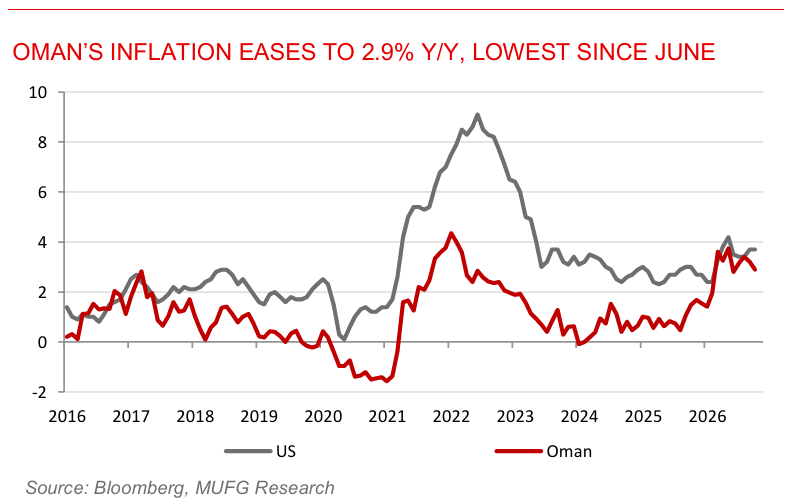
Oman’s inflation eases to 2.9% in October, lowest since June. Oman’s annual inflation moderated to 2.9% y/y in October 2026 from 3.2% in September, marking its lowest level since June and the first reading below 3% in four months. Inflation has remained volatile amid regional conflict, rising from 1.4% in January to a peak of 3.8% in May, with average inflation reaching approximately 3.0% in the first 10 months of 2026. Food prices have been a key driver, with food and non-alcoholic beverages increasing 8.0% y/y in September, followed by transportation (+4.8%) and miscellaneous goods and services (+4.7%). Oman’s inflation remains above KSA’s 1.9% but below Bahrain’s 3.1% and Dubai’s 5.0%. The moderation in inflation provides some relief to households, although elevated food prices and persistent regional shipping and transportation costs could limit further disinflation through year-end.