
To read the full report, please download the PDF above.
Middle East Daily
SOOJIN KIM
Research Analyst
DIFC Branch – Dubai
T: +44(4)387 5031
E: soojin.kim@ae.mufg.jp
MUFG Bank, Ltd. and MUFG Securities plc
A member of MUFG, a global financial group
Middle East Daily
COMMODITIES / ENERGY
Oil eases as Hormuz disruptions persist and Iranian exports stall. Oil prices edged lower, as ongoing disruptions in the Strait of Hormuz continued to strain global energy markets despite no clear progress toward ending the Middle East conflict. Brent slipped below USD107/b while WTI traded near USD101/b, with satellite images showing no oil tankers at Iran’s key Kharg Island export terminal for several days, signalling a potential halt in exports due to the US naval blockade. Although US President Trump downplayed concerns ahead of talks with Chinese President Xi, the conflict is increasingly fuelling inflation pressures as US gasoline prices hit their highest-level since 2022. The prolonged closure of Hormuz has disrupted flows of crude, gas, and fuels, forcing major Asian importers to seek alternative oil supplies. Meanwhile, Vietnam requested US permission for a crude tanker to pass through the blockade, showing mounting stress across global supply chains and energy markets.
Gold extends decline as US inflation boosts rate hike expectations. Gold fell for a second consecutive session after stronger than expected US inflation data increased expectations that the Fed may raise interest rates later this year. Gold traded near USD4,695/oz after US consumer prices recorded their largest monthly increase since 2023, while real wages declined for the first time in three years. Markets now price in more than a 40% probability of a Fed rate hike by year-end, driving US bond yields higher and weighing on non-yielding gold. Despite the pressure from rising rates and elevated energy-driven inflation, gold has remained relatively resilient due to strong demand from central banks. Meanwhile, India unexpectedly raised gold and silver import tariffs to around 15% from 6% as authorities seek to support the currency and strengthen foreign-exchange reserves.
MIDDLE EAST - CREDIT TRADING
End of day comment – 12 May 2026. Higher yields, stable spreads. Activity picked up today. We saw local support into lower prices/ higher yields, RM selling into tighter spreads and also the first time since a while more ETF activity (net seller). The move higher in G3 yields pressured mostly long end bonds. QATAR 50s which was well bid the last two sessions was sold today and closed -0.75pt/+2bp. The ADGB curve also remained offered with long end about -0.5pt/+1bp. In quasi sovgn names we are seeing the first long bonds around 6% bid yield (ADNOCM 54s, ADQABU 54s, ADNOUH 47s). Against this long end weakness short end and belly bonds found local buyers into higher yields and generically closed -2/-3bp in spread terms. In fins we had FABUH with a strong bid despite recent issuance, FABUH 31s conv closed unch/-5bp. The only sector under pressure remains corps bonds. Overall though it feels like higher yields brings more activity and two-way interest.
MIDDLE EAST - MACRO / MARKETS
Aramco warns mid-June Hormuz timeline is critical for regional markets. Saudi Aramco CEO Amin Nasser signalled that mid-June could become a critical turning point for global energy markets and regional economic outlooks, warning that delays in reopening the Strait of Hormuz beyond that timeframe could extend market disruptions into 2027. During Aramco’s earnings call, Nasser estimated cumulative supply losses at nearly 1 billion barrels, with around 100 million barrels of oil supply being lost each week the strait remains effectively closed, despite redirected exports and strategic reserve releases. He also warned that gasoline and jet fuel inventories are tightening rapidly while tanker logistics remain severely disrupted, with vessels stranded across different shipping basins. The comments carry major implications for GCC economies and financial markets, as many regional fiscal and economic assumptions, are currently based on expectations that Hormuz normalizes in Q2 or early Q3 2026. A prolonged disruption would likely force markets to reassess regional growth, inflation, sovereign funding, and energy supply expectations.
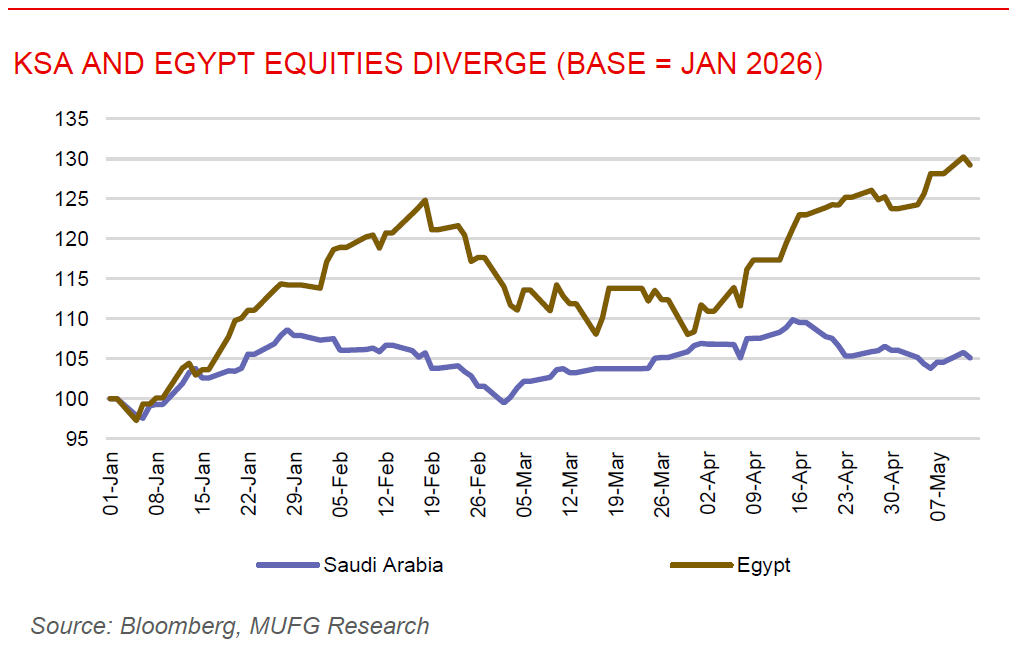
MENA equities diverge as Egypt outperforms while KSA faces supply pressures. One of the most notable trends across MENA equity markets this year has been the sharp divergence between EGX 30 and Tadawul performance. Egypt’s market has emerged as one of the strongest emerging market stories of 2026, supported by improving macroeconomic conditions, easing inflation, stronger FX reserves, and renewed foreign investor inflows following deep undervaluation in 2024. Investors have also been encouraged by ongoing policy reforms, including discussions around removing the capital gains tax on EGX transactions, while Egyptian equities continue to trade at significant valuation discounts relative to broader emerging markets. In contrast, Saudi Arabia’s market has traded broadly sideways despite strong oil prices and robust corporate earnings, including record quarterly profits from Saudi Aramco and the launch of its first share buyback program. The current divergence highlights that positioning, liquidity absorption, and capital flows are playing a larger role than fundamentals alone in driving regional equity performance.