
To read the full report, please download the PDF above.
Middle East Daily
SOOJIN KIM
Research Analyst
DIFC Branch – Dubai
T: +44(4)387 5031
E: soojin.kim@ae.mufg.jp
MUFG Bank, Ltd. and MUFG Securities plc
A member of MUFG, a global financial group
Middle East Daily
COMMODITIES / ENERGY
Oil paused after six-day rally as Hormuz talks stall. Oil edged lower as investors awaited progress on reopening the Strait of Hormuz. Brent slipped toward USD88/b, while WTI traded near USD82/b. US-Iran negotiations remain largely deadlocked, with both sides hardening their positions and the US maintaining pressure through its blockade of Iranian ports. Meanwhile, the IEA estimates the global oil market will face a sizeable 1.8mb/d supply deficit in Q3, more than double its previous projection, as the prolonged Middle East conflict and disruptions linked to the Russia-Ukraine war tighten supplies. However, near-term upward pressure was partly offset by a 17.4mb increase in US crude inventories, the largest build since January 2023, driven by weaker exports and higher imports. Going forward, progress on restoring Hormuz traffic remains the key catalyst for prices, while tight global balances should keep oil supported despite signs that higher prices are beginning to weigh on demand.
Gold holds near USD4,400 as softer US inflation eases rate-hike risk. Gold held near USD4,400/oz, supported by softer-than-expected US inflation that reduced pressure on the Fed to raise interest rates. US consumer prices increased just 0.1% m/m in July, suggesting that inflationary pressure from the earlier energy-price shock is moderating, while recent weakness in the labour market has further reduced the case for immediate tightening. Gold has also been supported by renewed investor demand and continued central-bank purchases, particularly from China, pushing the gold above its 100-day moving average for the first time since April. Going forward, upcoming US labour and inflation data and Fed Chair Kevin Warsh’s Jackson Hole remarks will be key for the rate outlook, while renewed Middle East escalation and a rebound in energy prices remain upside risks for inflation.
MIDDLE EAST - CREDIT TRADING
End of day comment – 12 August 2026. Another day where the USD rates market pushed cash prices around, but the inertia of cash prices led to spreads generally going wider across the region. With the 10yr auction tonight there is a good chance the same thing happens overnight. We've had some two ways in GCC floaters coming out of Asia this week and found a few sellers of sukuks here and there to feed whomever it is that is keen to make those spreads go to zero. Client activity remains very low. Even ETF accounts are not trading much though ETF basis in low territory. The PT accounts have been trying to get out of the same sticky positions all month. For KSA and Kuwait, Sov spreads are 3-4 wider from the 5yr point on out to the long end with only KSA 61 showing any real volume today trading in +15mm in the low 59s. The ARAMCO and PIFKSA curves mirrored KSA though the PIFKSA curve as a whole feel increasingly heavy as we progress towards issuance season in September. (Source: Matthew Dunker, Credit Trader)
MIDDLE EAST - MACRO / MARKETS
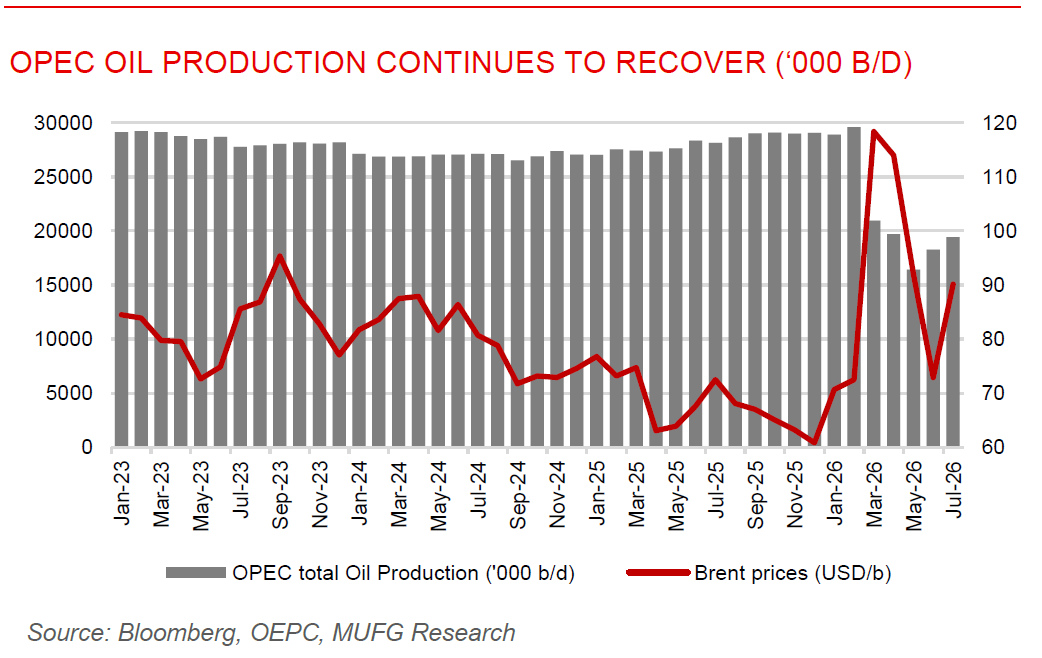
Gulf production recovers but export bottlenecks keep global oil market tight. The IEA's August Oil Market Report showed that Gulf oil production continued to recover in July, although renewed disruption to export routes prevented a corresponding increase in global supplies. Middle East production remained 8.3mb/d below pre-war levels, but the recovery that began in June was undermined by renewed hostilities and maritime disruptions. Regional oil loadings fell sharply from around 20mb/d at the start of July to roughly 12mb/d later in the month as the Strait of Hormuz was effectively closed again. The IEA consequently reduced its projected Q3 global oil supply by 1.7mb/d and now expects a global oil market deficit of 1.8mb/d in Q3. Global oil supply is forecast to decline by 4.3mb/d in 2026 before rebounding by 8.3mb/d to 110.3mb/d in 2027. Looking ahead, export capacity rather than production capacity is becoming the key constraint for Gulf producers. A durable reopening of Hormuz, normalisation of refinery operations and recovery in tanker loadings will be critical for translating higher upstream output into stronger exports and fiscal revenues through Q4.
EGA targets Q1 2027 production recovery after war damage. Emirates Global Aluminium (EGA) aims to restore its Al Taweelah smelter to pre-war production levels by Q1 2027 following a USD400 million repair programme after damage from Iranian strikes in March. The plant, which previously produced around 1.5 million tonnes annually, has gradually restarted operations, with active production pots rising to 18% from 7% in early July. While the recovery could help ease global aluminium supply tightness, export growth remains constrained by disruptions to Strait of Hormuz shipping, despite some use of alternative routes. Higher aluminium prices helped lift H1 adjusted net profit by 34% y/y to USD670 million. Looking ahead, the pace of Al Taweelah’s restart and normalisation of Hormuz shipping will be critical in determining how quickly EGA can restore export volumes, while the USD400 million repair bill also provides an early indication of the reconstruction costs facing Gulf industries damaged by the conflict.