
To read the full report, please download the PDF above.
Middle East Daily
EDWARD BELL
Head of Research
DIFC Branch – Dubai
T: +971 (4)387 5033
E: edward.bell@ae.mufg.jp
SOOJIN KIM
Research Analyst
DIFC Branch – Dubai
T: +971 (4)387 5031
E: soojin.kim@ae.mufg.jp
MUFG Bank, Ltd. and MUFG Securities plc
A member of MUFG, a global financial group
Middle East Daily
COMMODITIES / ENERGY
Oil retreats as Trump signals Russia energy thaw. Oil prices have started the week lower in response to statements from US President Donald Trump saying that an “energy ceasefire” was in effect between Russia and Ukraine and to a proposal that the US will directly import diesel from Russia. Brent futures are down 1.1% to USD 103.60b while WTI remains at a wide differential, trading at USD 90/b, down 1.3% at the start of the week. The geopolitical risk in the Middle East remains elevated with reports of another attack on a tanker in the Strait of Hormuz and threats from the IRGC against ships berthed near the critical chokepoint. Houthi militant attacks against the Riyadh airport have continued over the last several days with an increasing risk of an escalatory cycle of attacks. Japan’s trade minister, Ryosei Akazawa, called for greater cooperation in ensuring energy security and that Japan could facilitate trade between Middle Eastern oil exporters and Asian importers.
Gold holds range ahead of CPI release. Gold prices have begun trading without much conviction, holding around USD 4,190/oz after posting their first weekly gain in the last three last week. Gold and bond markets will be focused on this week’s release of the US September CPI to show whether core inflation has embedded more of a passthrough from higher energy prices along with perspectives on global growth due to be released by the IMF. Market pricing for an October rate hike is still around 20% with more conviction for a December move.
MIDDLE EAST - CREDIT TRADING
End of day comment – 09 October 2026. The market came storming out of the gates with Trumps post London close comments and the UST rally following the good 30y auction. Cash prices firmed and spreads tightened as especially long end bonds felt offerless. ETFs were the most active accounts today with inflows in the morning contributing to the spread tightening. That changed around mid-day when UST started to trade lower/ oil higher. Flows into the close are much more two ways. To be sure it was a quiet afternoon ahead of the holiday on Monday. We still closed tighter. ADGB curve again outperformed with good buying seen in 54s closing +0.875pt/-3bp. In QATAR new 36s was active closing +0.375pt/-2bp. OMMAN was strong in the sovgn curve with 31s going out +0.375pt/-6bp. Same cannot be said though for Omani quasis, especially ENEDEV continued to see sellers, 33s closed unch/+3bp. Overall it was a constructive week where higher yields and wider spreads from the September move finally brought some buying interest back. (Source: Dominik Roth, Credit Trader)
MIDDLE EAST - MACRO / MARKETS
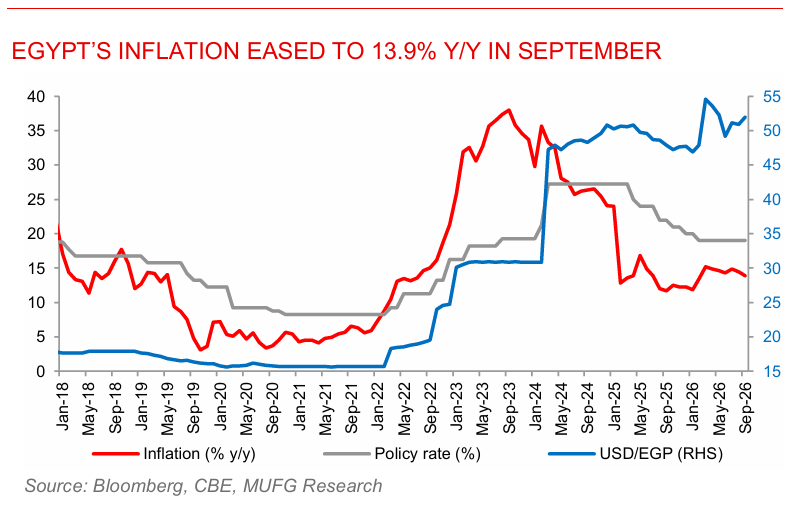
Egypt inflation eases to 13.9% in September despite rising food prices. Egypt’s annual urban inflation slowed to 13.9% y/y in September from 14.5% y/y in August, marking a second consecutive monthly decline and its lowest level since February, despite renewed energy-related pressures from the Iran war. However, consumer prices rose 1.3% m/m, accelerating from 0.1% in August, while food and beverage inflation increased to 7.2% y/y from 6.3%, highlighting persistent underlying price pressures. The slowdown follows a 12% electricity tariff increase for higher-consuming households in July, alongside elevated energy import costs as Egypt becomes increasingly reliant on imported gas. Meanwhile, the Central Bank of Egypt (CBE) maintained its policy rates in September, extending its pause in monetary easing amid regional uncertainty. The bank also revised down its inflation projections, expecting a gradual decline toward its 7% ±2ppt target in H2 2027. The renewed increase in monthly and food inflation suggests that further monetary easing will depend on sustained disinflation and easing energy-related pressures.
UAE banks face tighter liquidity as lending outpaced deposit growth. UAE banks are facing increasing liquidity pressures as strong credit demand, driven partly by infrastructure investment to bypass the Strait of Hormuz, outpaces deposit growth amid the prolonged regional conflict. Bank lending rose 18.1% y/y in Q2 2026, compared with deposit growth of around 14%, pushing the loan-to-deposit ratio above 80% from 77.7% in 2025. Liquidity conditions have tightened further due to foreign-currency deposit outflows linked to an Indian savings scheme and the expiry of central bank liquidity support measures introduced earlier in the war. Competition for deposits has consequently intensified, with local banks offering promotional savings rates well above the UAE central bank’s 3.9% base rate. Although banking-sector liquidity remains within regulatory comfort levels, sustained credit expansion and higher deposit costs could put pressure on funding margins and profitability, particularly if capital inflows remain subdued.