
To read the full report, please download the PDF above.
Middle East Daily
EDWARD BELL
Head of Research
DIFC Branch – Dubai
T: +971 (4)387 5033
E: edward.bell@ae.mufg.jp
SOOJIN KIM
Research Analyst
DIFC Branch – Dubai
T: +971 (4)387 5031
E: soojin.kim@ae.mufg.jp
MUFG Bank, Ltd. and MUFG Securities plc
A member of MUFG, a global financial group
Middle East Daily
COMMODITIES / ENERGY
Oil retreats as rising regional supply eases market tightness. Oil prices failed to hold on to an early rally overnight with Brent futures sliding from an intraday high of USD 94.73/b to close at USD 92.76/b with losses extending in early trade today. WTI is also tracking lower at USD 85.30/b. Saudi Arabia reported oil production of 10.56m b/d in October according to OPEC’s monthly oil market report, up from 8.4m b/d a month earlier. Iraq also reported a substantial monthly increase in production of nearly 500k b/d to 4.89m b/d. Both countries have been participating with the US to secure oil exports through the Strait of Hormuz, helping to lift regional exports back to near pre-conflict levels. However, with still no apparent movement on diplomacy between the US and Iran, markets will still keep a geopolitical risk premium in spot oil even as balances look set to loosen in the final weeks of the year. In European natural gas, prices were steady overnight and are showing little change at EUR 86.55/MWh in early trade today
Gold falls below USD 4,000 as Fed hike bets intensify. Gold prices were lower overnight as markets firm up pricing for a December hike from the Federal Reserve. Spot gold fell 1% to USD 3,988/troy oz and is furthering those losses in early trade today. Markets are still pricing in greater than a 25bps hike from the Fed in December and another 50bps of tightening by the end of 2027, up from just 40bps of total hikes priced in for the rest of 2026 and 2027 only as recently as last week. More hawkish signals from central banks will weaken the case for gold though some stability in equity markets overnight should help to limit loss-covering selling in gold markets.
MIDDLE EAST - MACRO / MARKETS
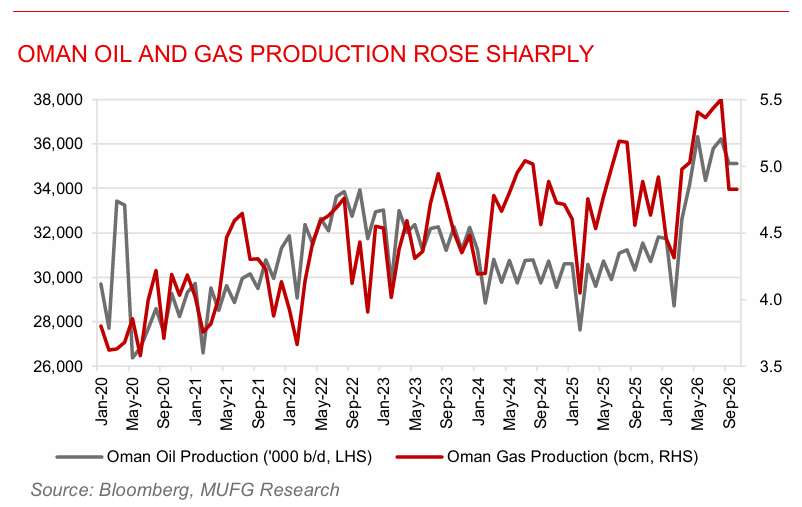
Oman’s records OMR 90mn fiscal surplus as energy revenues rise. Oman recorded a fiscal surplus of OMR 90mn (USD 234mn) in the first nine months of 2026, reversing a deficit of OMR 433mn a year earlier, supported by stronger hydrocarbon revenues. Total government revenue increased 16% y/y to OMR 9.83bn, with oil and gas contributing approximately 73% of the total. Notably, gas revenues surged 61% y/y to OMR 2.09bn, while oil revenues rose 7% to OMR 5.05bn, supported by an average realised oil price of USD 81/b. Meanwhile, public expenditure increased 9% to OMR 9.74bn, including OMR 1.22bn in development spending. The fiscal outturn significantly exceeded the government's 2026 budget expectations, which projected a deficit of OMR530mn based on oil prices of USD 60/b. Public debt declined to OMR 14.1bn at end-September from OMR 14.6bn at end-2025. Oman's relatively limited exposure to Strait of Hormuz disruptions has also supported fiscal resilience amid regional conflict. The return to surplus strengthens Oman's fiscal buffers and debt-reduction capacity, although continued dependence on hydrocarbon revenues leaves public finances vulnerable to energy price volatility and regional uncertainty.
ADNOC gas targets higher LNG exports as Hormuz shipments recover. ADNOC Gas plans to further increase LNG and other fuel exports in Q4 2026, supported by improving tanker movements through the Strait of Hormuz despite persistent regional security risks. The company operated its Das Island LNG facility at full capacity during Q3, with export volumes rising 72% q/q and net income doubling, supported by recovering shipments and elevated global energy prices. The stronger performance prompted ADNOC Gas to raise its full-year net income target to at least USD 4bn, compared with its previous guidance of USD 3.5bn-4bn. Although exports remain below year-earlier levels, the company expects further improvements in LNG, naphtha and LPG shipments as maritime traffic gradually normalises. Meanwhile, ADNOC Gas is exploring a potential LNG export facility on the UAE’s east coast to reduce dependence on Hormuz, alongside its ongoing Ruwais LNG expansion, which will increase total export capacity to around 15mn tonnes annually. Recovering export volumes and higher energy prices should strengthen earnings, while investment in alternative export infrastructure could enhance long-term supply resilience.
Saudi issuers retain strong buffers despite war-related pressures. S&P Global Ratings expects Saudi Arabia’s economy to contract by 1.3% in 2026 as oil production falls and non-oil growth weakens, before rebounding strongly by 8.0% in 2027 as oil exports recover. The fiscal impact is viewed as manageable, with the deficit forecast at 5.8% of GDP in 2026, while substantial government net assets, alternative oil exports via Yanbu, and resilient banks provide important buffers. Banks, utilities and telecommunications are expected to remain relatively resilient, but tourism, real estate, mining, chemicals and healthcare face greater pressure from higher logistics and input costs, supply-chain disruption and weaker confidence. Despite these headwinds, S&P considers most rated Saudi issuers sufficiently well positioned to absorb the shock and therefore maintains stable outlooks on most issuers, although a significant re-escalation of the conflict remains the key downside risk.