
To read the full report, please download the PDF above.
Middle East Daily
SOOJIN KIM
Research Analyst
DIFC Branch – Dubai
T: +44(4)387 5031
E: soojin.kim@ae.mufg.jp
MUFG Bank, Ltd. and MUFG Securities plc
A member of MUFG, a global financial group
Middle East Daily
COMMODITIES / ENERGY
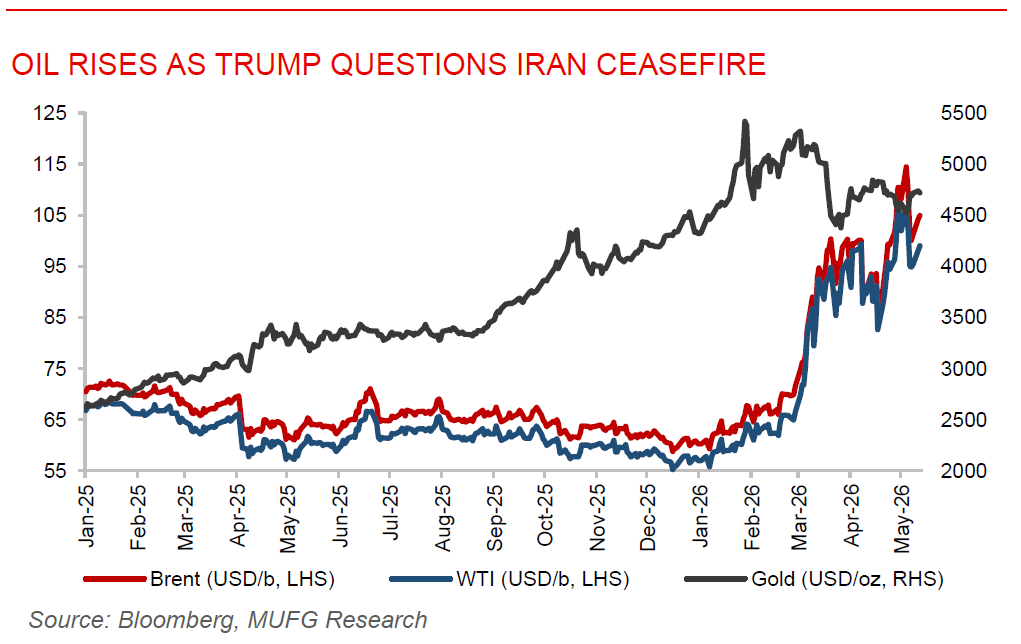
Oil rises as Trump questions Iran ceasefire and Hormuz disruptions continue. Oil prices moved higher after President Trump cast doubt on the durability of the ceasefire with Iran, prolonged uncertainty around the Strait of Hormuz and global energy supplies. Brent traded near USD105/b while WTI approached USD99/b, as Trump described the truce as being on “massive life support” and criticised Iran’s latest peace response. Iran reportedly demanded sanctions relief and an end to the US naval blockade while seeking to retain some control over traffic through Hormuz. The disruption has significantly reduced flows of crude, gas, and fuels, intensifying inflation concerns and pushing US fuel prices higher. Trump is also reportedly considering reviving naval escorts for commercial ships in the Strait, while the US continues tightening sanctions on Iranian oil exports to China. Saudi Aramco CEO Amin Nasser warned that the market is losing around 100mb of supply each week Hormuz remains shut, although producers continue rerouting some exports through alternative routes.
Gold holds steady despite Middle East deadlock and inflation concerns. Gold traded little changed near 4,730/oz as investors balanced ongoing tensions in the Middle East with improving risk sentiment in global equity markets. President Trump warned the fragile ceasefire around the Strait of Hormuz was on “massive life support,” highlighting the lack of progress toward ending the conflict. Despite rising inflation risks linked to higher energy prices and continued disruptions in Hormuz, gold demand remained supported by its safe-haven appeal, even as stock markets advanced on optimism surrounding AI-related growth. Investors are also closely watching upcoming US inflation data, which is expected to show stronger price pressures following the war-driven surge in energy and commodity costs.
MIDDLE EAST - CREDIT TRADING
End of day comment – 11 May 2026. Strong spread performance, low activity. The day was as quiet as Friday overall. With the weekend news (unacceptable), oil and UST yields were higher overnight. Cash markets adjusted to the left first thing. But spreads remained very resilient/ tighter as were global risk markets. The ADGB curve was a touch wider led by some selling in long end bonds, 70s closing -0.50pt/+2bp. Against this, QATAR remained bid in long end, especially 50s again which hardly came off in cash terms closing -0.125pt/-2bp. Same sort of pattern can be seen in quasi sovgn, where QPETRO 31s (unch/-3bp) and 41s (-0.125/-1bp) are strongly bid whereas it’s not difficult to find offers in UAE names like ADNOCM 54s (-0.5pt/+1bp) or MUBAUH belly bonds (MUBAUH 33s -0.25pt/+1bp). The only sector with a bit more of a risk off sentiment are corps where ALDAR was generically -0.25/0.5pt (+3bp) and other smaller issuers which do not seem to have much bid side liquidity. One other thing to note is the absence of any material ETF flows lately.
MIDDLE EAST - MACRO / MARKETS
World Bank approves USD1bn support package for Egypt’s economic reforms. World Bank Group approve USD1bn in financing for Egypt to support private sector-led growth, strengthen fiscal resilience, and accelerate the country’s transition toward a greener economy, including USD200 million credit guarantee from the UK. The financing comes as Egypt continues implementing reforms following years of external shocks and regional instability, including the ongoing Middle East conflict. The program supports measures to improve governance of state-owned enterprises, encourage fair competition, enhance domestic revenue collection, deepen debt markets, and reduce government borrowing costs. In addition, the package promotes green reforms through better emissions monitoring, carbon credit market development, support for clear energy investment, and improving financial sustainability of the electricity and water sectors. The initiative is part of broader international support for Egypt’s reform agenda alongside IMF and the EU, aimed at strengthening economic stability, attracting investment, and supporting sustainable and inclusive growth.
Qatar’s reserves climb to USD72bn in April as gold accumulation continues. The Qatar Central Bank reported that the country’s international reserves and foreign currency liquidity rose 1.9% y/y to USD71.98bn at end-April 2026, with official international reserves up 2.23% y/y to USD55.6bn. Gold holdings surged by USD4.6bn y/y to USD 16.9bn while balances held with foreign banks rose by USD2bn to USD6.5bn. The pivot away from foreign sovereign paper toward gold and bank deposits mirrors broader GCC reserve-management trends through the Iran war and reinforces Qatar’s external buffer ahead of the North Field LNG expansion ramp-up. Going forward, the trajectory of Qatar’s reserves will hinge on the pace of LNG export normalisation through Hormuz, the QCB’s continued gold-accumulation strategy amid elevated gold prices, and the fiscal pull from the 2026 budget, while sustained hydrocarbon revenue and prudent sovereign asset management should keep the reserve buffer comfortably above the 11-month import-cover threshold..