
To read the full report, please download the PDF above.
Middle East Daily
SOOJIN KIM
Research Analyst
DIFC Branch – Dubai
T: +44(4)387 5031
E: soojin.kim@ae.mufg.jp
MUFG Bank, Ltd. and MUFG Securities plc
A member of MUFG, a global financial group
Middle East Daily
COMMODITIES / ENERGY
Oil falls as Trump signals possible Iran peace deal. Oil prices extended losses after President Trump said a peace agreement with Iran could be signed as soon as this weekend, raising hopes that disruptions to energy flows through the Strait of Hormuz may eventually ease. Brent crude fell toward USD89/b and WTI traded below USD87/b, although markets remained cautious amid conflicting signals from the US and Iran. While Trump indicated that negotiations were nearing completion and suggested Iran’s leadership had broadly agreed to a framework, Iranian officials have not confirmed any deal. The prospect of reopening Hormuz and restoring oil exports has weighed on prices, but significant risks remain, including ongoing security threats to shipping, damage to energy infrastructure, and the time required to restart shut-in production. Meanwhile, declining oil inventories in key markets such as the US and Singapore highlight that global supply conditions remain tight.
Gold rebounds as prospects of US-Iran deal improve. Gold held onto its strongest daily gain since March after President Trump said a peace agreement with Iran could be finalized as soon as this weekend, raising hopes for an end to the conflict that has disrupted global markets and energy supplies. Gold traded near USD4,220/oz after rebounding sharply from recent lows, supported by uncertainty surrounding the negotiations and the absence of formal confirmation from Iran. The conflict has driven oil prices higher and increased inflationary pressures, prompting central banks to adopt a more cautious stance, including the European Central Bank’s recent rate hike. Despite the recovery, gold remains significantly below its pre-war levels, reflecting the combined impact of higher interest-rate expectations, stronger bond yields, and recent technical selling pressure.
MIDDLE EAST - MACRO / MARKETS
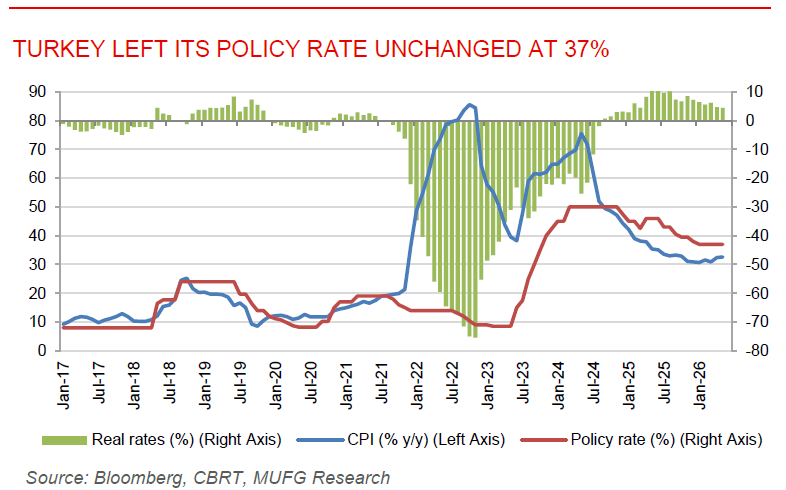
CBRT maintains tight policy as weak demand offsets inflation risks. The Central Bank of Turkey (CBRT) left its policy rate unchanged at 37%, while signalling a cautious balance between persistent inflation risks and a slowing domestic economy. The CBRT noted that underlying inflation eased slightly in May after rising earlier in the year and emphasised that leading indicators continue to point to weak domestic demand following the sharp slowdown in Q1 2026 GDP growth. Importantly, the CBRT removed its previous reference to potential second-round inflation effects, suggesting that softer consumption and weaker economic activity are increasingly helping to offset inflationary pressures stemming from higher energy prices and geopolitical tensions. Yet, policymakers maintained a tightening bias and reiterated their willingness to tighten further if the inflation outlook deteriorates, underscoring that price stability remains the primary objective. The decision reinforces expectations that interest rates will remain unchanged for an extended period, with markets anticipating the first cautious rate cuts only in late 2026 if disinflation continues. While easing inflation, seasonal foreign-exchange inflows, and stabilising oil prices could create room for a gradual policy shift, upside risks remain significant, particularly from renewed energy price shocks, geopolitical developments, and tighter global financial conditions. Overall, the latest communication suggests the CBRT is becoming more attentive to growth concerns, but not at the expense of its commitment to restoring price stability.
Non-Iranian oil flows through Hormuz show signs of recovery. Non-Iranian oil exports through the Strait of Hormuz increased by roughly 50% in early June, rising to around 1.8mb/d from 1.2mb/d in May, as Gulf producers gradually restore shipments despite ongoing US-Iran tensions. The recovery reflects growing use of alternative transit arrangements and “dark” tanker movements, although overall volumes remain well below pre-war levels of around 20mb/d. In contrast, Iranian crude exports through the strait have effectively halted amid continued US enforcement measures targeting Iran’s oil trade. The gradual return of Gulf barrels, combined with weaker Chinese crude demand and strategic stockpile releases, has helped ease concerns over supply shortages and contributed to a significant decline in oil prices from their wartime highs. Nonetheless, shipping risks remain elevated as both US and Iran continue to contest access to the strategic waterway, leaving the sustainability of the recovery uncertain.
Suez Canal traffic and revenues rebound on Hormuz disruptions. Egypt’s Suez Canal experienced a notable recovery in April 2026, with oil tanker traffic rising 28% y/y to 529 vessels and total ship crossings increasing 14% to 1,182 vessels. The improvement was largely driven by the disruption of energy flows through the Strait of Hormuz, which prompted Gulf producers to redirect exports via alternative routes, including Saudi Arabia’s Red Sea infrastructure and the Suez Canal. As a result, canal revenues climbed 27% y/y to USD 419 million, the highest monthly level since early 2024. While the rebound provides a welcome boost to one of Egypt’s key foreign-exchange earners, both traffic volumes and revenues remain well below pre-Gaza war levels. The outlook remains uncertain, as any escalation involving the Houthis or renewed instability in the Red Sea could disrupt the recovery in shipping activity.