
To read the full report, please download the PDF above.
Middle East Daily
SOOJIN KIM
Research Analyst
DIFC Branch – Dubai
T: +44(4)387 5031
E: soojin.kim@ae.mufg.jp
MUFG Bank, Ltd. and MUFG Securities plc
A member of MUFG, a global financial group
Middle East Daily
COMMODITIES / ENERGY
Oil jumps as US rejects Iran proposal and Hormuz risks intensify. Oil prices surged after President Trump rejected Iran’s latest proposal to end the Middle East conflict, raising concerns that disruptions in the Strait of Hormuz will persist. Brent crude climbed above USD105/b, while WTI approached USD99/b, as the fragile ceasefire between the US and Iran came under renewed pressure. The near closure of Hormuz since late February has severely disrupted global flows of crude, fuels, and gas, with the IEA calling it the biggest supply shock in history. Tensions escalated further after a drone strike hit a cargo vessel near Qatar, while the UAE and Kuwait intercepted hostile drones. Saudi Aramco CEO Amin Nasser warned that markets may not fully normalise until 2027 if shipping disruptions continue, even as Gulf producers reroute limited exports through alternative routes. Markets are increasingly pricing in prolonged supply tightness, with market expecting shipping disruption in the strait to extend well into the second half of the year.
Gold slips as Iran talks stall and inflation concerns persist. Gold edged lower after US President Trump rejected Iran’s latest proposal to end the Middle East conflict, raising concerns that disruptions in the Strait of Hormuz and resulting inflation pressures will persist. Gold traded near USD4,698/oz as investors weighed the fragile ceasefire following renewed weekend clashes, including a drone strike near Qatar and intercepted drones over UAE and Kuwait. Markets are increasingly expecting higher interest rates to combat inflation risks tied to elevated energy prices, which is negative for non-yielding gold. Investors are also focused on upcoming US inflation data and the end of Fed Chair Jerome Powell’s term, while strong US labour market data continues to support expectations that the Fed will keep rates elevated for longer.
MIDDLE EAST - CREDIT TRADING
End of day comment – 08 May 2026. Spreads a touch wider. We had overnight news of US/Iran trading fire coupled with higher yields, so cash prices adjusted to the left in the morning. It felt never like the market was too concerned about the Iran news though and PIFKSA new issues took the attention of the market. In my space the only notable sovereign flow was selling in ADGB 70s which closed -0.625pt/+5bp. That was though more security specific as the ADGB curve generally was +2/3bp. QATAR held with a good bid in QATAR 50s closing unch/-1bp. OMAN had some sellers in long end bonds again, today in 48s which closed -0.5pt/+3bp. It was very quiet in quasis, fins and corps. With the UST recovery post NFPs spreads widened 1/2bp generally in the afternoon but flows were virtually non-existent.
MIDDLE EAST - MACRO / MARKETS
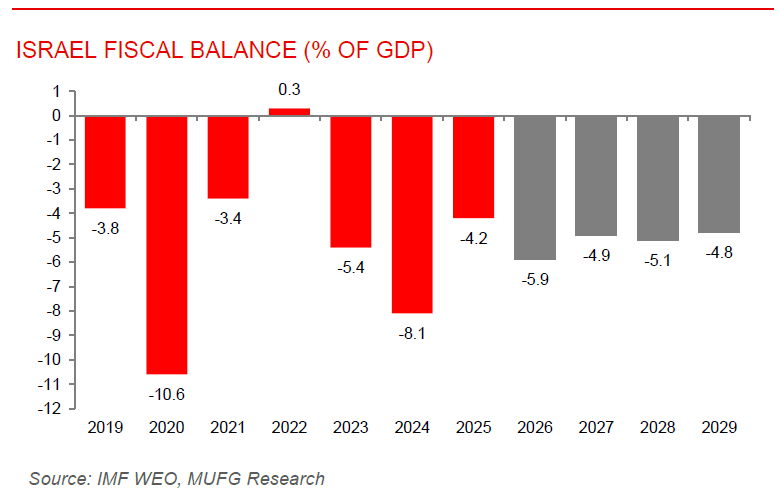
S&P affirms Israel’s ‘A’ rating amid ongoing regional tensions. Israel retained its ‘A’ credit ratings with a stable outlook, reflecting confidence that the economic fallout from ongoing conflicts involving Iran, Gaza, and Lebanon will remain manageable if large scale military escalation is avoided. S&P highlighted Israel’s strong economic fundamentals, including its wealth and diversified economy, resilient high-tech sector, strong external position, and sizeable foreign reserves, which continue to support stability despite elevated geopolitical risks. S&P expects the ceasefire with Iran and Hamas to broadly hold, although regional tensions and periodic clashes are likely to persist. After an estimated sharp contraction in early 2026 due to the conflict with Iran, Israel’s economy is projected to rebound strongly, with GDP growth expected to approach 6% in 2027 as business confidence recovers and labour shortage eases. However, defence spending is expected to remain structurally higher, keeping fiscal deficits elevated and pushing government debt higher over the medium term. S&P also emphasised the resilience of Israel’s banking system, stable depositor confidence, and continued current account surpluses driven by technology exports, while warning that renewed regional escalation could weaken growth and investor confidence.
Aramco profit surges on higher oil prices and Hormuz disruptions. Saudi Aramco reported a 26% y/y increase in first quarter adjusted net profit to nearly USD33.6bn, beating market expectations, as higher oil and fuel prices boosted earnings amid disruptions caused by the Iran war. The surge followed a sharp rise in global oil prices after the effective closure of the Strait of Hormuz, which pushed Brent sharply higher and tightened global energy supplies. Aramco benefited from stronger crude, fuel, and chemical prices, while also rerouting exports through its East-West pipeline to the Red Sea port of Yanbu, helping maintain supply flows despite shipping disruptions in the Gulf. CEO Amin Nasser described the pipeline as a “critical supply artery” that helped mitigate the global energy shock. The company said its average realised crude selling price rose to USD76/9/z during the quarter, while exports through the pipeline reached its 7mb/d capacity. Despite the strong earnings performance, free cash flow remained below divided payments, while Aramco’s gearing ratio increased slightly, reflecting higher leverage.