
To read the full report, please download the PDF above.
Middle East Daily
SOOJIN KIM
Research Analyst
DIFC Branch – Dubai
T: +44(4)387 5031
E: soojin.kim@ae.mufg.jp
MUFG Bank, Ltd. and MUFG Securities plc
A member of MUFG, a global financial group
Middle East Daily
COMMODITIES / ENERGY
Oil extends gains as US-Iran demands complicate Hormuz talks. Brent crude traded near USD88/b, while WTI remained above USD82/b, extending a four-day rally as tougher US an Iranian demands reduced prospects for a near-term agreement to restore normal shipping through the Strait of Hormuz. President Trump introduced new demands for Iranian compensation, while Iran continues to seek reparations and an end to the US blockade as conditions for an agreement. Hormuz traffic remains severely constrained at around five vessels per day, keeping a significant portion of global energy flows at risk. Supply concerns are also spreading to the Red Sea, where Houthi attacks have disrupted shipping and reportedly delayed the restart of Saudi Arabia’s Jazan refinery. With diplomatic positions hardening, global inventories already tight and alternative exports routes facing security risks, the prolonged disruption to Hormuz is likely to keep a sizeable geopolitical premium embedded in oil prices.
Gold climbs above USD4,400 ahead of US inflation data. Gold rose above USD4,400/oz, extending its recent recovery as investors positioned ahead of key US inflation data that could shape expectations for the Fed’s next policy move. Gold gained as much as 1%, supported by technical buying, stronger Chinese gold-ETF inflows and increased central-bank purchases. Markets expect US CPI to rise 0.1% m/m in July, and a softer reading following the recent weak jobs report could reduce expectations of further monetary tightening. However, persistent energy-driven inflation remains a key risk as tougher US demands on Iran diminish prospects for a near-term reopening of the Strait of Hormuz. While the prospect of higher-for-longer rates could constrain further gains, renewed investment flows, central-bank demand and persistent geopolitical uncertainty are providing stronger support for gold.
MIDDLE EAST - CREDIT TRADING
End of day comment – 10 August 2026. In case the recent mild weather led you to forget we are in the depths of the summer today's volumes certainly would have reminded you. Investment grade bonds largely moved with the US rates move today whilst HY and cash priced bonds are ending tighter if marginally lower in cash price. Sukuks across names were more active, but, given the time of year, are susceptible to trading at levels that appear to be healthily in the uneconomic zone. For KSA and Kuwait, Sukuks were the focus of what little trading there was with SRCSUK 32s and KSA 5¼ 34s in demand from locals. We printed the KSA 34s just inside z+100 which marks the tightest since mid-June which were the all-time tights at z+97. SRCSUK 35s and 36s are still around +20bps back from the KSA sukuks. Conventional sovereigns were 1-2bps tighter but mostly tracking rates. PIFKSA sukuks were also in focus if not trading. Having bid up 33s and 36s last week the street moved up PIFKSA 5.171 31s today unchanged in cash but -4bps. (Source: Matthew Dunker, Credit Trader)
MIDDLE EAST - MACRO / MARKETS
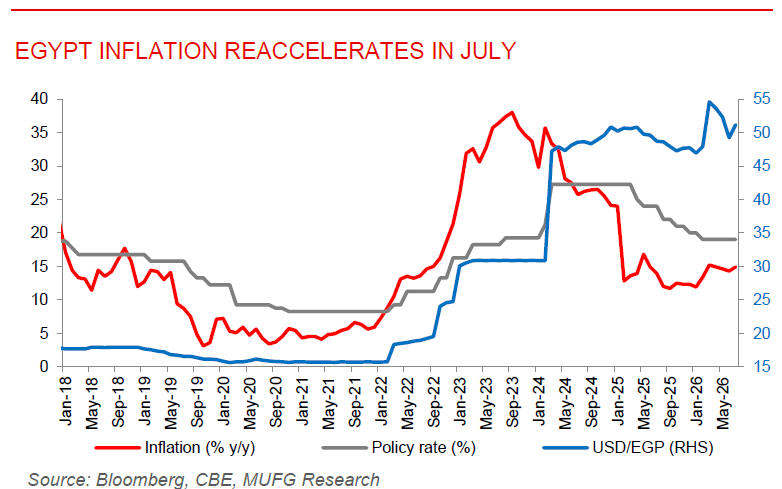
Egypt inflation reaccelerates, reinforcing cautious rate outlook. Egypt’s urban inflation accelerated to 14.9% y/y in July from 14.3% y/y in June, marking the first increase since March and interrupting three consecutive months of disinflation. Prices were unchanged on a monthly basis following a 0.4% decline in June, while food and beverage inflation accelerated notably to 8.0% y/y from 5.4%, despite food prices falling 0.6% m/m. The renewed rise comes as higher energy costs, currency weakness and regional uncertainty continue to generate price pressures, with further upside risks from electricity tariff adjustments. The Central Bank of Egypt (CBE), which kept its deposit and lending rates unchanged at 19% and 20% in July, now expects average inflation of 16%-17% in 2026, significantly above its previous 11% forecast. The July uptick, together with persistent geopolitical and administered-price risks, strengthens the case for the CBE to remain cautious on further monetary easing at its August 20 meeting, with a more sustained disinflation trend expected only from early 2027.
Qatar and Saudi Arabia build FDI stocks despite softer Saudi flows. FDI stocks continued to expand in Qatar and Saudi Arabia in Q1 2026, pointing to continued accumulation of long-term foreign capital despite heightened regional uncertainty. Qatar’s inward FDI stock increased from USD45.4bn at end-2025 to USD47.2bn by end-March 2026, while outward FDI rose to USD60.9bn, with foreign investment concentrated in mining and quarrying, financial services and manufacturing. In Saudi Arabia, the broader investment picture remained positive, although quarterly flows showed more moderate momentum. Gross FDI inflows rose 2.4% y/y to USD7.1bn in Q1 2026, while a 50.6% increase in outward FDI to USD0.9bn pushed net inflows down 2.4% to USD6.2bn. Going forward, Qatar’s North Field expansion should remain an important anchor for investment, while Saudi Arabia faces the greater challenge of translating its growing foreign investment base into consistently stronger quarterly FDI flows toward its Vision 2030 ambitions. Regional security, trade connectivity and stability in the Strait of Hormuz will remain important determinants.