
To read the full report, please download the PDF above.
Middle East Daily
SOOJIN KIM
Research Analyst
DIFC Branch – Dubai
T: +44(4)387 5031
E: soojin.kim@ae.mufg.jp
MUFG Bank, Ltd. and MUFG Securities plc
A member of MUFG, a global financial group
Middle East Daily
COMMODITIES / ENERGY
Oil holds above USD 100/b as Iran signals prolonged escalation. Oil held near recent highs, with brent around USD 101/b, while WTI traded above USD 96/b. Prices were supported by renewed Middle East fighting and Iran’s warning that it is prepared to intensify attacks if US strikes continue, raising the risk of further disruption through the Strait of Hormuz. Prospects for a near-term resolution remain limited, with President Trump indicating the conflict could continue beyond the November midterm elections, while US officials have reportedly considered the possibility of a much longer war. Meanwhile, Chinese buying has strengthened, and US gasoline and diesel prices remain elevated. With diplomatic prospects limited and both tanker traffic and regional energy infrastructure exposed to further attacks, a prolonged conflict could keep a sizeable geopolitical premium embedded in crude and refined-product prices.
Gold holds near USD 4,400/oz ahead of key US inflation data. Gold steadied near USD 4,400/oz as investors waited for key US inflation data ahead of the Fed’s September 14-15 meeting. Higher Treasury yields remain a headwind after a planned US government purchase of up to USD 6bn of longer-dated debt failed to materially lower borrowing costs, while Brent’s move above USD 100/b has reinforced concerns that Middle East-driven energy inflation could keep price pressures elevated. Markets are currently pricing around a 65% probability of a Fed rate hike this month. This week’s PPI and CPI data will be critical for the near-term direction, with persistent inflation and higher yields limiting upside while geopolitical uncertainty, de-dollarisation concerns and demand for portfolio hedges continue to provide underlying support.
MIDDLE EAST - CREDIT TRADING
End of day comment – 09 August 2026. Risk was off from the start as oil topped 100, news flow from US/Iran around tit for tat tanker attacks and another move higher in G3 yields. Spreads fluctuating into the close post US buyback announcement but by and large sovgn spreads are 1/2bp wider. ADGB had sticky offers in long end where 54s closed -0.75pt/+2bp. Quasis broadly matched that sovgn move, there was a bit more weakness in TAQAUH, especially around the 10y point where 36s/37s closed -0.75pt/+4bp. Fins had sellers across names on the back of the new FABUH 31s which seems to reprice the fins space by about 5/10bp and the market is rather hesitant to bid as new supply is expected. MASQUH priced a 5y conventional at T+115bp in 500mm. On the back of it the 30s sukuk traded -0.375pt/+5bp. Given the steepness between outstanding 35s and 37s the concession is debatable depending on where you look, but to me looks +15/20bp. It is clear that any new issue in this market will come with a concession, so it feels the way is still wider in the secondary. Mind from tomorrow on we get inflation numbers. (Source: Domonik Roth, Credit Trader)
MIDDLE EAST - MACRO / MARKETS
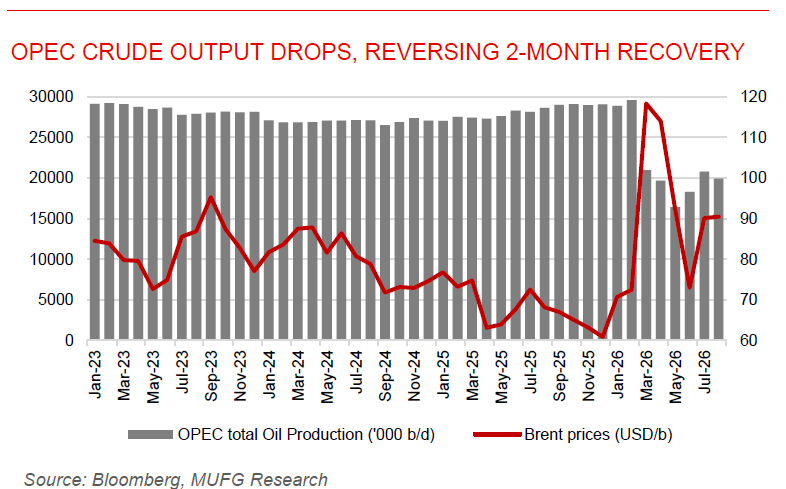
OPEC output falls sharpy as Saudi export routes face disruption. OPEC crude production fell 900kb/d to 19.9mb/d in August, reversing two months of recovery as renewed Middle East hostilities constrained Saudi supply. Saudi output dropped 1.1mb/d to 7mb/d, the lowest since May, while observed exports fell by roughly a third to 3.03mn b/d. The kingdom is facing simultaneous pressure on both export corridors, with tanker attacks disrupting Gulf shipments through Hormuz and Houthi threats constraining the Red Sea route. Higher production from Iraq, up 270kb/d to 3mb/d, and Venezuela only partially offset the Saudi decline. Meanwhile, OPEC+ kept October production targets unchanged, although actual supply remains well below quotas because of export constraints. Iraq is also seeking a 6mb/d capacity baseline for future quotas, compared with its current 4.4mb/d ceiling. With physical export capacity rather than OPEC+ quotas increasingly determining supply, continued disruption to Saudi and Iraqi flows could keep the global market tight and support Brent near USD 100/b.
PIIF launches Al Khafji Coastal Development with private sector focus. Saudi Arabia’s Public Investment Fund has launched the Gulf Coast Development Company to develop a major tourism and residential destination along the Al-Khafji coastline near the Kuwaiti border. Spanning around 20 sq km with 10 km of waterfront, the project is planned to include residential neighbourhoods, commercial, tourism, educational and marina facilities. Development will proceed in three phases, with the first targeted for completion in 2030. Notably, PIF intends to develop the project alongside private-sector and regional investors rather than financing it entirely from its own balance sheet, while no total investment value has yet been disclosed. The approach comes as Saudi Arabia manages tighter fiscal conditions and recalibrates investment priorities. Greater reliance on private capital could allow PIF to sustain its tourism and urban-development pipeline while preserving liquidity, with the project also supporting regional tourism, housing development and economic activity in the Eastern Province.