
To read the full report, please download the PDF above.
Middle East Daily
EDWARD BELL
Head of Research
DIFC Branch – Dubai
T: +971 (4)387 5033
E: edward.bell@ae.mufg.jp
SOOJIN KIM
Research Analyst
DIFC Branch – Dubai
T: +971 (4)387 5031
E: soojin.kim@ae.mufg.jp
MUFG Bank, Ltd. and MUFG Securities plc
A member of MUFG, a global financial group
Middle East Daily
COMMODITIES / ENERGY
Oil plunges as Middle East conflict risks ease. Oil prices have pushed to their lowest levels since August as geopolitical threats to the Middle East moderate. Brent futures fell 5.9% overnight and are extending moves lower today with January futures at USD 91.50/b. WTI has pushed to USD 85.84/b in trade today after more than a 4% decline overnight. US President Donald Trump has said that the conflict is “effectively over” and that the US would maintain the “status quo” and also held a meeting with Qatar’s prime minister overnight, whose country has been a primary mediator in the conflict. Regional exports of oil and natural gas continue to rise close to pre-conflict norms, helping to close gaps between futures and physical prices. Saudi Arabia reported that the East-West pipeline was attacked again overnight though the damage was limited. In Europe, natural gas prices extended last week’s losses with a 3.6% decline overnight and further moves lower to EUR 81.57/MWh in early trade today.
Gold holds firm as lower energy prices ease inflation fears. Gold prices pushed higher overnight to nearly USD 4,140/troy oz but have faded some of those gains in early trade today. The sustained move lower in energy prices are helping to temper inflation expectations which may give gold some room to consolidate if markets shift to less hawkish stances on rate hikes from the Fed and other central banks. However, the underlying strong performance of the US economy is still keeping Fed speakers cautious on inflation. In the rest of the precious metals complex silver and palladium are testing lower while spot platinum is holding steady.
MIDDLE EAST - CREDIT TRADING
End of day comment – 09 November 2026. It was a strong day in terms of price and spread performance, but flows remained two way. Volumes picked up significantly today, on the one hand you had ETFs selling, RM selling, on the other side local and dealer bids held the market firm. Look no further than oil prices for gauging hopes/expectations on some US/Iran resolution and post London close Trump will meet the Qatari PM. Earlier news on a hormuz agreement were denied, but market expectations remain high. The recovery in equities and credit indices gave the market some tailwinds as well. ADGB closed -5bp across the curve with 54s in the long end bid closing +0.25pt/-5bp. QATAR was not as strong as there were some sellers into higher prices in 36s (+0.125pt/-3bp) and 49s (+0.125pt/-3bp). Like Friday OMAN underperformed, especially in the short end/belly. Today 29s were active closing -0.125pt/+2bp. Quasi sovgn followed sovgn moves, in Qatar QPETRO 41s outperformed the sovgn curve closing +0.25pt/-6bp. Financial bonds are starting to see some buying in T2 and AT1. (Source: Dominik Roth, Credit Trader)
MIDDLE EAST - MACRO / MARKETS
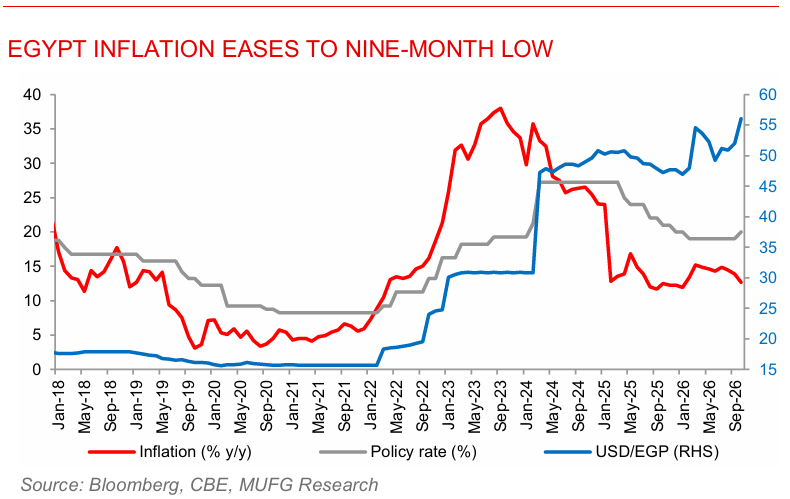
Egypt inflation eases to nine-month low as price pressures moderate. Inflation (urban) in Egypt slowed to 12.7% y/y in October from nearly 14% a month earlier. That was the slowest pace of inflation since January this year with a large decline in housing and fuel inflation helping to limit price gains last month. Core inflation also slowed to 13.1% from more than 14% in September. Price pressures have been relatively contained in Egypt this year amid the backdrop of external pressures. However, the central bank looks to have adopted a cautious stance, hiking rates at the October MPC meeting and also allowing much more flexibility in the value of the EGP. After hitting a record low against the US dollar at the end of October, the EGP has since rallied more than 3.5% since the start of November.
IMF projects Oman’s GDP growth at 4.5% in 2026 amid regional conflict. The IMF highlighted Oman’s economic resilience amid the ongoing Middle East conflict, forecasting real GDP growth of 4.5% in 2026, supported by stronger hydrocarbon production and continued non-oil expansion. During its 2026 Article IV mission, the IMF noted that GDP expanded 3.8% y/y in H1 2026, while nonhydrocarbon growth is projected at 1.4% for the full year. Inflation increased to approximately 3.0% during January–September, driven by higher food, transportation and import costs, and is expected to gradually moderate toward 2% over the medium term. Oman’s fiscal and external positions remain robust, with the IMF projecting an average fiscal surplus of 5.3% of GDP during 2026–27 and a current account surplus of 6.5% of GDP in 2026. Government debt declined to 30.4% of GDP at end-June, while the banking sector remains well capitalised and liquid. The IMF emphasised that sustained fiscal discipline, stronger private-sector participation and accelerated Vision 2040 reforms will be essential to preserving macroeconomic stability, strengthening economic diversification and maintaining resilience against prolonged regional uncertainty.