
To read the full report, please download the PDF above.
Middle East Daily
SOOJIN KIM
Research Analyst
DIFC Branch – Dubai
T: +44(4)387 5031
E: soojin.kim@ae.mufg.jp
MUFG Bank, Ltd. and MUFG Securities plc
A member of MUFG, a global financial group
Middle East Daily
COMMODITIES / ENERGY
Oil extends gains as Hormuz deal remains elusive. Brent crude traded above USD84/b, while WTI hovered near USD79/b, extending gains as Iran and Oman remained short of an agreement to restore normal shipping through the Strait of Hormuz. Iran’s Foreign Minister Abbas Araghchi said a deal was “very close” but cautioned that it would not immediately reopen the waterway. While Iran reiterated conditions including sanctions relief and an end to the US naval blockade. Supply risks were reinforced by another tanker incident in Hormuz and a Houthi-claimed attack on Saudi Arabia’s Jazan refinery where a fire was later extinguished. Although weak Chinese demand and emergency reserve releases have helped cushion the market, available supply buffers remain thin. With Hormuz flows still constrained and regional attacks continuing, oil prices are likely to retain a sizeable geopolitical premium despite tentative diplomatic progress.
Gold holds above USD4,300/oz as weak US jobs data eases rate hike risk. Gold steadied above USD4,300/oz after surging more than 7% last week, its strongest weekly gain since late January, as unexpectedly weak US labour market data reduced expectations of a near-term Fed rate hike. US employers cut jobs in July, and prior months were revised lower, pushing the dollar down and supporting gold, while investors now await inflation data for further guidance on the Fed outlook. Sentiment has also been reinforced by stronger investor demand, with hedge funds raising bullish gold positions to a six-month high and Chinese gold-backed ETFs extending inflows. The PBoC also added 640,000oz to reserves in July, marking a 21st consecutive month of purchases. With rate hike expectations easing and geopolitical risks around Hormuz and the Red Sea still elevated, gold remains well supported.
MIDDLE EAST - CREDIT TRADING
End of day comment – 07 August 2026. Very quiet session, interrupted by some rates volatility around the NFP print. Spreads are broadly unchanged in the long end and 1/2bp wider in the front/belly on the UST curve steepening. However, over the week we tightened 5/10bp as we are starting to see more inflows (mainly from ETFs) which steadily improved technicals. We still have to go over big macro events with next week’s CPI and the Iran/ Hormuz situation. On the latter the market is still awaiting any announcement and with the lack of it oil is starting to move higher/ UST are off the highs. (Source: Dominik Roth, Credit Trader)
MIDDLE EAST - MACRO / MARKETS
Syria deepens engagement with World Bank and IMF. Syria is stepping up cooperation with international financial institutions as the government seeks to rebuild core economic institutions, restore financial sector capacity and ease its isolation from global capital flows. The World Bank approved a new USD100 million IDA grant to support the creation of a modern, secure and digitally enabled financial sector, taking total approved World Bank development grants to around USD491 million. Previous grants have included USD146 million for electricity, USD150 million for water, USD75 million for health, and USD20 million for public financial management, while the government aims to secure additional support for education, agriculture, transport, social protection and environmental management, potentially lifting total World Bank grants to nearly USD1bn over the next three years. Separately, the IMF agreed a broad technical assistance programme covering fiscal reform, revenue mobilisation, public debt management, banking sector rehabilitation, while also advancing work on debt sustainability and economic data. The growing engagement should improve institutional credibility and help reconnect Syria with international financial channels, but very large reconstruction needs, weak banking capacity and incomplete economic data mean external support will remain essential for a sustained recovery.
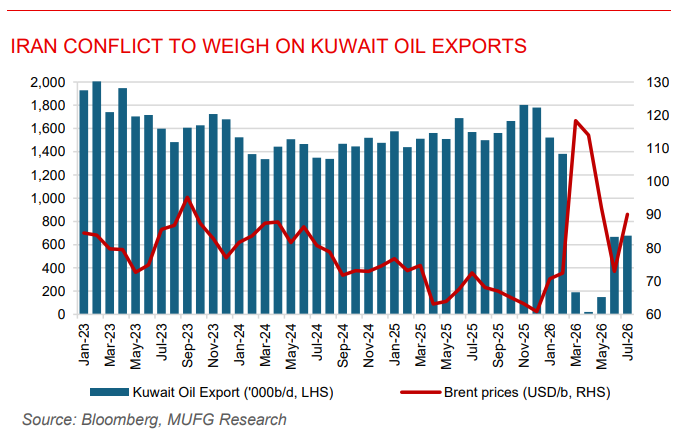
Fitch affirms Kuwait at ‘AA-’ with stable outlook. Fitch Ratings affirmed Kuwait’s sovereign rating at ‘AA-’ with a stable outlook, supported by exceptionally strong fiscal and external buffers that continue to offset heavy oil dependence, weak governance and structural spending pressures. Fitch expects the Iran conflict to weigh on activity and oil exports, with crude production averaging around 2mb/d in FY26 and real GDP contracting as the oil sector weakens, although non-oil activity should remain positive. The agency forecasts the reported fiscal deficit to widen to around 19% of GDP in FY26, reflecting lower hydrocarbon volumes and rigid wage and subsidy spending, but including estimated investment income Kuwait would still record a 1.7% of GDP surplus. Sovereign net foreign assets are projected to rise to 668% of GDP in 2026, more than ten times the ‘AA’ median, providing a substantial shock absorber. The stable outlook reflects Fitch’s view that Kuwait’s extraordinary asset position can absorb near-term geopolitical and fiscal pressures, although prolonged disruption to oil exports or failure to address structural fiscal weaknesses would remain the key downside risks.