
To read the full report, please download the PDF above.
Middle East Daily
SOOJIN KIM
Research Analyst
DIFC Branch – Dubai
T: +44(4)387 5031
E: soojin.kim@ae.mufg.jp
MUFG Bank, Ltd. and MUFG Securities plc
A member of MUFG, a global financial group
Middle East Daily
COMMODITIES / ENERGY
Oil nears USD 100/b as US-Iran escalation deepens Hormuz risks. Oil extended gains, with Brent approaching USD 100/b and WTI trading near USD9 4/b, after US strikes destroyed five Iranian crude tankers near the Kharg Island export hub, intensifying concerns over regional supply flows. The attacks followed Iranian attempts to target a US navy vessel and prompted Iran to retaliate with missiles toward Jordan and warn that vessels near Kuwaiti and Bahraini ports could be targeted. The escalation comes alongside renewed Houthi attacks on Saudi energy infrastructure, forcing several facilities to halt operations and further broadening regional supply risks. Although some crude continues to transit Hormuz, often via vessels operating without transponders, shipping risks remain acute. With military action increasingly targeting tankers and energy infrastructure, the threat of deeper disruption to Gulf exports risks tightening markets further and pushing Brent back toward tiple-digit levels.
Gold edges higher as weaker dollar offsets inflation concerns. Gold edged higher after three consecutive sessions of losses, as a weaker dollar provided support to gold. The dollar index has declined around 0.4% this week, partly reflecting a stronger yen, making gold cheaper for buyers using other currencies. However, renewed US-Iran hostilities continue to cloud the outlook pushing Brent close to USD 100/b and reviving concerns over energy-driven inflation. Higher oil prices have strengthened the case for further Fed tightening, with markets pricing around a 60% probability of a rate hike at next week’s meeting. Gold has traded largely around USD 4,400/oz since rebounding from July lows near USD 4,000/oz. Near-term direction will hinge on this week’s US inflation data, with a softer dollar and geopolitical risks providing support while elevated energy prices and higher interest rate expectations remain key headwinds.
MIDDLE EAST - CREDIT TRADING
End of day comment – 08 August 2026. The market is back from Labour Day and it didn't take long for primary markets to get active. Mashreq announced a 5y senior deal, followed by FABUH 5y which priced at T+90bp. That offers a new issue premium of 10bp and adds to the granularity of the FABUH curve. Bonds in outstanding issues changed hands around +5bp on the day (up to -0.25pt). Then DPWDU announced a 6y EUR and 10y USD mandate, that will be interesting to see pricing as spreads were trading towards the tightest levels this year pre-announcement. Seen mostly 33s (-0.375pt/+6bp) and 35s (-0.375/+5bp) trading after the mandate news. Besides the new issue related flows though the market remained rather quiet. We still trading with a widening bias on the back of expected primary market pick up and ETF/ RM outflows. Sovereign bonds were in general stable and unch in spread terms whereas quasis continue to see selling and closed +1/2bp with up to 0.25pt lower cash prices. TAQAUH and QPETRO saw most of the selling. (Source: Domonik Roth, Credit Trader)
MIDDLE EAST - MACRO / MARKETS
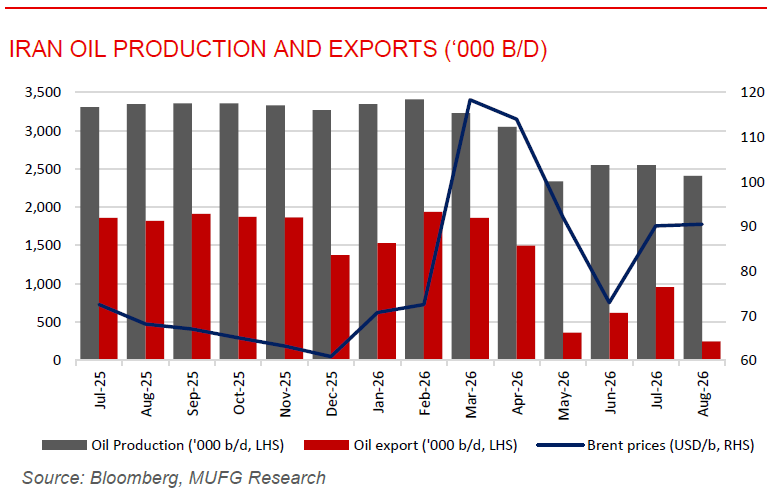
US blockade deepens Iran’s oil and currency crisis. Iran’s oil revenues are rapidly declining as the US naval blockade prevents crude shipments from leaving the Gulf, while stocks already positioned outside the blockade are being depleted. Kpler estimates Iranian crude held on vessels outside the Gulf has fallen from around 90mb in mid-July to 29mb, with current deliveries of roughly 1mb/d potentially exhausting these supplies by mid-October. Iran loaded only 255,000 b/d in August, 85% below the February-April average, but these barrels remain trapped inside the Gulf. The squeeze is increasingly forcing production cuts and has also hit petrochemical exports, with loadings down roughly two-thirds from early 2026. With oil normally financing around one-third of the state budget, the loss of export revenues is intensifying pressure on an economy already facing 66% average inflation in July and a projected 5.4% GDP contraction in 2026. As offshore inventories diminish and financial sanctions constrain payment channels, the loss of hard-currency earnings risks further weakening the rial, raising import costs and intensifying inflationary and fiscal pressures.
Saudi Arabia plans first post-war mortgage-backed sukuk. Saudi Arabia is preparing its first residential mortgage-backed securities issuance since the US-Iran war, as authorities seek to diversify bank funding and deepen domestic capital markets. The state-owned Saudi Real Estate Refinance Company (SRC) plans to issue sukuk backed by SAR 431.3mn (USD 114.9mn) of mortgages acquired from lenders including Saudi National Bank and Arab National Bank. The underlying mortgages have a relatively conservative 58% loan-to-value ratio, while 86% of borrowers derive their income from the government. The programme could ultimately allow banks to transfer as much as SAR180bn of legacy mortgages to SRC by 2030, potentially freeing balance-sheet capacity for new lending. Scaling securitisation could ease liquidity and capital pressures on Saudi banks, support continued housing-credit growth and help develop a deeper secondary mortgage and domestic debt market.