
To read the full report, please download the PDF above.
Middle East Daily
SOOJIN KIM
Research Analyst
DIFC Branch – Dubai
T: +44(4)387 5031
E: soojin.kim@ae.mufg.jp
MUFG Bank, Ltd. and MUFG Securities plc
A member of MUFG, a global financial group
Middle East Daily
COMMODITIES / ENERGY
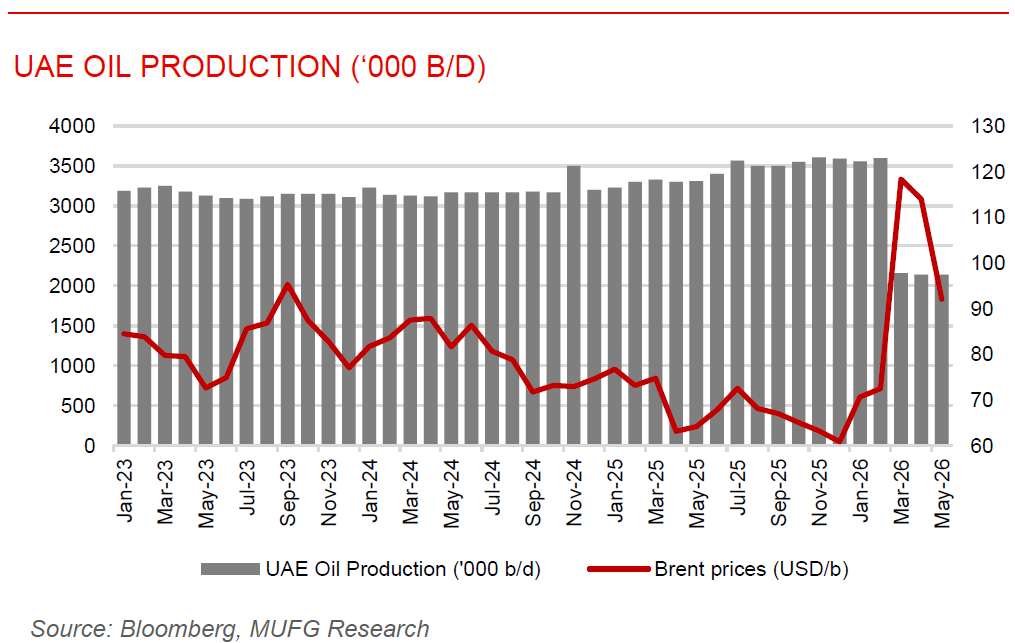
Oil eases as Israel and Iran reaffirm ceasefire. Oil prices edged lower after Israel and Iran signalled their intention to maintain a fragile ceasefire following a recent escalation that threatened broader efforts to end the conflict. Brent crude slipped toward USD93/b and WTI traded below USD91/b, as both sides indicated they would refrain from further attacks unless provoked. While the de-escalation improved market sentiment, the Strait of Hormuz remains effectively closed, continuing to disrupt global flows of crude, fuels, and natural gas. Markets also remain cautious as negotiations between US and Iran continue, with significant obstacles still standing in the way of a full restoration of energy exports, including mine clearance, infrastructure repairs, and the restart of shut-in production. As a result, geopolitical risk premiums remain embedded in oil prices despite the recent easing in tensions.
Gold holds steady as Middle East ceasefire supports market stability. Gold traded near USD4,320/oz as Israel and Iran reaffirmed their commitment to halt attacks, easing immediate concerns over a wider escalation in the Middle East. The ceasefire supports ongoing diplomatic efforts to resolve the conflict, although disruptions to energy flows through the Strait of Hormuz continue to fuel inflation concerns and keep central banks cautious on interest rates. Higher-for-longer rate expectations remain a headwind for non-yielding assets such as gold, particularly after strong US economic data reinforced expectations of tighter monetary policy. Despite recent stabilisation, gold remains around 18% below its pre-conflict level, reflecting the combined impact of rising bond yields, a stronger dollar, and shifting interest rate expectations.
MIDDLE EAST - CREDIT TRADING
End of day comment – 08 June 2026. It was a weaker day overall. In the morning the market repriced cash to the left given oil up/ UST down with the weekend developments. Flows were skewed to selling from RM/ETF side. Then with Trump tweets to stop shooting and Iran's announcement they had finished attacking Israel for now macro risk sentiment improved. That stopped the selling but didn't bring any buyers out. Spreads were widening with the UST recovery and at some stages were +5/7bp on the day before the street stepped up bids. Into the close ETFs are selling again, but with better macro markets, these flows are having no impact on spreads. Closing ADGB curve +2/3bp, QATAR +2bp, SHJGOV +3bp, OMAN +3bp and Quasi sovgn +3/5bp. Long end bonds are outperforming short end/ belly bonds, but there is an element of some correction post the NFP move. All said, the market feels heavy, it is easier to buy than to sell. (Source: Dominik Roth, Credit Trader)
MIDDLE EAST - MACRO / MARKETS
World Bank approves USD900 million for Iraq transport corridor. The World Bank has approved a USD900 million financing package for Iraq’s Transport Economic Corridor (ITREC) project, a major initiative aimed at modernising the country’s road infrastructure and strengthening trade links with Turkey, Jordan, and Syria. The project will focus on upgrading key sections of the Baghdad-Turkey corridor and the east-west route connecting Iraq to neighbouring markets, improving mobility, freight efficiency, and regional integration. With road transport accounting for more than 90% of transportation activity in Iraq, the investment is expected to benefit nearly 8 million people through reduced travel times, lower logistics costs, improved road safety, and better access to economic opportunities. Beyond physical infrastructure, the project will also support transport-sector reforms, climate-resilient asset management, and private-sector participation, helping Iraq advance its goal of becoming a regional trade and transit hub while supporting economic diversification, job creation, and long-term growth.
ADNOC crude sales signal gradual recovery in Gulf oil trade. ADNOC has sold at least 14 million barrels of UAE crude to Asian buyers for June–August delivery, marking one of the first major Gulf crude sales since the outbreak of the Iran conflict. The cargoes, primarily Upper Zakum crude, were sold at relatively low premiums to the Dubai benchmark, highlighting a sharp normalization from the elevated differentials seen during the peak of the disruption. The sales also indicate a gradual recovery in UAE export flows, supported by shipments through the Habshan-Fujairah pipeline and limited tanker movements via the Strait of Hormuz. The pricing suggests Asian demand for Middle Eastern crude is returning, but at more competitive levels, creating pressure on Saudi Aramco’s market share as its official selling prices remain significantly higher. Looking ahead, future ADNOC tenders, August crude pricing decisions, and the pace of Hormuz traffic recovery will be key indicators of whether Gulf oil markets continue to normalise or remain fragmented by regional tensions.