
To read the full report, please download the PDF above.
Middle East Daily
SOOJIN KIM
Research Analyst
DIFC Branch – Dubai
T: +44(4)387 5031
E: soojin.kim@ae.mufg.jp
MUFG Bank, Ltd. and MUFG Securities plc
A member of MUFG, a global financial group
Middle East Daily
COMMODITIES / ENERGY
Oil extends rally as US-Iran conflict escalates further. Oil prices extended their gains, with Brent rising above USD79/b and WTI approaching USD74/b, after the US launched a second consecutive day of strikes on Iranian targets. Iran retaliated with missile and drone attacks targeting US military bases in the region, while shipping activity through the Strait of Hormuz slowed again as security risks intensified. The US also revoked the sanctions waiver that had allowed limited Iranian oil exports, raising the prospect of tighter global supply and leaving Iranian crude facing renewed uncertainty. Also, declining fuel inventories and reduced tanker movements through Hormuz reinforced concerns over near-term market tightness. Going forward, the trajectory of the US-Iran conflict, the security of shipping through the Strait of Hormuz, and the scale of any disruption to Gulf oil exports will remain the key drivers of oil prices, with any further escalation likely to restore a larger geopolitical risk premium.
Gold holds near multi-month low as rising oil prices reinforce rate concerns. Gold prices remained subdued, with bullion trading near USD4,080/oz, after three consecutive sessions of losses as renewed US strikes on Iran lifted oil prices and revived concerns over persistent inflation. Higher energy prices have strengthened expectations that the Federal Reserve may keep interest rates higher for longer, with the minutes of the Fed’s June meeting showing some policymakers remained open to further tightening despite leaving rates unchanged. The combination of elevated inflation risks and higher-for-longer interest rate expectations continued to weigh on the non-yielding precious metal. The evolution of the US-Iran conflict and the Fed’s policy outlook will remain the key drivers of gold prices, with persistent inflation likely to limit any significant upside.
MIDDLE EAST - CREDIT TRADING
End of day comment – 08 July 2026. Risk off day. With overnight strikes on Iran and early morning retaliation on BHRAIN/KUWAIT the market was greeted by wider UST yields with a flattening bias. Spreads were though unch to start as the market has seen this before and looked through it. Once Trump said the ceasefire is over and later threatened new strikes/ blockade the market started to widen. Volumes remained low and again eod moves showed a wide dispersion depending on the credit. Higher beta underperformed, BHRAIN up to -1pt/+5bp as was SHJGOV. New issues also had a hard time. New SRCSUK 32s closed +5bp, new 36s +2bp. AT1 were also for sale, new or old, but with a buyer/bidding strike the market didn't find clearing levels and marked them 0.25/0.5pt lower. What outperformed was ADGB where higher yields on UST/spreads wider lately seem to lure buyers back in both in short/belly and long end bonds. Closing the curve up to -0.5pt and broadly unch in spreads. Global risk markets are also on the backfoot so barring any +ve news overnight the path of least resistance is wider. Oil is again the risk/temperature barometer of markets and as I type Brent is >80 on the day’s high. (Source: Dominik Roth, Credit Trader)
MIDDLE EAST - MACRO / MARKETS
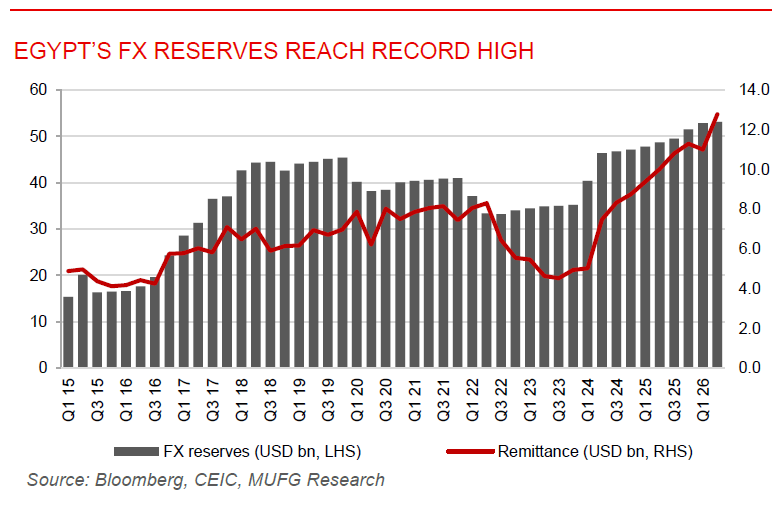
Egypt’s FX reserves reach record high on strong external inflows. Egypt’s net international reserves climbed to a record high of USD55.1bn at the end of June 2026, rising from USD53.1bn in May, underscoring the continued strengthening of the country’s external position. The increase was supported by robust foreign currency inflows from exports, tourism, and remittances, with transfers from Egyptians working abroad rising 33.2% y/y to USD39.2bn during the first ten months of FY2025/26, while annual remittances reached a record USD41.5bn in 2025. The continued accumulation of reserves reflects improving foreign exchange liquidity, strengthens Egypt’s ability to meet external obligations, and reinforces investor confidence amid ongoing economic reforms and improving macroeconomic conditions. Looking ahead, the sustainability of reserve growth will depend on continued strength in remittances, tourism, and export revenues, alongside external financing inflows from the IMF, the EU, and other international partners, as well as continued progress on structural reforms.
IMF sees uneven GCC slowdown in 2026, followed by strong 2027 rebound. The IMF’s July 2026 WEO update points to a sharply uneven GCC outlook, with the impact of regional transport and production disruptions varying significantly across economies. Saudi Arabia is expected to remain comparatively resilient, with growth forecast at 1.7% in 2026 before accelerating to 5.5% in 2027, supported by its more diversified export routes and greater ability to mitigate disruptions to regional shipping flows. In contrast, Qatar and Kuwait are among the economies facing the steepest contractions this year, reflecting their greater exposure to disruptions affecting energy production and transport, before recording double-digit rebounds in 2027 as export flows and activity normalise. More broadly, the IMF sees the regional shock as concentrated rather than uniform, implying substantial divergence in near-term GCC performance despite a shared external backdrop.