
To read the full report, please download the PDF above.
Middle East Daily
SOOJIN KIM
Research Analyst
DIFC Branch – Dubai
T: +44(4)387 5031
E: soojin.kim@ae.mufg.jp
MUFG Bank, Ltd. and MUFG Securities plc
A member of MUFG, a global financial group
Middle East Daily
COMMODITIES / ENERGY
Oil heads for strong weekly gain as US intensifies pressure on Iran. Brent held near USD 100/b, and WTI approaching USD 93/b, as traders weighed renewed US-Iran tensions against a potential agreement between Iran and Oman to manage shipping through the Strait of Hormuz. Iran said a deal including a temporary safe passage was imminent, although uncertainty remains over a potential US response and Iran has warned vessels of continued risks if passing near Oman. Despite security concerns, around 10mb/d of oil is still flowing through Hormuz, according to Vitol, helping prevent a more severe supply squeeze. Meanwhile, Saudi Aramco’s Jazan facilities also faced another attack, although no major new damage was reported. With Brent already more than 30% higher since the conflict began, the proposed Hormuz arrangement could ease some supply concerns, but persistent tanker and infrastructure attacks are likely to keep crude and refined-product markets tight.
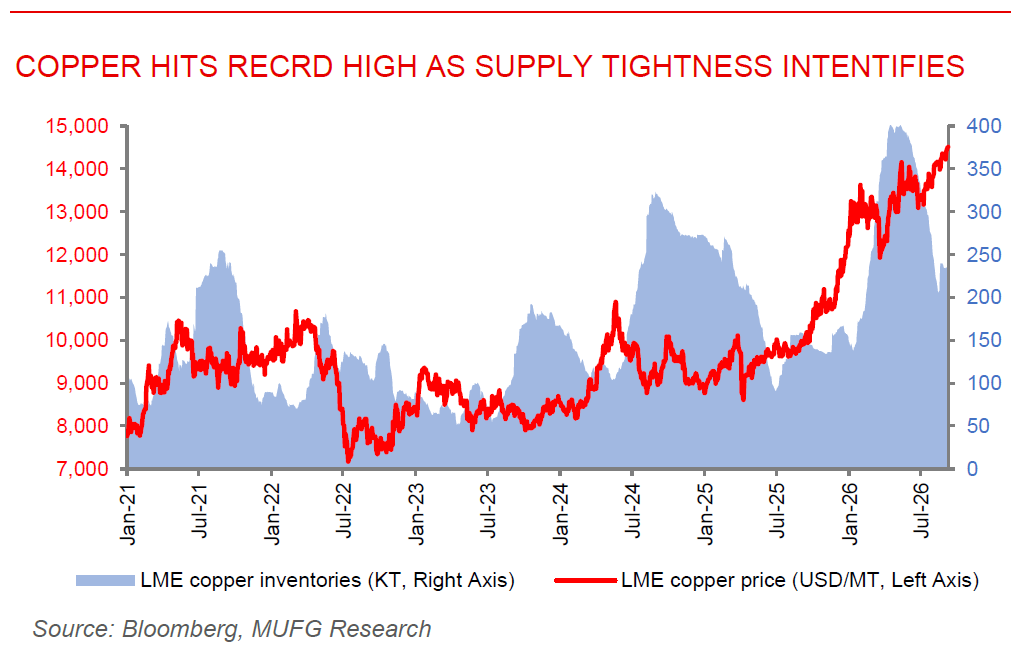
Copper hits record high as supply tightness intensifies. Copper extended its rally to a fourth session, reaching a record USD 14,617/t on the London Metal Exchange as tight near-term supply and expectations of US tariffs on refined copper boosted prices. The metal has gained around 17% this year, supported structurally by constrained mine supply and rising demand from data centres, renewable-energy infrastructure and power grids. Near-term tightness has intensified as large volumes of refined copper have been redirected toward the US ahead of potential tariffs, draining LME inventories and keeping the futures curve in steep backwardation. Meanwhile, Chinese demand is expected to strengthen as the world’s largest copper consumer enters its traditional peak manufacturing season, with inventories on the Shanghai Futures Exchange falling to their lowest since 2024.
MIDDLE EAST - MACRO / MARKETS
Egypt’s foreign reserves hit record high on gold gains. Egypt’s net international reserves rose to a record USD 57.2bn in August, up USD 920mn or 1.6% from July and marking a fourth consecutive monthly high. However, the increase was entirely driven by gold, whose reserve value jumped USD1.92bn to USD19.06bn, while SDR holdings increased modestly to USD 606mn. In contrast, the more liquid foreign-currency component declined by USD 1.2bn to USD 37.6bn, highlighting a more nuanced external-liquidity picture than the headline reserve increase suggests. Egypt’s broader external position nevertheless continues to benefit from strong remittance inflows, a firmer pound and continued IMF, Gulf and multilateral financing. The decline in foreign currency reserves likely reflects ongoing import financing and external debt-service requirements amid heightened regional uncertainty. While record headline reserves provide an important external buffer, the evolution of the foreign-currency component will be more important in assessing Egypt’s underlying dollar liquidity and resilience to external financing pressures.
Oman’s trade surplus jumps 51% as exports strengthen. Oman’s merchandise trade surplus surged 51% y/y to around USD 12.2bn in H1 2026, as strong export growth significantly outpaced the increase in imports, providing further support to the Sultanate’s external position. Total merchandise exports increased 15.3% to USD 34.3bn, led by a 16.5% rise in oil and gas exports to USD 22.4bn. Importantly, non-oil exports also maintained solid momentum, rising 11.4% to USD 9.35bn, while re-exports increased 20% to USD 2.54bn, highlighting continued progress in broadening Oman’s export base beyond hydrocarbons. In contrast, merchandise imports grew by just 2.1% to USD 22.4bn, contributing to the sharp widening of the trade surplus. The UAE remained Oman’s largest market for non-oil exports and its main source of imports, while Saudi Arabia and India were also important export destinations. The combination of stronger hydrocarbon receipts continued non-oil export growth and relatively subdued imports is strengthening Oman’s external buffers and supporting the broader economic diversification agenda.
Iraq struggles to sustain oil export recovery as shipping costs surge. Iraq is struggling to secure buyers for September crude after sharply reducing the discounts offered on barrels collected inside the Persian Gulf, threatening the tentative recovery in exports. State marketer SOMO narrowed discounts by around USD 9-10/b, offering Basrah Medium at USD 15-18/b below benchmark, compared with discounts of USD 25-27/b in August. Traders argue the new pricing is insufficient to compensate for elevated freight and security risks associated with navigating the Strait of Hormuz, where Iraq remains heavily dependent for exports. Shipping costs have surged, with daily earnings for a Gulf-to-China supertanker reaching about USD 704,000, the highest since at least 2017, following renewed attacks on vessels. Iraq is considering securing tankers itself and alternative ship-to-ship transfers outside the Gulf, but logistical challenges remain substantial. The pricing standoff highlights Iraq’s difficult trade-off between maximising revenue per barrel and maintaining export volumes, with persistently high freight and war-risk costs potentially forcing SOMO to restore deeper discounts to attract buyers.