
To read the full report, please download the PDF above.
Middle East Daily
EDWARD BELL
Head of Research
DIFC Branch – Dubai
T: +971 (4)387 5033
E: edward.bell@ae.mufg.jp
SOOJIN KIM
Research Analyst
DIFC Branch – Dubai
T: +971 (4)387 5031
E: soojin.kim@ae.mufg.jp
MUFG Bank, Ltd. and MUFG Securities plc
A member of MUFG, a global financial group
Middle East Daily
COMMODITIES / ENERGY
Oil rises as Iran tension and supply risks support energy markets. Oil prices are pushing higher as markets respond to press reports that the US could resume strikes against Iran prior to the upcoming mid-term elections. Brent futures have pushed up to above USD 102.30/b while WTI is close to USD 90/b, both up 2%. US President Donald said he didn’t think a deal with Iran was imminent while the pace and range of attacks on shipping in the Strait of Hormuz and in the Gulf has increased recently. A tanker was reported to have been stuck north of Qatar, the first attack in the Gulf since early September. The EIA data showed a draw in commercial crude stocks of 3.2m bbl last week along with more modest draws across the rest of the barrel. Oil output in the US ticked higher to 13.98m b/d while US oil exports jumped 1.2m b/d to 4.8m b/d. The IEA released a statement that confirmed that the 100m bbl stock release announced at the end of last week would be part of an agreement reached earlier this year to release 400 m bbl, rather than additional barrels. European natural gas prices are pushing higher, up 2% to EUR 79.70/MWh, representing a third day of gains as the market focuses on risks to LNG flows from the Middle East.
Gold recovers despite hawkish Fed. Gold is moving tentatively higher, pushing back up to USD 4,134/troy oz after a loss of 1.3% took it to USD 4,111/troy oz overnight. Minutes from the September FOMC showed there was unanimity in supporting the 25bps hike last month and that Fed policymakers expected another hike by the end of the year. The tone from the Fed is continuing to keep a bid under the US dollar and the recent stabilisation in oil and products prices will keep the risk of energy inflation live in the coming weeks. Markets are still pricing in less than a 20% probability of an October hike by the Fed but are firming up pricing for a December move.
MIDDLE EAST - CREDIT TRADING
End of day comment – 07 October 2026. It was a slightly weaker day overall in my GCC universe, but given the macro weakness in equity and credit, GCC spreads held rather well. The morning was rather quiet with mixed flows. We got a bit of a wobble around midday in the UST weakness but broadly spreads closed only 1/3bp wider with cash up to 0.5pt lower. Front end bonds in general have a bid now. The steepening of the UST curve on the back of markets pricing out an October hike has led to some buyers coming out looking for up to 3y bonds. Then despite the price weakness in long end bonds there is still a bid/interest in low cash price bonds supporting the market. Flows remained subdued but in the last two days buyers have been outnumbering sellers, especially international RM is starting to pick more bonds up at these spread/yield levels. In financial news, DIBUH called its 500mm 3.375% Tier1 sukuk which should calm the nerves a bit in this area. Overall, the cash market feels better anchored, in the absence of primary issuance technicals are steadily improving. (Source: Dominik Roth, Credit Trader)
MIDDLE EAST - MACRO / MARKETS
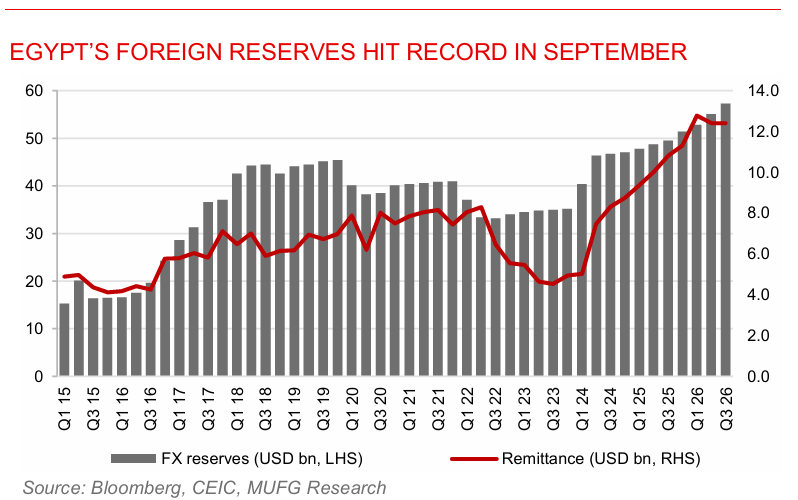
Egypt’s foreign reserves hit record USD 57.35bn in September. Egypt’s net international reserves rose to a record USD 57.35bn in September 2026, increasing by USD 133m from August and extending their gains for a ninth consecutive month. Reserves were 15.8% higher y/y, representing an increase of USD 7.81bn from September 2025. The monthly improvement was driven by a USD 1.74bn rise in foreign-currency holdings to USD 39.3bn, partly offset by a decline in the value of gold reserves to approximately USD 17.5bn, reflecting fluctuations in global gold prices. The continued accumulation strengthens Egypt’s external liquidity buffers against import financing needs, debt-servicing obligations and regional economic uncertainty. It also follows continued IMF-supported reforms, including a USD 1.8bn disbursement in July, with reserve coverage exceeding the IMF’s adequacy benchmark as of June. The increase in liquid foreign-currency assets is particularly encouraging, suggesting an improvement in Egypt’s underlying external position despite the decline in gold valuations. Sustained reserve growth, however, will depend on remittances, export receipts, capital inflows and the stability of external financing conditions.
Iraq devalues Dinar as oil revenue shortfall deepens fiscal pressures. Iraq devalued its dinar for the first time in three years, adjusting the official exchange rate to around IQD1,500–1,520/USD from IQD1,300–1,320, as weaker oil revenues intensified fiscal pressures. The move aims to increase the dinar value of oil receipts and help finance the 2026 budget, including additional public-sector employment commitments. Although crude exports recovered to 2.6mb/d in September, shipments averaged just 1.6mb/d during January-September, down 52% y/y. The parallel exchange rate reportedly approached IQD1,700 per dollar following the adjustment, raising concerns over inflation and further currency weakness. The devaluation offers temporary fiscal relief, but sustained stability will depend on further oil-export recovery, spending discipline and progress in diversifying export routes.