
To read the full report, please download the PDF above.
Middle East Daily
SOOJIN KIM
Research Analyst
DIFC Branch – Dubai
T: +44(4)387 5031
E: soojin.kim@ae.mufg.jp
MUFG Bank, Ltd. and MUFG Securities plc
A member of MUFG, a global financial group
Middle East Daily
COMMODITIES / ENERGY
Oil rises as fresh US-Iran clashes threaten peace efforts. Oil prices jumped after renewed military clashes between the US and Iran raised doubts about the prospects for a deal to end the nearly 10-week conflict. Brent crude climbed toward USD103/b while WTI traded near USD96/b after US forces struck Iranian military targets in response to attacks on US navy destroyers in the Strait of Hormuz. Although US said it does not seek escalation, President Trump warned of stronger retaliation if Iran does not quickly agree to a deal. The conflict continues to severely disrupt global energy markets, with Hormuz effectively closed under a dual US-Iran blockade that has sharply reduced oil flows and created a major supply shock. Regional tensions also remain elevated after missile and drone interceptions in the UAE. Meanwhile, the IEA warned that the war is removing around 14mb/d from global supply, adding that any recovery in reduction would likely be gradual even if hostilities ease.
Gold supported by China buying amid Middle East risks. Gold traded near USD4,720/oz as buying interest strengthened following strong purchases by China’s central bank (PBoC) and renewed tensions in the Middle East after the US struck Iranian military targets in response to attacks on navy destroyers in the Strait of Hormuz. The situation has heighted uncertainty around the fragile ceasefire and the reopening of the vital energy route, while data showed the PBoC bought 8 tons of gold in April, its largest monthly purchase since 2024, reinforcing expectations of continued central bank demand. Despite geopolitical risks, gold has fallen around 11% since the conflict began as fears of higher inflation and prolonged elevated interest rates supported the US dollar, which typically pressures non-yielding gold. Investors are now focused on upcoming US nonfarm payroll data for further clues on the Fed’s policy.
MIDDLE EAST - CREDIT TRADING
End of day comment – 07 May 2026. Spreads tighter with some weakness into the close. Yday strength carried through to today, especially in the ADGB curve. More bonds got bought there and even short end/belly bonds found buyers and good bids. ADGB 30s closed +0.25pt/-5bp. QATAR had again a quieter day but closes to +0.25pt in cash and -2/-3bp led by buying interest in long end. OMAN had some early morning sellers in 47s but eventually followed the overall market tighter, 47s close +0.25pt/-3bp. In fins new FABUH 31s sukuk got well received but didn't show a great deal of activity and closed 100.15/100.30 from 100 reoffer with most trades around 100.20/100.25. In the corp space ALDAR hybrids continued to clear but 56s has a sticky offer and closed unchanged whilst 55s closed +0.25pt. Into the close we are seeing some international RM selling and some UST weakness on the back of some Hormuz headline. That flips the flow picture for the day slightly in favour of sellers.
MIDDLE EAST - MACRO / MARKETS
PIF’s USD7bn bond sale draws strong investor demand. PIF attracted strong investor demand for its USD7bn multi-tranche dollar bond issuance, signalling renewed confidence in Gulf debt markets as regional issuers gradually return to public markets following disruptions caused by the Iran conflict. The sale of three-, seven-, and 30-eyar bonds reportedly drew more than USD24bn in peak orders, allowing the fund to tighten pricing significantly from initial guidance. The successful issuance highlights continued appetite for high-quality Gulf credit despite ongoing geopolitical uncertainty and elevated market volatility linked to the conflict in the Strait of Hormuz. The deal also reflects improving conditions in regional capital markets after Gulf borrowers had increasingly relied on private placements and domestic funding during the height of the crisis. Recent issuances by major UAE banks further point to a gradual reopening of Middle East debt markets as investor sentiment stabilises. Going forward, the strong demand is expected to support further Gulf sovereign and corporate bond issuance as regional borrowers continue to diversify funding sources and finance long-term economic transformation plans.
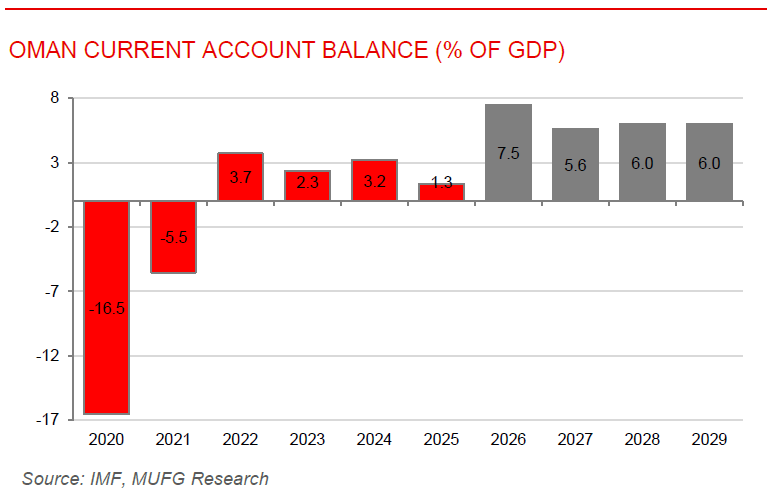
World Bank highlights Oman’s fiscal strength and economic resilience. Oman received a positive economic outlook from the World Bank Group during a meeting hosted by the Ministry of Finance. The report highlighted Oman’s improving fiscal and economic performance in 2025, with GDP growth reaching 3.1%, supported by government reforms aimed at strengthening fiscal sustainability, improving spending efficiency, and advancing economic diversification. Oman also maintained a manageable fiscal deficit of 1.2% of GDP, achieved a current account surplus driven by stronger non-oil and services exports, and kept inflation low at 0.8%. Looking ahead, the World Bank expects the Omani economy to continue growing by ~2.4% in 2026, supported by higher oil prices, continued non-oil sector expansion, and stable public debt levels projected at 35% of GDP. Officials emphasised that Oman Vision 2040 and ongoing fiscal reforms are strengthening the country’s resilience to regional and global challenges while improving competitiveness and long-term economic stability.