
To read the full report, please download the PDF above.
Middle East Daily
EDWARD BELL
Head of Research
DIFC Branch – Dubai
T: +971 (4)387 5033
E: soojin.kim@ae.mufg.jp
SOOJIN KIM
Research Analyst
DIFC Branch – Dubai
T: +971 (4)387 5031
E: soojin.kim@ae.mufg.jp
MUFG Bank, Ltd. and MUFG Securities plc
A member of MUFG, a global financial group
Middle East Daily
COMMODITIES / ENERGY
Oil rises as Hormuz attacks offset recovering Gulf flows. Oil prices are rising after a choppy session overnight when early losses were unwound over the course of the day. Brent for December delivery is trading close to USD 101.60/b, up around 1%, while WTI has pushed back above USD 90/b, up around 0.8%. Front-month spreads in the Brent market are holding around USD 3/b, up from a one-week low overnight of USD 2.38/b. Markets are tracking the ongoing fighting in Yemen and whether government forces backed by Saudi Arabia have been able to secure control over the Bab al Mandeb waterway while US vice president JD Vance said the US would only end its war with Iran if it gave up its nuclear enrichment programme. In the US, the API reported a draw in commercial crude inventories of 2.1m bbl last week with official EIA date out later today. European natural gas futures are also pushing higher, up 1.2% to EUR 76.60/MWh extending overnight gains. European gas storage is at 73% of capacity as of 5 October, well below seasonal norms for this part of the year.
Gold edges lower as higher oil revives inflation concerns. Gold prices continue to drift with little conviction in either gains or losses. Spot gold is trading around USD 4,140/troy oz, down slightly on the day as the gain in energy prices is pushing Treasury yields higher. Minutes of the September FOMC will be released tonight and will be the next major catalyst for gold ahead of inflation expectations out later this week. The September minutes will give some colour on how the Fed is interpreting the inflation outlook for the US economy with market pricing in slightly more than one hike by the end of the year.
MIDDLE EAST - CREDIT TRADING
End of day comment – 06 October 2026. What a difference a day makes. GCC bonds were on the front foot from the start, initially on a mix of short covering and ETF buying. Cash was higher throughout the day, and spreads gyrated with the UST moves. Flows became more two ways in the afternoon though and although buyers still outstripped sellers on the day, volumes remain subdued overall. Sovgn bonds outperformed, ADGB closed 3/5bp tighter with cash up to 0.75pt higher. QATAR was also 3/5bp tighter away from the new issues, 36s got squeezed today and closed +0.75pt/-7bp and now straddles it reoffer spread of 10y+65bp. In higher betas MOROC EUR curve was an outperformer with buyers mainly in 34s closing +0.875pt/-12bp. Away from that quasis/fins and corps had a quieter day in terms of activity and underperformed sovgn issues closing generically +0.25/0.5pt (-2/4bp).(Source: Dominik Roth, Credit Trader)
MIDDLE EAST - MACRO / MARKETS
GCC economies set for strong 2027 rebound as energy flows normalise. The World Bank expects GCC economies to rebound by an average 8.6% in 2027, following sharp contractions this year, assuming regional tensions stabilise and oil production and shipping through the Strait of Hormuz normalise. Qatar is projected to lead the recovery with 25% growth as LNG production capacity returns, followed by Kuwait at 20.5%, the UAE at 8% and Saudi Arabia at 6.1%. The rebound would mark a sharp reversal from the contractions expected across these economies in 2026 as the conflict disrupted hydrocarbon production and exports. Meanwhile, regional oil importers have been comparatively insulated from the direct energy-export shock, with Egypt’s growth forecast to accelerate to 5.1% from 4.4%, while Morocco is also expected to maintain stronger momentum. Saudi Arabia could enter the recovery with a broader non-oil economic base following years of Vision 2030 investment. The scale and distribution of the 2027 rebound will depend heavily on the normalisation of Hormuz shipping, restoration of Qatar’s LNG capacity and the durability of non-oil growth across the region.
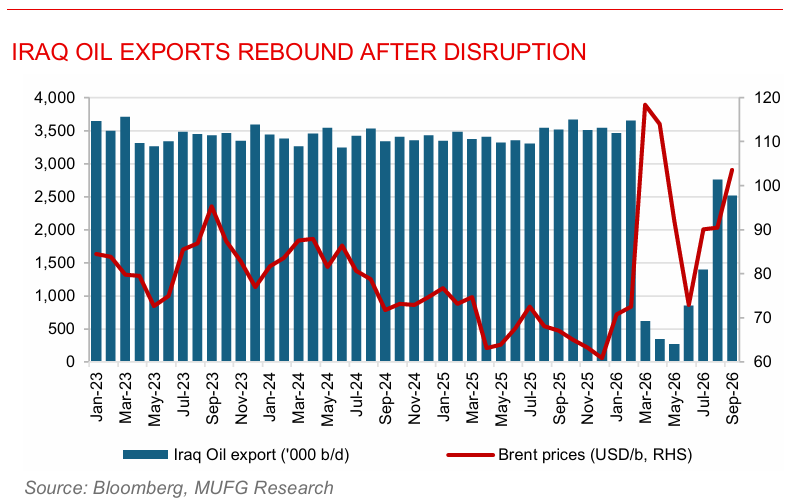
Iraq approves USD 2.7bn financing package to support economy. Iraq’s cabinet approved a USD 2.7bn financing package aimed at stimulating economic activity and cushioning the fiscal impact of disruptions to oil exports. The measure adds to Iraq’s recent efforts to diversify funding sources and sustain domestic investment, including pipeline and investment agreements reached earlier this year. Iraq remains particularly exposed to regional shipping disruptions, with around 93% of its crude exports normally transported through Gulf routes, leaving government revenues vulnerable to instability around the Strait of Hormuz. The initiative also reflects a broader MENAT trend of governments using fiscal support and additional financing to mitigate the economic fallout from the conflict, alongside increased borrowing in Saudi Arabia and Qatar and counter-cyclical investment in the UAE. The package’s effectiveness will depend on the pace of disbursement, the sectors targeted and its ability to support non-oil growth while hydrocarbon revenues remain under pressure.