
To read the full report, please download the PDF above.
Middle East Daily
EDWARD BELL
Head of Research
DIFC Branch – Dubai
T: +971 (4)387 5033
E: soojin.kim@ae.mufg.jp
SOOJIN KIM
Research Analyst
DIFC Branch – Dubai
T: +971 (4)387 5031
E: soojin.kim@ae.mufg.jp
MUFG Bank, Ltd. and MUFG Securities plc
A member of MUFG, a global financial group
Middle East Daily
COMMODITIES / ENERGY
Oil holds near USD 101/b as Gulf supply recovery weighs on prices. Oil prices are stabilizing with Brent December futures around USD 101/b after a soft start to the week as the market responded to a price cut in Saudi official selling prices and military advances by Yemeni forces to take control of the Bab el Mandeb chokepoint. WTI November futures are also holding a little stronger in early trading today at just under USD 90/b. Kuwait Petroleum Corp said that production in the country was about 75% of pre-conflict levels according to a statement from the company’s CEO as shipping through the Strait of Hormuz has recovered. Even as flows from the Middle East had recovered by the end of September, time and physical spreads remain wide and point to the premium for near-term accessibility for barrels.
Gold holds near USD 4,139/oz as dollar and yields weigh. Gold prices eased overnight to USD 4,139/troy oz and are extending a move lower in early trade today as markets keep their focus on a rising US dollar. Widespread selloffs in government bond markets are helping to keep the US dollar bid, weighing against demand for gold. The ISM services report for September showed that prices paid hit their highest level since 2022, keeping the risk of inflation and a possible rate hike in October live; market probability of a 25bps hike at the October 28 FOMC has risen to nearly 24%, moderately higher than levels over the last few days.
MIDDLE EAST - CREDIT TRADING
End of day comment – 05 October 2026. At the end a stronger day in terms of spreads, but with a wobbly start. The weakness in UST and the steepening seem relentless which still motivates plenty of sellers. But equally and more importantly yields/ spreads seem to attract new buyers as well. We noticed a small turn in flows today around midday which gave the market finally a more tow way flavour. Pockets of strengths were: QATAR new issues, especially 36s which has buyers just above 6% yield closing -0.25pt/-5bp. Some low cash price duration bonds also started to steepen, DUGB 50s closed -0.375pt/-4bp. And then some recent beaten down bonds found buyers, like the MOROC EUR curve which widened just over 45bp in sept, today saw buying mainly in 34s closing +0.25pt/-6bp. On the other hand, more illiquid risk is for sale, like fins AT1 and T2 or SHARSK, SHARSK 31s closed -0.5pt/+5bp, in general the spread between sukuks and conventional bonds is converging. Overall, the focus though remains on rates markets which still look unsettled no matter what.(Source: Dominik Roth, Credit Trader)
MIDDLE EAST - MACRO / MARKETS
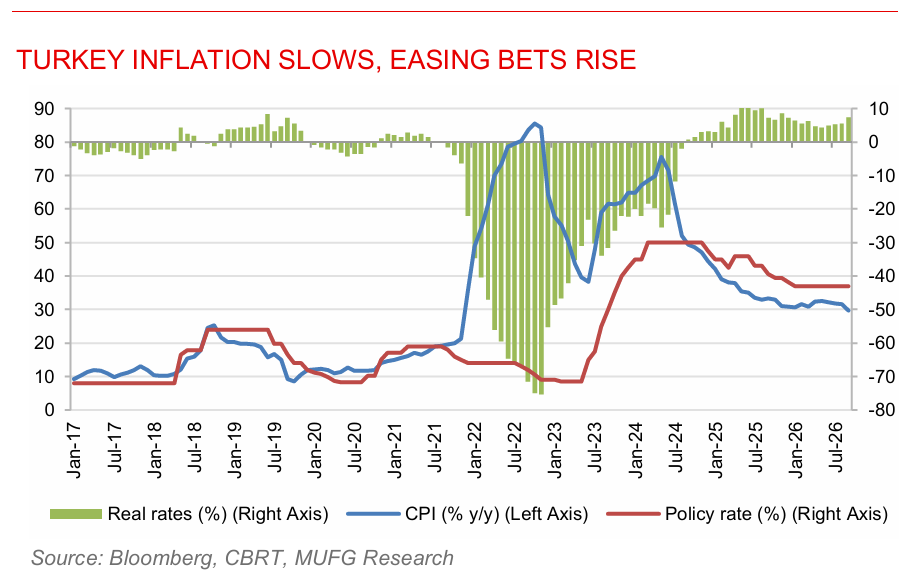
Turkey Inflation Falls below 30%, strengthening the Case for Further Easing. Inflation in Turkey slowed sharply in September to 29.7% y/y, down from 31.5% a month earlier. On a monthly basis, the pace of inflation was steady at 1.8% m/m. The September print was the slowest pace of annual inflation in Turkey since November 2021 and was helped to slow down by leasing food price inflation along with a smaller contribution from housing costs. Transport prices remain elevated at 35.1% y/y. There was a seasonal spike in education prices thanks to the start of new school year fees feeding into the basket. The moderation in September inflation means that real policy rates have widened to 7.3% after the Central Bank of Turkey (CBRT) kept policy rates unchanged last month and opens room for the central bank to resume cutting when it meets later this month: the next MPC will be held 22 October 2026. Year-ahead swap rates are pricing in about 120bps of easing, up from less than 100bps at the end of last week and a recent low of just 33bps of easing priced in mid-September.
Kuwait oil output recovers as Hormuz traffic improves. Kuwait’s oil production has recovered to around 2m b/d, or 75% of its pre-war level of 2.6m b/d, as more tankers navigate the Strait of Hormuz despite persistent security risks. Output had fallen below 1m b/d during the early months of the conflict as shipping through the strait collapsed, but Kuwait Petroleum Corp (KPC) said it is now meeting crude supply commitments as more customers send vessels to collect cargoes. Kuwait is also expanding its 29-vessel tanker fleet and exploring alternative pipeline routes through Saudi Arabia and the UAE, although KPC stressed that such infrastructure cannot fully replace Hormuz. Meanwhile, OPEC+ agreed to keep November production unchanged after six consecutive monthly increases, with OPEC output still more than 4m b/d below pre-war levels. Improving Hormuz traffic should support Kuwait’s production recovery, but shipping risks and persistent fuel shortages continue to constrain the broader normalisation of Gulf energy supply.