
To read the full report, please download the PDF above.
Middle East Daily
EDWARD BELL
Head of Research
DIFC Branch – Dubai
T: +971 (4)387 5033
E: edward.bell@ae.mufg.jp
SOOJIN KIM
Research Analyst
DIFC Branch – Dubai
T: +971 (4)387 5031
E: soojin.kim@ae.mufg.jp
MUFG Bank, Ltd. and MUFG Securities plc
A member of MUFG, a global financial group
Middle East Daily
COMMODITIES / ENERGY
Oil rebounds as markets reassess Middle East geopolitical risks. Oil prices are holding on to overnight gains after several days of selling pressure. Brent is trading back close to a USD 100/b handle while WTI has moved closer to USD 92/b after falling to nearly USD 86/b in the days following the US midterms. Markets are likely taking a pause to reassess geopolitical positions with press reports suggesting that diplomacy is still gaining ground between the US and Iran. Aramco cut its OSP for Asian buyers to USD 7/b below benchmarks, its lowest level since the peak of the Covid-19 pandemic as the company seeks to recapture market share and regional export volumes have increased. Geopolitical threats remain at the fore, however, with Iranian officials claiming that five thankers were damaged transiting the Strait of Hormuz overnight while the UKMTO reported attacks on shipping further up the Gulf. European natural gas is closely tracking moves in oil futures with TTF futures up nearly 5% in early trade today at EUR 94.82/MWh.
Gold consolidates recent gains ahead of US payrolls. Gold prices are consolidating recent gains, trading around USD 4,050/troy oz after two days of gains post the US midterm elections. The next major catalyst for gold will be the release of the nonfarm payrolls report for October, due out later today. MUFG expects that 90k jobs will have been added last month with the unemployment rate to hold steady at 4.2%. A broader equity sell-off, concentrated in tech stocks, is a risk for gold prices though if investors cover losses by selling down gold positions.
MIDDLE EAST - CREDIT TRADING
End of day comment – 05 November 2026. Cash in GCC bonds adjusted to the right in the morning with UST rallying post London close. Spreads started to tighten once UST retraced a bit and we were about -5bp in the tights/highs for the main sovgn curves. Flows became a bit more two ways through early afternoon. Then came the NASDAQ sell off and all bets are off since. Most curves are about 5bp wider now although only the most liquid sovgn names are trading. Long end bonds outperformed on the day again as the bid in the morning was very strong, especially in ADGB were 54s closes +0.75pt/unch. Against this though the belly bonds are +3/5bp with some sellers into the close in QATAR 36s closing +0.375pt/+4bp. Liquidity away from sovgn bonds evaporated in the last 2 hours. The bid we have seen post midterm, especially in AT1, should reverse fast if macro risk remains weak. All said we just got a NYT headline on Iran reviewing a nuclear program proposal, but although the mood towards GCC has markedly improved post midterm, the question remains whether GCC bonds can withstand the macro weakness. (Source: Dominik Roth, Credit Trader)
MIDDLE EAST - MACRO / MARKETS
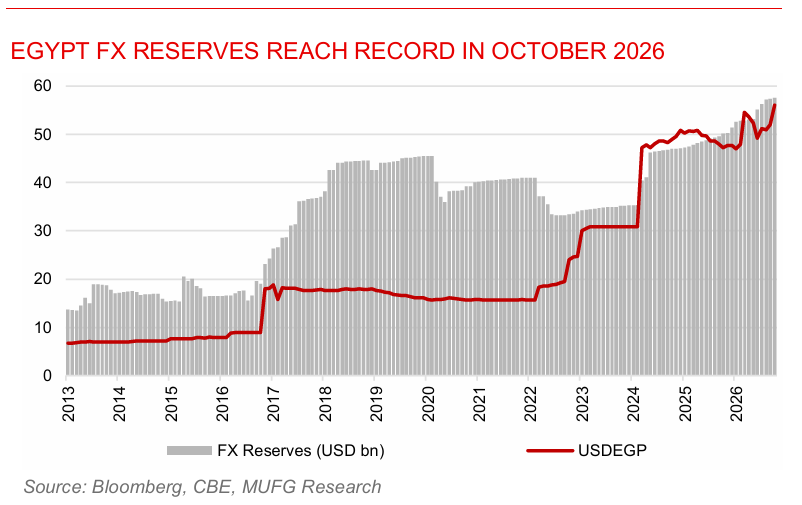
Egypt’s foreign reserves reach record despite slowing accumulation. Egypt’s net international reserves increased to a record USD 57.5bn in October from USD 57.35bn in September, according to the Central Bank of Egypt (CBE). Reserves have increased 11.8% (USD 6.1bn) since end-2025, although monthly accumulation has slowed considerably from USD 920mn in August to approximately USD 150mn in both September and October. The modest increase came amid renewed foreign portfolio outflows and currency depreciation, with the Egyptian pound reaching a record low near EGP56/USD on October 26, before recovering to approximately EGP54 following the CBE’s 100bp rate increase to 20% on October 29. External buffers remain supported by strong remittance inflows, which surged 29.6% to USD 47.3bn in FY2025/26, while the IMF estimated reserve coverage at 119% of its adequacy benchmark in June. Although record reserves strengthen Egypt’s external resilience, slowing accumulation and persistent portfolio volatility highlight the importance of sustained capital inflows, currency stability and progress under the IMF programme in maintaining external buffers.
Israel’s foreign reserves rise in October amid currency stability. Israel’s foreign-exchange reserves increased to a record USD 237.8bn in October 2026, equivalent to 34.3% of GDP, according to the Bank of Israel. Reserves were 2.5% (USD 5.8bn) above their year-earlier level, but below August’s USD 241.6bn peak. The USD 775mn monthly increase was mainly driven by USD 1.76bn in valuation gains, partly offset by USD 965mn in government FX activity, indicating that the rise largely reflected valuation effects rather than additional reserve accumulation. External buffers remain strong amid improving economic conditions, with GDP rebounding 15.4% q/q annualised in Q2, inflation easing to 1.6% in September and the Bank of Israel holding its policy rate at 3.25% in October. Israel’s substantial reserves continue to provide a strong buffer against currency volatility and external shocks.