
To read the full report, please download the PDF above.
Middle East Daily
SOOJIN KIM
Research Analyst
DIFC Branch – Dubai
T: +44(4)387 5031
E: soojin.kim@ae.mufg.jp
MUFG Bank, Ltd. and MUFG Securities plc
A member of MUFG, a global financial group
Middle East Daily
COMMODITIES / ENERGY
Oil extends decline as Trump signals progress on Iran deal. Oil prices fell for a second straight session, with Brent dropping toward USD108/b and WTI near USD100/b, after President Trump said “great progress” had been made toward a final agreement to end the Iran war. While the US plans to pause efforts to escort ships through the Strait of Hormuz, the naval blockade on Iranian ports will remain in place, keeping supply disruptions elevated. The US also signalled a reduced likelihood of renewed military escalation, with officials confirming that the ceasefire remains intact despite recent attacks in the Gulf region. Oil markets remain highly volatile after prices surged roughly 50% since the conflict began, driven by severe disruption bottlenecks that have stranded thousands of sailors and vessels. Meanwhile, tighter US crude inventories and ongoing Middle East supply risks continue to support prices despite improving sentiment around diplomacy.
Gold rises as Iran deal optimism weakens dollar. Gold prices extended gains, rising toward USD4,630/oz, as optimism over progress in US-Iran negotiations weakened the dollar and supported demand for gold. President Trump said “great progress” had been made toward a final agreement with Iran and announced a pause in US efforts to help stranded ships leave the Strait of Hormuz while talks continue. US officials also signalled that active military operations have largely ended, although tensions remain elevated after reports of further attacks on vessels in the region. Despite the rebound, gold remains under pressure from persistent inflation concerns caused by the energy supply shock, which have increased expectations that the Fes could raise interest rates rather than cut them. Investors are now closely watching upcoming US labour market data for further clues on the interest-rate outlook.
MIDDLE EAST - CREDIT TRADING
End of day comment – 05 May 2026. A mixed day with a touch wider spread. London had to catch up with Mondays move, especially the UST/oil move on the flare up of military engagement. Whilst this didn't help market sentiment, it never felt panicky and flows were balanced, we saw local buying, ETFs leaning to buying and only in the afternoon some RM index name outflows. UST recovered somewhat from the lows as the ceasefire was by and large holding today. That pushed spreads a touch wider into the close, but largely sovereign bonds were anywhere from unch to -0.125pt and +1/2bp. Quasis were a bit softer than sovereign as the afternoon outflow of UAE index names like ADNOCM, ADQABU or ADNOUH pressured prices up to -0.375 with spreads +2/4bp on the day. It was very quiet in fins and corps, seen buyers though in DPWDU front end bonds where yields >5% seem to bring some local yield buyers out. Primary markets remain quiet, and whilst the situation around the conflict remains fluid, secondary market levels are in new issue territory.
MIDDLE EAST - MACRO / MARKETS
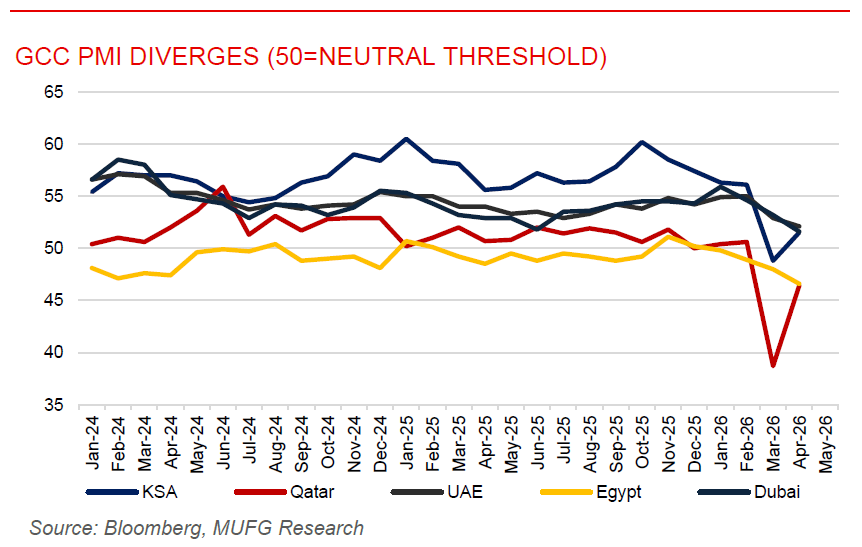
GCC PMIs diverge as Saudi Arabia returns to expansion while Qatar rebounds sharply. The latest S&P PMI readings revealed a mixed picture across MENAT economies. Saudi Arabia’s headline PMI climbed back into expansionary territory, rising to 51.5 from 48.8, signalling a recovery in non-oil business conditions after a brief contraction. Qatar staged the most pronounced rebound, with its PMI jumping to 46.4 from 38.7, though activity remained firmly below the 50 neutral thresholds. The UAE held onto growth momentum, easing only marginally to 52.1 from 52.9, while Dubai’s gauge softened to 51.6 from 53.2, pointing to a moderation in the pace of non-oil expansion. Egypt remained the regional laggard, with its PMI slipping further to 46.6 from 48.0, underscoring continued strain on private sector activity amid persistent cost pressures and subdued demand.
Saudi Arabia’s fiscal deficit widens amid high spending and war pressures. Saudi Arabia recorded a first-quarter fiscal deficit of SAR125.7bn (USD33.5bn), the largest shortfall since 2018, as government spending on economic diversification projects continued to rise despite weaker oil revenues. Revenues totalled SAR261bn against expenditures of SAR386.7bn, while oil revenues fell 3% y/y to SAR144.7bn and non-oil revenues rose 2% to SAR116bn. Public debt increased to SAR1.67 trillion from SAR1.52 trillion at the start of the year, with the government projecting a full-year 2026 deficit of SAR165.4bn. The figures highlight growing fiscal pressures linked to the ongoing Iran war and regional disruptions, including the partial closure of the Strait of Hormuz, although the kingdom has managed to redirect most oil exports through the Red Sea port of Yanbu. Despite slower GDP growth and elevated spending, higher global oil prices could help narrow the deficit later in the year if export levels remain stable. Saudi Arabia has increasingly relied on borrowing to fund spending needs, completing around 90% of its 2026 financing plan, while plans by JPMorgan to include Saudi local-currency bonds in a major emerging-market index from 2027 are expected to support foreign investment inflows and improve debt market liquidity.