
To read the full report, please download the PDF above.
Middle East Daily
EDWARD BELL
Head of Research
DIFC Branch – Dubai
T: +971 (4)387 5033
E: soojin.kim@ae.mufg.jp
SOOJIN KIM
Research Analyst
DIFC Branch – Dubai
T: +971 (4)387 5031
E: soojin.kim@ae.mufg.jp
MUFG Bank, Ltd. and MUFG Securities plc
A member of MUFG, a global financial group
Middle East Daily
COMMODITIES / ENERGY
Oil falls as Saudi price cut signals improving supply. Oil prices have started the week on a softer footing after Saudi Aramco announced deep cuts for official selling prices (OSP) to Asian buyers, pushing December Brent futures down 0.7% to USD 101.56/b. WTI is also tracking lower, holding around USD 90/b. Aramco cut its OSP to Asia to USD 5/b below regional benchmarks as it strives to recapture market share lost as the regional conflict has impacted oil exports. The market is also still weighing the impact of another release of strategic petroleum reserves from G7 economies announced at the end of last week with 100m bbl due to be released over the next four months. How much of this announcement represents new commitments to draw down on stockpiles versus delivering on pledges from earlier this year was not clear. At the same time, the threat to regional shipping persists with several vessels coming under attack around the coasts of Oman and Yemen.
Gold rebounds as weak US jobs data eases rate-hike bets. Gold prices have extended a drift lower even as a softer-than-expected September NFP from the US cut expectations of a Fed rate hike this month even further. Spot gold has opened the week at USD 4,133/troy oz, down about 0.2% after a loss of 3.4% last week. Markets are now pricing in less than a 20% probability of another hike from the Fed this month even as inflationary pressures are embedding in many economies. The gold market has been seemingly solely focused on the outlook for rates and has ignored geopolitical conditions in recent weeks with spot prices dropping 6% in September month/month.
MIDDLE EAST - CREDIT TRADING
End of day comment – 02 October 2026. The market stabilised today. We tightened about 5bp back on a mix of buying flows in the morning and weaker UST into the close. But it was a typical low volume Friday, so it’s hard to read too much into it. There was buying/ short covering in ADGB today, mainly in the long end where 54s closed +0.875pt/-5bp. The same to a lesser extend was seen in QATAR, 48s was most active closing +0.5pt/-2bp. The quasi sovgn space was still more dominated by sellers though, ADNOUH 47 was an active bond closing +0.25pt/unch. With spread over last week broadly speaking +15/20bp and the rates volatility overnight and post NFP volatility won't go away anytime soon. It still feels we are in a risk reduction environment. (Source: Dominik Roth, Credit Trader)
MIDDLE EAST - MACRO / MARKETS
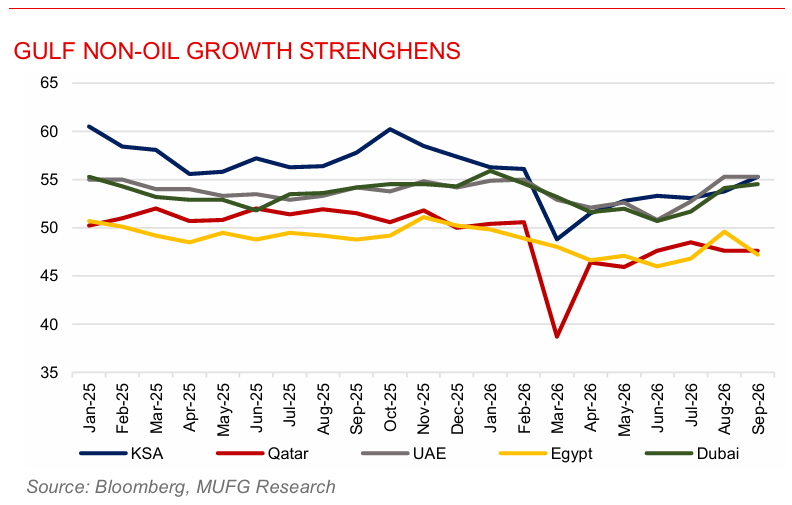
Gulf non-oil growth strengthens while Egypt’s downturn deepens. Gulf non-oil activity strengthened in September, with Saudi Arabia’s Riyad Bank PMI rising to a seven-month high of 55.3 from 53.8 in August. New orders reached their strongest level since February, pointing to firmer demand, although output growth moderated to 55.7 from 60.1. The UAE PMI held at 55.3, supported by accelerating output, which climbed to 61.1, its highest since February, and continued employment growth. Dubai also strengthened, with its PMI rising to 54.5 from 54.1 and output reaching 61, the strongest since December 2025. Egypt diverged sharply, with its PMI falling to 47.2 from 49.6, extending the non-oil private-sector downturn to a ninth consecutive month. Output dropped to 45.1 and new orders weakened further, reversing signs of stabilisation over the summer. The September data highlight a widening regional divergence, with stronger demand, business activity and hiring supporting Saudi and UAE growth, while persistent demand weakness continues to constrain Egypt despite easing inflation and stable interest rates.
Gulf crude exports recover unevenly as Hormuz flows resume. Gulf crude exports showed a broad but uneven recovery in September as producers adapted to persistent shipping risks and more tankers navigated the Strait of Hormuz. Saudi observed exports surged to 6.13mb/d from 3.41mb/d in August, approaching the 2025 average, as nearly 4mb/d was redirected through Hormuz after the East-West pipeline was halted for much of the month. UAE shipments climbed to 3.5mb/d from 2.8mb/d, supported by record Fujairah exports of 2.3mb/d, which accounted for 65% of observed flows and bypass Hormuz. Oman exports reached 1mb/d, an 18-month high, amid stronger shipments to Asian buyers. Elsewhere, Kuwait maintained exports above 1mb/d but remained well below normal levels, while Iraq slipped to 2.51mb/d and Qatar fell sharply to 367kb/d. Iraq partly offset weaker Basrah shipments through higher flows via Türkiye’s Ceyhan port. Overall, the data suggest Middle East crude availability is recovering, led by Saudi Arabia and the UAE, although continued tanker attacks, widespread AIS-dark shipping and infrastructure disruptions leave export flows vulnerable and the observed figures subject to significant revisions.