
To read the full report, please download the PDF above.
Middle East Daily
EDWARD BELL
Head of Research
DIFC Branch – Dubai
T: +971 (4)387 5033
E: edward.bell@ae.mufg.jp
SOOJIN KIM
Research Analyst
DIFC Branch – Dubai
T: +971 (4)387 5031
E: soojin.kim@ae.mufg.jp
MUFG Bank, Ltd. and MUFG Securities plc
A member of MUFG, a global financial group
Middle East Daily
COMMODITIES / ENERGY
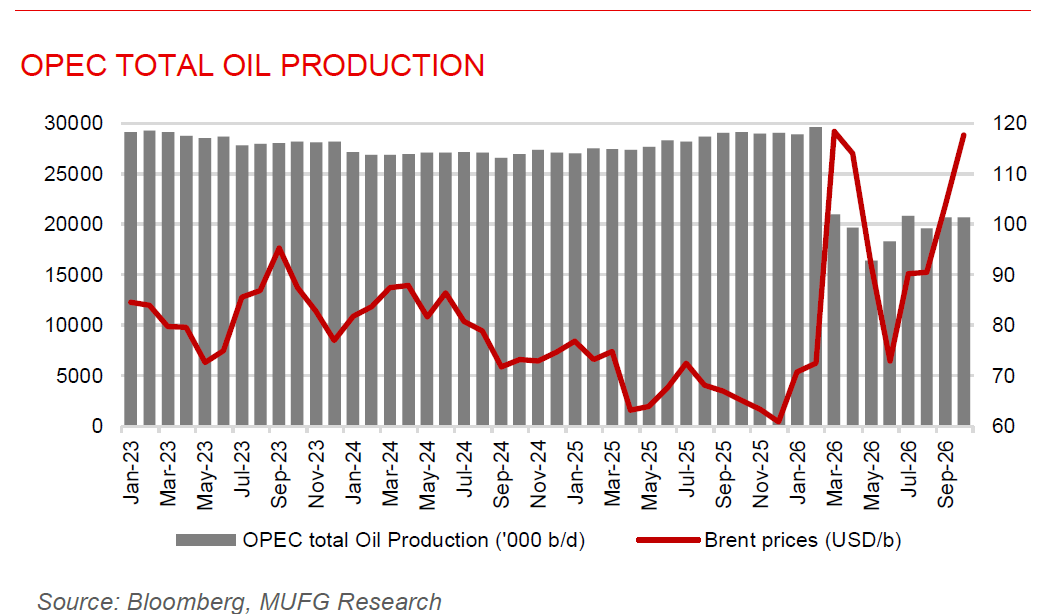
Oil plunges as diplomatic optimism erodes Middle East risk premium. Oil prices extended their plunge as markets look with more optimism on a diplomatic outcome to the conflict in the Middle East. Brent futures have fallen to USD 94/b, their lowest level since the end of August, while WTI has dropped to USD 87/b. Time spreads have also dropped substantially with the prompt Brent spread at less than USD 2.50/b, having been more than USD 5/b in mid-October. US President Trump said to the press on the eve of the midterm elections that he had no plans to attack Iran while Democratic control over Congress will impose some eventual restraint on foreign policy. Geopolitical threats continue, however, with reports that the Houthis have again struck the Riyadh airport and several ships damaged in the Strait of Hormuz overnight. The UAE is reportedly considering building a new oil export pipeline to link production sites in Abu Dhabi to the export terminal at Fujairah, adding another way to bypass the Strait of Hormuz. The UAE’s existing pipeline to Fujairah has allowed it to remain a stable supplier of oil to global markets and a second pipeline is already under construction. In the US, commercial crude stocks dropped by 865k bbl last week along with a 400k bbl decline in SPR stockpiles. Draws were also reported across the rest of the barrel. Oil exports from the US dropped by 1.2m b/d last week to 3.7m b/d while production was marginally higher at 14m b/d.
Gold extends post-election rally as energy prices and yields fall. Gold prices have extended their post-election rally, adding 2% in trade today to push back above USD 4,140/troy oz. A major drop in energy prices and a broader risk rally is helping to provide near-term support for gold prices while the expectation that inflation will not deteriorate further following the moves lower in oil prices have helped to push USTs higher and cut the yield attractiveness.
MIDDLE EAST - MACRO / MARKETS
Oman’s trade surplus widens sharply as oil and non-oil exports strengthen. Oman’s merchandise trade surplus widened to OMR 6.5bn (USD 16.9bn) in January–August 2026 from OMR 3.9bn (USD 10.1bn) a year earlier, supported by stronger hydrocarbon and non-oil exports, according to preliminary data from the National Centre for Statistics and Information (NCSI). Total exports increased 19.7% y/y to OMR 18.3bn, significantly outpacing a 4.4% rise in imports to OMR 11.9bn. Oil and gas exports surged 23.9% y/y to OMR 12.1bn, remaining the primary driver of trade growth, while non-oil exports rose 10.5% to OMR 4.9bn, reflecting improving diversification momentum. Re-exports also increased 19.7% to OMR 1.3bn. The UAE remained Oman’s largest non-oil export destination, with shipments nearly doubling to OMR 1.6bn, while also serving as its largest import supplier at OMR 3.3bn. Meanwhile, Iran led re-export destinations, followed by the UAE and Saudi Arabia. The widening trade surplus highlights Oman’s strengthening external position and growing non-oil trade activity, although continued reliance on hydrocarbon revenues leaves the trade balance vulnerable to fluctuations in global energy prices and regional demand.
Gulf oil exports recover in October despite persistent Hormuz disruptions. Crude oil exports across the Gulf continued to recover in October despite ongoing regional conflict and shipping disruptions around the Strait of Hormuz. Saudi Arabia’s crude exports rose to approximately 7.0m b/d from 6.2m b/d in September, exceeding pre-war levels, supported by stronger shipments through the Red Sea port of Yanbu, which increased to 3.1m b/d. Meanwhile, Iraq’s exports climbed to 3.4m b/d from 3.1m b/d, approaching pre-war levels as shipments from Basrah and northern export routes strengthened. Kuwait’s crude exports surged nearly 31% m/m to 1.4m b/d, reaching their highest level since January, although remaining below historical averages. The UAE’s crude and condensate shipments edged up to 3.7m b/d from 3.7m b/d, as increased Gulf exports offset weaker flows through Fujairah. In contrast, Iran recorded no observed seaborne crude or condensate exports for a second consecutive month, amid the US naval blockade. The recovery highlights improving Gulf export resilience despite persistent security threats, although renewed attacks and limited tanker visibility continue to create significant uncertainty around regional oil flows.
IMF highlights Algeria’s diversification progress amid fiscal and investment challenges. The IMF highlighted Algeria’s gradual progress in diversifying beyond hydrocarbons, supported by infrastructure investment, regulatory reforms and efforts to expand non-oil production and exports. Investment, land and mining reforms have improved the business environment, while major projects aim to strengthen productive capacity. However, oil and gas still dominate exports and public finances, leaving the economy vulnerable to energy price swings. The IMF cautioned that high public investment has increased import demand and fiscal and external pressures, highlighting the need for better project prioritisation and spending efficiency. It also stressed stronger private-sector competitiveness, improved access to finance and skills, and fair competition with state-owned enterprises. Fiscal consolidation, stronger nonhydrocarbon revenues and rebuilding financial buffers remain key priorities for sustaining diversification and reducing reliance on hydrocarbons.