
To read the full report, please download the PDF above.
Middle East Daily
SOOJIN KIM
Research Analyst
DIFC Branch – Dubai
T: +44(4)387 5031
E: soojin.kim@ae.mufg.jp
MUFG Bank, Ltd. and MUFG Securities plc
A member of MUFG, a global financial group
Middle East Daily
COMMODITIES / ENERGY
Oil eases amid renewed clashed and fragile ceasefire. Oil prices edged lower after a sharp rally, with Brent slipping toward USD113/b and WTI near USD104/b, as markets reacted to renewed US-Iran clashes that cast doubt on the fragile ceasefire. Fighting intensified around the Strait of Hormuz, where US forces escorted vessels through the chokepoint while repelling Iranian attacks, and a strike hit facilities near Fujairah. President Trump warned the conflict could continue for several more weeks, underscoring ongoing geopolitical uncertainty. Despite signs of limited diplomatic progress, the dual blockade and near-total disruption of shipping have driven oil prices sharply higher this year, tightening global supply and fuelling inflation concerns. Rising energy costs are already impacting global markets, pushing bond yields higher and contributing to inflation pressures in oil-importing economies, highlighting the broader economic risks from prolonged instability in the region.
Gold edges up as dip buying emerges amid rising tensions. Gold prices ticked higher, rising by 0.6% toward USD4,550/oz, as investors stepped in to buy after a recent selloff triggered by renewed Middle East tensions. Escalation clashes between the US and Iran around the Strait of Hormuz, including attacks on vessels and strikes near Fujairah, have shaken a fragile ceasefire and reignited inflation concerns. The surge in oil prices and rising US Treasury yields, driven by expectations that the Fed may need to raise interest rates, continue to weigh on non-yielding gold. Despite this headwind, short-term buying interest has helped support gold, while investors remain focused on upcoming US economic data and Treasury borrowing plans for further direction on monetary policy.
MIDDLE EAST - MACRO / MARKETS
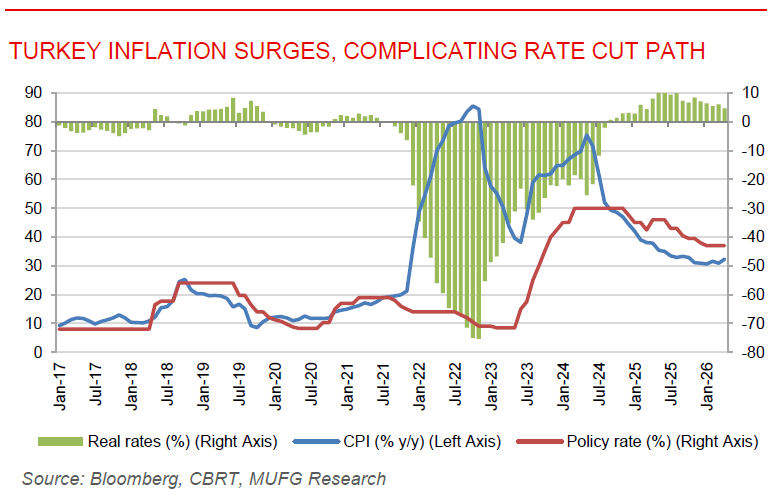
Turkey inflation surges, slowing rate cut outlook. Turkey’s inflation accelerated sharply to 32.4% y/y in April from 30.9% y/y in March, exceeding expectations and signalling a more challenging disinflation path amid rising geopolitical pressures. The increase was driven by broad-based price gains, particularly in food, housing, utilities, and transport, with higher energy costs, linked to the Iran war, playing a key role. Monthly inflation also jumped to 4.2%, reflecting strong pass-through from rising electricity and natural gas prices, alongside persistent food inflation risks. While inflation is still expected to ease gradually to ~29% by year-end, this remains well above the Central Bank of the Republic of Turkey’s target range, highlighting ongoing upside risks. As a result, the central bank is expected to proceed more cautiously with monetary easing, with the policy rate now projected to decline to about 33% by December compared to earlier expectations of deeper cuts. Continued volatility in energy prices, potential disruptions to fertilizer supply, and broader geopolitical uncertainty could further delay easing or even force tighter policy if inflation pressures intensify, underscoring a more constrained and uncertain policy outlook.
ADNOC commits USD55bn to accelerate growth and boost local industry. ADNOC has unveiled plans to invest USD55bn (AED200bn) in new projects between 2026 and 2028, marking a major step-up in execution as it advances its long-term growth and energy strategy. The investment, part of its broader five-year CAPEX program, will span upstream and downstream operations and is aimed at meeting rising global energy demand while strengthening the UAE’s industrial and manufacturing base. Announced at the “Make it with ADNOC” Forum, the initiative highlights a strong focus on local value creation through the In-Country Value (ICV) program and the “Local+” platform, which prioritises UAE-based manufacturers and integrates them into ADNOC’s supply chain. The strategy brings together international EPC contractors and over 70 pre-qualified local manufacturers to enhance project delivery, boost accountability, and drive industrial capacity. The initiatives are also expected to unlock significant opportunities for SMEs, deepen supply chain resilience, and support the broader “make it in the Emirates” agenda, reinforcing the UAE’s position as a globally competitive hub for energy, industry, and manufacturing.
Gulf ratings remain resilience amid conflict-driven pressures. Qatar and Abu Dhabi both maintain strong sovereign credit ratings despite facing short-term economic pressures from regional conflict and energy disruptions. S&P affirmed Qatar’s ‘AA’ rating with a stable outlook, noting that while reduced LNG output is expected to push the country into fiscal and external deficits in 2026, its vast financial buffers, equivalent to about 135% of GDP, and policy flexibility provide resilience, with growth projected to recover from 2027 alongside LNG expansion projects and diversification efforts. Similarly, Fitch upheld Abu Dhabi’s ‘AA’ rating, supported by its low debt and extensive sovereign wealth assets, even as it anticipates a mild economic contraction and narrower fiscal surplus in 2026 due to geopolitical risks and increased spending; nonetheless, higher oil prices, alternative export routes, and strong institutional capacity are expected to underpin stability and enable a rebound once regional tensions ease.