
To read the full report, please download the PDF above.
Middle East Daily
SOOJIN KIM
Research Analyst
DIFC Branch – Dubai
T: +44(4)387 5031
E: soojin.kim@ae.mufg.jp
MUFG Bank, Ltd. and MUFG Securities plc
A member of MUFG, a global financial group
Middle East Daily
COMMODITIES / ENERGY
Oil heads for strongest weekly gain since July on Hormuz risks. Oil headed for its strongest weekly gain since July, with Brent approaching USD 96/b and up more than 7% on the week, while WTI traded near USD 92/b, as renewed US-Iran hostilities revived concerns over prolonged disruption to energy flows through the Strait of Hormuz. Iranian forces continued targeting vessels in the waterway and launched missiles toward Jordan, Kuwait and Bahrain, while Israel signalled it could re-enter the conflict if attacked. Despite heightened security risks, some Gulf crude continues to flow through Hormuz, helping limit further price gains, while Saudi Arabia kept its flagship crude price unchanged for next month, suggesting some easing in physical-market tightness. Nevertheless, Brent has risen almost 60% this year, with diesel and LNG markets experiencing even greater pressure amid Middle East and Russia-Ukraine supply disruptions.
Gold holds near USD 4,480/oz as Fed rate hike expectations ease. Gold steadied around USD 4,480/oz after rising more than 2% yesterday, as expectations for further Fed tightening eased. Fed Governor Christopher Waller signalled he would support keeping rates unchanged if inflation continues to moderate, prompting markets to reduce the probability of a September rate hike to around 50%, from roughly 70% earlier in the week. Gold also benefited from a weaker dollar, which fell to its lowest level since May amid growing expectations of intervention in the Japanese yen market and potential BoJ tightening. The rebound follows a volatile week in which renewed Middle East tensions and higher energy prices fuelled inflation concerns and pushed gold sharply lower. Going forward, US payrolls and next week’s inflation data will be critical for the Fed outlook, with further evidence of disinflation likely to support gold.
MIDDLE EAST - CREDIT TRADING
End of day comment – 03 September 2026. The widening trend continues. Today more on rates move than cash weakness, however into the close sellers are getting busier. Dealers are also a bigger source of bids wanted requests today. There was a moment of strength post 1:30pm numbers and Wallers comment which generally lifted risk sentiment. But positioning remains heavy as the takeout was not big enough to clear technicals. The only bonds tighter are ADGB long end bonds which closed +0.5pt/-1bp. Other sovgn curves are about +1/2bp with cash up to 0.25pt higher. Quasis struggled more than sovgn issues. Selling into higher cash prices kept any move higher in check and with cash up to 0.125pt higher and the rates move spreads look generically +3/4bp. To be fair this is still part of the normalisation of market pricing post Jackson Hole tightening, especially in the front end/belly. It also reflects more new issues getting announced, especially in KSA names which leads to accounts raising cash/ selling GCC bonds in general. At least the risk sentiment has somewhat improved and flows are picking up. (Source: Domonik Roth, Credit Trader)
MIDDLE EAST - MACRO / MARKETS
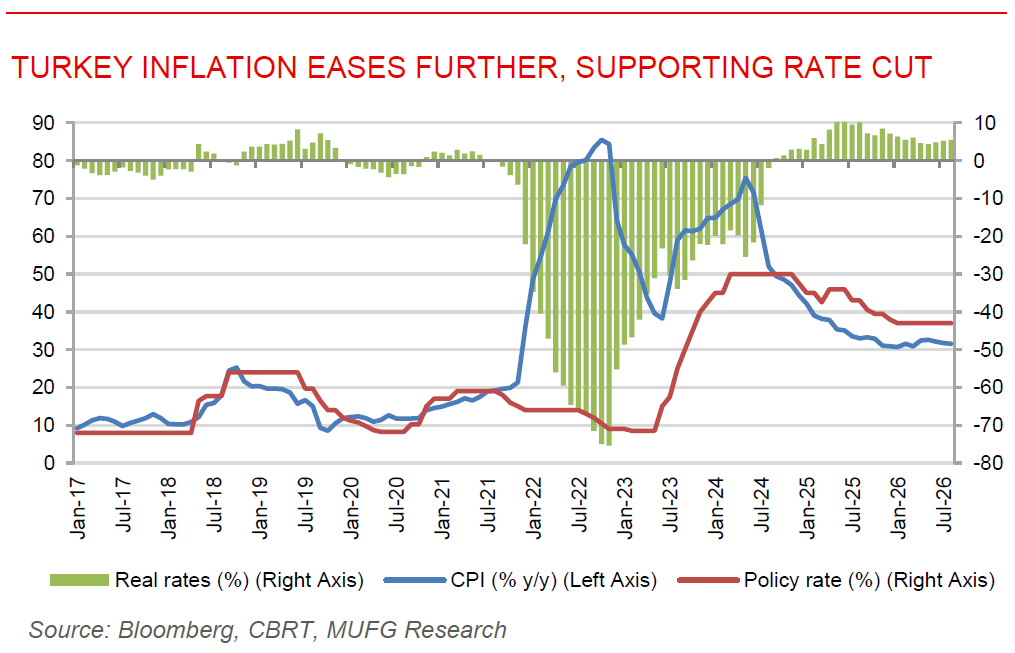
Turkey inflation eases further, strengthening September rate cut case. Turkey’s annual inflation slowed for a third consecutive month to 31.5% y/y in August from 31.8% in July, reinforcing the case for a rate cut at the central bank’s September meeting. Monthly inflation rose modestly to 1.84% from 1.78% but also undershot forecasts despite higher energy costs linked to the Iran conflict. Underlying inflation also continued to improve, with core goods inflation falling to its lowest level since November 2020. The CBRT has resumed funding banks at its 37% policy rate, reversing the effective tightening to 40% introduced after the outbreak of the Middle East conflict, while Governor Fatih Karahan has highlighted cooling domestic demand as helping to offset external inflation pressures. With the central bank projecting year-end inflation of 28%, continued disinflation and weaker domestic demand should support further monetary easing, although elevated oil prices and conflict-related energy costs may constrain the pace of rate cuts.
Saudi crude exports slump to nine-year low as shipping risks intensify. Saudi Arabia’s observed crude exports fell to around 3mb/d in August, the lowest level as assessed by Kpler tracking data going back to early 2017, as attacks on tankers increasingly disrupted both Red Sea and Hormuz shipping routes. After Iran effectively shut Hormuz earlier in the conflict, Saudi Arabia shifted substantial volumes to the Red Sea, pushing exports through Yanbu to around 4.3mb/d in June. However, flows fell to 3.7mb/d in July and roughly 2.25mb/d in August following Houthi threats and attacks on Saudi-linked vessels. Renewed US-Iran hostilities have further complicated exports, with two Saudi crude tankers attacked in Hormuz this week and some customers reportedly becoming reluctant to load from Red Sea ports. Alternative voyages around Africa would significantly increase shipping distances and costs. With both Hormuz and Red Sea routes facing security risks, disruptions to Saudi export are helping to keep upward pressure on oil prices and freight costs.