
To read the full report, please download the PDF above.
Middle East Daily
SOOJIN KIM
Research Analyst
DIFC Branch – Dubai
T: +44(4)387 5031
E: soojin.kim@ae.mufg.jp
MUFG Bank, Ltd. and MUFG Securities plc
A member of MUFG, a global financial group
Middle East Daily
COMMODITIES / ENERGY
Oil holds near USD 95/b as Hormuz flows offset escalation risks. Oil steadies after a three-day rally, with Brent above USD 95/b and WTI near USD 91/b as signs of continued energy flows through the Strait of Hormuz offset concerns over renewed US-Iran fighting. Brent has surged more than 8% over the past three sessions, although President Trump suggested the latest US bombing campaign would be relative short-lived. Despite persistent security risks, the US military reportedly escorted 40 vessels carrying 18mb of oil through Hormuz on Tuesday. However, neither the US nor Iran has shown willingness to restart negotiations, and the US is extending regional troop deployment, leaving the risk of prolonged disruption elevated. Meanwhile US crude inventories fell 4.5mb last week, the first decline since late July. Looking ahead, sustained Hormuz export flows could limit further price gains, but renewed military escalation should keep a sizeable geopolitical risk premium embedded in crude prices.
Gold rebounds as shorter US-Iran campaign eases inflation fears. Gold rose above USD 4,430/oz as President Trump signalled that renewed US military action against Iran was unlikely to be prolonged. The comments halted oil’s latest rally, easing concerns that another sustained energy-price shock could intensify inflation and force the Fed to tighten policy more aggressively. Expectations for higher rates also moderated after New York Fed President John Williams said underlying inflation continued to ease, and higher energy costs had yet to spread broadly into services, while August private sector employment data pointed to softer hiring. Going forward, the duration of US-Iran hostilities and resulting oil price pressures will remain important for gold, with easing inflation supporting gold, while renewed energy-driven price pressures and Fed tightening expectations would constrain further gains.
MIDDLE EAST - CREDIT TRADING
End of day comment – 02 September 2026. The market trades with a widening bias. Flows were skewed to sellers with a ratio S:B 2:1 and activity picked up in GCC. That however was skewed towards new KSA sukuk deals. Nevertheless, ETFs and international RM remain net sellers away from new issues. That puts a break into every so little cash price recovery and with cash prices by and large -0.125/-0.375pt and rates fluctuating spreads are broadly 1/2bp wider. Liquidity is a challenge in some more illiquid bonds, but to be fair some of those still have to reprice to the new rate environment. We are also seeing more sellers coming out in EUR bonds as the European rates market continues to underperform UST. MOROC EUR for example going out +2/4bp but have tightened about 15bp over the past month and now are starting to see spread sellers. The repricing away from IG sovereign bonds should continue. (Source: Domonik Roth, Credit Trader)
MIDDLE EAST - MACRO / MARKETS
Saudi Arabia returns to global debt market as funding needs rise. Saudi Arabia returned to international debt markets with five- and ten-year US dollar-denominated sukuk, attracting strong investor demand, with orders exceeding USD 9bn and ultimately reaching more than USD 17bn. The issuance comes as the kingdom continues to raise funding to meet elevated financing needs and reportedly explores additional borrowing, including a potential USD 6-8bn syndicated loan, while Saudi Aramco is also considering further bank financing. Saudi Arabia's 2026 funding requirements are estimated at around SAR 217bn (USD 58bn), covering both the projected budget deficit and debt maturities. Borrowing needs are being driven in part by softer oil revenues and continued spending commitments. Given the kingdom's relatively low debt burden by international standards, Saudi Arabia retains significant capacity to access debt markets.
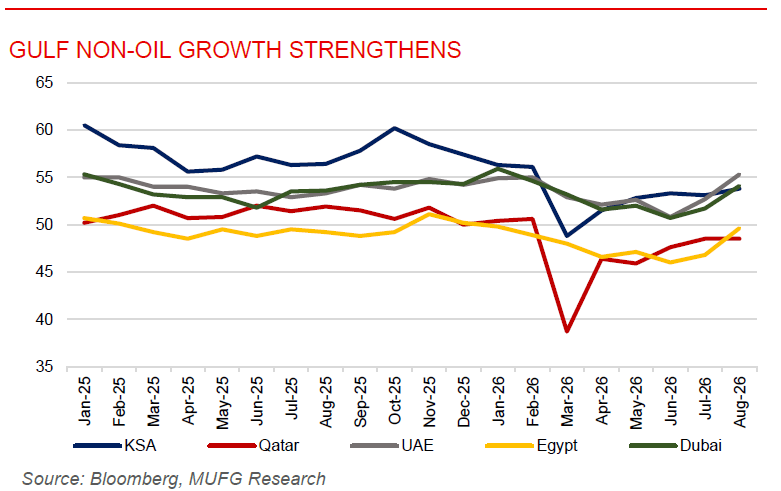
Gulf non-oil growth strengthens as regional conditions improve. Non-oil private-sector activity strengthened across the region in August, led by Saudi Arabia, where the PMI rose to 53.8 from 53.1, its highest level in six months, supported by faster output growth, stronger hiring and improved supply conditions, despite continued weakness in export orders. The UAE PMI rebounded sharply to 55.3 from 52.7, recovering from a recent slowdown as business activity and demand strengthened, while Dubai's PMI increased to 54.1 from 51.7, with new business growth reaching a five-month high and signalling renewed momentum in the emirate's non-oil economy. Meanwhile, Egypt's PMI rose to 49.6 from 46.8, its highest reading in seven months, indicating a marked easing in contractionary pressures and improving business conditions. Going forward, resilient domestic demand, ongoing investment activity and improving business confidence should continue to support non-oil growth in Saudi Arabia and the UAE, while easing inflationary pressures and a sustained recovery in domestic demand will be critical for Egypt's return to expansion in the coming months.