
To read the full report, please download the PDF above.
Middle East Daily
SOOJIN KIM
Research Analyst
DIFC Branch – Dubai
T: +44(4)387 5031
E: soojin.kim@ae.mufg.jp
MUFG Bank, Ltd. and MUFG Securities plc
A member of MUFG, a global financial group
Middle East Daily
COMMODITIES / ENERGY
Oil extends rally as Middle East tensions threaten supply outlook. Oil prices rose for a third consecutive session, with Brent approaching USD97/b and WTI near USD95/b, as growing doubts over a US-Iran peace agreement and renewed regional tensions heightened concerns about prolonged supply disruptions. Markets remain focused on the future of energy flows through the Strait of Hormuz, with delays in reaching a deal raising the likelihood that global inventories will need to be drawn down further before Gulf exports fully recover. Geopolitical risks also intensified as fighting between Israel and Lebanon continued, while Iran launched missiles toward neighbouring countries and US forces reportedly carried out strikes on Iranian targets. Although President Trump said he remains optimistic about securing an interim agreement with Iran, conflicting reports on the status of negotiations have added uncertainty to the market.
Gold slips as Middle East tensions sustain inflation and rate concerns. Gold edged lower, trading near USD4,460/oz, as renewed clashes in the Middle East increased uncertainty around US-Iran negotiations and prolonged concerns over inflation and disrupted energy supplies. Despite President Trump expressing optimism about reaching an interim agreement with Iran, fresh military exchanges involving Iran, the US, and regional actors highlighted the fragile security environment. Rising oil prices have reinforced fears that elevated energy costs could keep global inflation higher for longer, prompting central banks to maintain restrictive monetary policies. Strong US labour markets have further strengthened expectations that interest rates will remain elevated, weighing on non-yielding assets such as gold. As a result, gold remains about 15% below its pre-war level, despite continuing geopolitical uncertainty.
MIDDLE EAST - CREDIT TRADING
End of day comment – 02 June 2026. Overnight the market got a boost from Trump’s comment on Israel/ Hezbollah which moved credit spreads tighter and UST yields 5/6bp lower. Our universe adjusted cash prices to the right and the market felt grabby especially in long end bonds. But the longer the day went on, the quieter it got and the early morning pop higher/ tighter started to fade. It was a headline poor day as well with respect to US/Iran. But overall the bid in long end remains firm, especially in UAE names where ADGB 54s (+0.75pt/-2bp) and UAE 52s (+0.75pt/-2bp) were leading the pack. QATAR on the other hand saw some offers in 48s and 49s closing +0.375pt/+1bp. Higher beta sovgn were bid as well, but didn't see many trades, OMAN belly led the way here with 32s (+0.5pt/-4bp) outperforming. It was very quiet in fins and corps where the market hasn't seen much risk transfer lately, the liquidity preference is clearly shown in sovgn bond activity. FABUH perps were for sale (-0.125pt/+5bp) and DPWDU bonds also remained better offered with the curve hardly higher and +2/3bp. Conviction in these names will only return with a new ceasefire agreement and Hormuz opening. (Source: Dominik Roth, Credit Trader)
MIDDLE EAST - MACRO / MARKETS
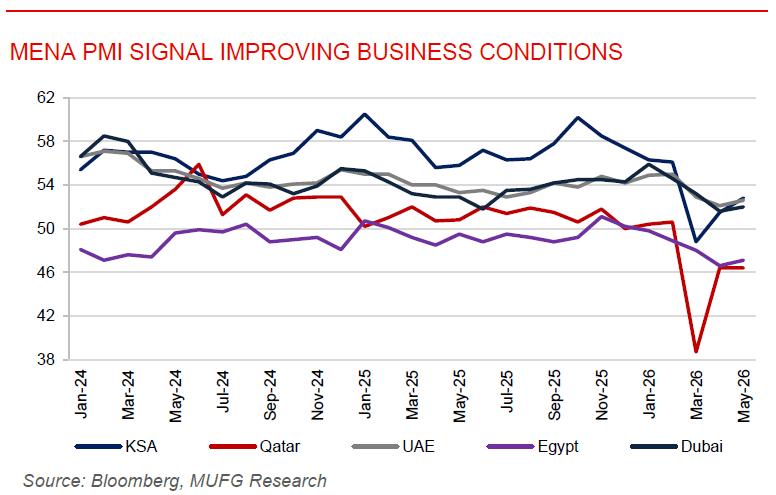
MENA PMIs signal improving business conditions after Iran war disruptions. The latest May 2026 PMI readings suggest business activity across much of the MENA region is stabilising after the initial shock from the Iran conflict. KSA’s PMI improved to 52.8 from 51.5 in April, reflecting continued momentum in non-oil sectors supported by government spending, major infrastructure projects, and resilient logistics activity. The UAE PMI also strengthened to 52.6, with growth supported by strong business activity in Abu Dhabi, expanding financial services, and ongoing trade rerouting. Dubai’s PMI edged higher to 52.0, indicating steady private sector expansion. Egypt’s PMI rose to 47.1 from 46.6, remaining below the 50-point expansion threshold but pointing to a gradual easing in contradictory pressure rather than a full recovery. Overall, the data indicate that regional business activity is recovering from April’s weakness, although the pace remains uneven, with upcoming June PMI release likely to provide a clearer indication of whether the recovery is becoming more broad-based across the region.
Saudi M&A activity remains resilient despite regional uncertainty. Saudi Arabia recorded 24 M&A deals worth USD689 million in Q1 2026, a 4% increase in transaction volume from a year earlier, highlighting the Kingdom’s resilience despite heightened regional tensions and a broader slowdown in Middle East dealmaking. While total M&A activity across the region declined in both value and volume, Saudi Arabia continued to attract investor interest, supported by Vision 2030 reforms, strong government backing, and the growing role of the Public Investment Fund. The figures also precede several major transactions expected later in the year, including potential Aramco asset monetisation initiative and a pipeline of PIF-backed IPOs. Looking ahead, M&A and capital market activity are likely to strengthen in the second half of 2026 as privatisation plans, corporate listings, and investment reforms continue to deepen Saudi Arabia’s capital markets and expand private-sector participation in the economy.