
To read the full report, please download the PDF above.
Middle East Daily
SOOJIN KIM
Research Analyst
DIFC Branch – Dubai
T: +44(4)387 5031
E: soojin.kim@ae.mufg.jp
MUFG Bank, Ltd. and MUFG Securities plc
A member of MUFG, a global financial group
Middle East Daily
COMMODITIES / ENERGY
Oil surges as renewed US-Iran fighting heightens Hormuz risk. Oil extended gains for a third session, with Brent trading around USD 96/b after surging 4.6% on Tuesday and WTI near USD 91/b, as renewed US-Iran hostilities intensified concerns over energy flows through the Strait of Hormuz. The US conducted a second day of strikes on Iran, while Iran retaliated against Jordan, Bahrain and Kuwait, raising the risk of a sustained escalation. Despite the strikes, crude continues to move through Hormuz, with US officials estimating flows averaged around 8mb/d, alongside another 4–5mb/d bypassing the strait through pipelines. However, this remains well below normal pre-war flows, while threats to shipping remain elevated. Oil is now more than 30% higher since the conflict began in February, with refined-product markets facing even greater tightness.
Gold extends decline as inflation and rate hike risks intensify. Gold fell for a third consecutive session, trading around USD 4,305/oz as rising energy prices and hawkish Fed expectations pushed bond yields and the dollar higher. Renewed US-Iran strikes have driven oil prices sharply higher, intensifying concerns that energy costs could keep inflation elevated and require further monetary tightening. Markets now price an almost 70% probability of a Fed rate hike in September, alongside at least two increases by March 2027, following Fed Chair Kevin Warsh’s hawkish inflation message. Meanwhile, the 30-year US Treasury yield climbed above 5.28%, reversing the decline triggered by the Treasury’s expanded bond-buyback programme last month and highlighting persistent concerns over US debt and inflation. Geopolitical uncertainty may provide some safe-haven support, but higher energy-driven inflation and rising Treasury yields are likely to remain significant headwinds for gold.
MIDDLE EAST - CREDIT TRADING
End of day comment – 01 September 2026. After the UK holiday we were greeted by a much higher UST yield curve. The market was repricing GCC bonds lower and it took the first hour to find some clearing levels. From there it was a pretty orderly day. Flows were skewed to better selling, both ETFs and RM were net reducing risk. Looking at levels, pre-Warsh and todays close we are anywhere from unch/+3bp in long end bond spreads and anywhere from unch/-3bp in belly bonds. That broadly reflects the flattening bias of the UST curve since Jackson Hole with yields in cash bonds since then 7/10bp wider. Primary markets are starting to see some life. KSA set T+70bp in 5y and T+80bp in 10y for their dual tranche sukuk bonds pricing later today. Smaller deals were also announced by KIB and ANB (At1). Macro markets are on the retreat as rates vol, and more expected DM IG supply keeps risk sentiment weak. Whilst primary markets will open up, new issues will most likely. (Source: Domonik Roth, Credit Trader)
MIDDLE EAST - MACRO / MARKETS
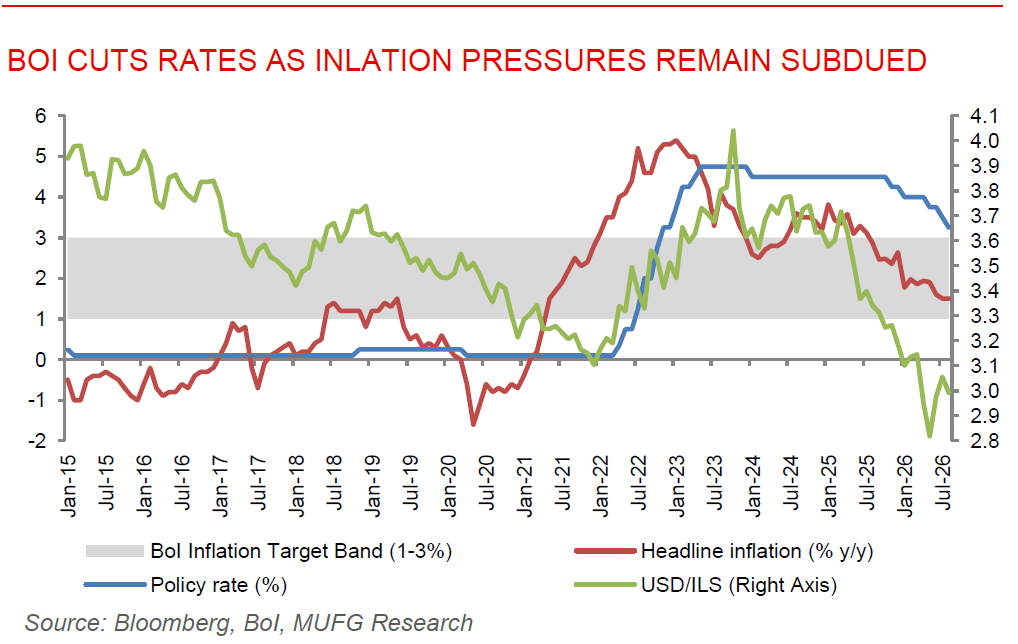
Bank of Israel cuts rates again as inflation pressures remain subdued. The Bank of Israel (BoI) cut its policy rate by 25bps to 3.25%, moving another step toward neutral despite lingering geopolitical and fiscal uncertainty. The decision reflected continued moderation in inflation, which has remained below the 2% midpoint of the target range, alongside signs that underlying economic activity is softer than the strong headline Q2 GDP rebound suggests. The BOI estimates the output gap has narrowed to -0.8% from -4.6%, while easing housing inflation and tentative signs of improving labour supply also support further normalization. However, uncertainty around the 2026 defence budget, fiscal adjustment and the October 27 election warrants caution, particularly as higher energy prices could revive inflation pressures. Looking ahead, we think one additional 25bp cut appears possible by year-end, taking the policy rate to 3%, although higher fiscal spending could delay further easing while sustained geopolitical de-escalation could allow faster rate cuts.
Turkey’s manufacturing downturn eases in August. Turkey’s manufacturing PMI rose to 48.1 in August from 47.7 in July, reaching a three-month high but remaining below the 50 threshold and extending the sector’s contraction for a 29th consecutive month. Output and new orders continued to decline amid subdued demand and uncertainty stemming from the Middle East conflict, although the pace of deterioration moderated. Export orders also weakened, while conflict-related supply-chain disruptions lengthened delivery times and manufacturers continued to reduce employment and purchasing activity. The subdued manufacturing backdrop is consistent with broader signs of slowing economic momentum, with Q2 GDP growth easing to 2.3% y/y and strengthens the case for further monetary easing from the Central Bank of Turkey (CBRT)’s current 37% policy rate. Going forward, the pace of CBRT easing, a sustained recovery in new orders and any de-escalation of regional tensions will be key to determining whether manufacturing can return to expansion later this year.