
To read the full report, please download the PDF above.
Middle East Daily
EDWARD BELL
Head of Research
DIFC Branch – Dubai
T: +971 (4)387 5033
E: soojin.kim@ae.mufg.jp
SOOJIN KIM
Research Analyst
DIFC Branch – Dubai
T: +971 (4)387 5031
E: soojin.kim@ae.mufg.jp
MUFG Bank, Ltd. and MUFG Securities plc
A member of MUFG, a global financial group
Middle East Daily
COMMODITIES / ENERGY
Oil watching deployment of more US troops to Middle East. December Brent futures jumped more than 4% overnight to close out at USD 102.31/b as the oil market responded to news that the US was sending additional forces to the Middle East and to an announcement from China that it was suspending refined fuel exports. Adding to the geopolitical risk premium was news that another tanker had been hit while transiting the Strait of Hormuz overnight. OPEC+ countries will hold a joint ministerial monitoring committee on October 4 but are unlikely to endorse any change in OPEC+ production policy, particularly as security over supply flows from the Middle East remains in question. Prices are holding steady at around USD 102/b in early trading today. North Sea physical prices remain elevated as the market tracks a drain on global inventories and worries that the US may seek to impose a ban on diesel exports.
Gold bounces as October Fed hike expectations decline. Gold prices added around USD 20/troy oz overnight to close at USD 4,177.66/troy oz as markets dampen expectations of back-to-back rate hikes from the Fed. The probability of another 25bps hike at the FOMC’s October 28 meeting has dropped to just 28%, down from around 70% a week ago. A drop in US Treasury yields overnight along with more cautious commentary from Fed officials is helping to support gold while PCE inflation released earlier in the week came in below expectations for August. The non-farm payrolls report released later today will be the next major catalyst for gold prices with market expectations at a gain of 90k jobs for September, down from 160k estimated for August.
MIDDLE EAST - CREDIT TRADING
End of day comment – 01 October 2026. It was a very weak day in GCC bonds, the spread widening accelerated and GCC bonds underperformed global credit markets by a wide margin. Dealers cut aggressively out of risk in the morning, there was a local bid in parts of the market late morning, and the market took a breath. Into the close we widen again with spreads getting a double whammy from lower GCC bond prices and higher UST as outflows from ETFs/RM resumed. ADGB closes 15/20bp wider. There was again pressure on the long end 54s (-1.5pt/+18bp) and in the 10y area 4.75 36s pp (-1pt/+20bp). QATAR didn't do much better (+12/15bp) but both new issue tranches 31s (unch/+5bp) and 36s (unch/+5bp) outperformed, by now they are in line with the curve though after this outperformance. Higher beta like OMAN/MOROC/SHJGOV are also +15/20bp with cash up to 1.25pt lower. Without any trigger to turn things around, without inflows/buyers it seems we are at the stage where risk is getting cut regardless of price/spread even in AA sovereign bonds. (Source: Dominik Roth, Credit Trader)
MIDDLE EAST - MACRO / MARKETS
Lebanon seeks new IMF staff-level agreement as banking reforms advance. Lebanon is seeking a new staff-level agreement with the IMF as a high-level delegation holds talks in Washington, aiming to translate recent banking reforms into progress toward a broader financial assistance program. The government has passed a bank restructuring law welcomed by the IMF, although its referral to the Constitutional Council for review has created uncertainty over implementation. A full IMF-supported program would still require passage of the financial gap law, which would determine how losses from the 2019 financial crisis, estimated by the government at around USD 70bn in 2022, are distributed among the state, central bank, commercial banks and depositors. The IMF has also emphasised the need for an internationally consistent bank-resolution framework, central-bank governance reforms and a 2027 budget and medium-term fiscal framework compatible with debt sustainability. Progress toward an agreement could help unlock wider multilateral financing for reconstruction, energy infrastructure and social support, but implementation of the remaining banking and fiscal reforms remains critical.
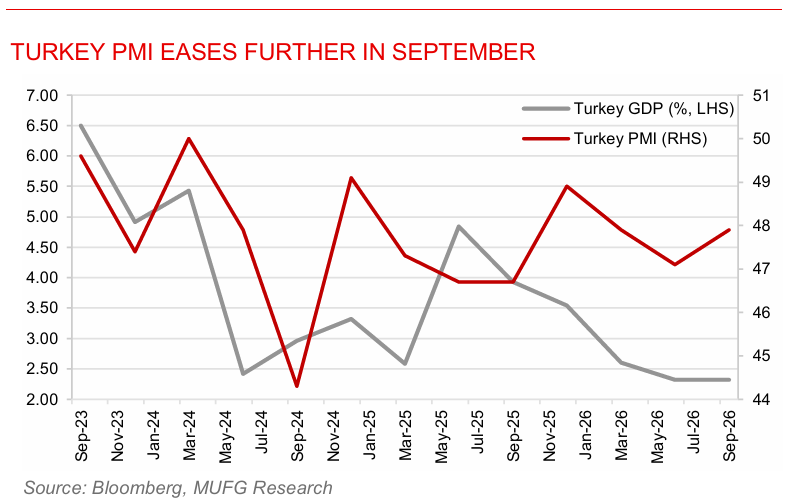
Manufacturing activity in Turkey eases further in September. Turkey’s manufacturing PMI dipped in September to 47.9, down from 48.1 a month earlier. Firms reported rising input cost inflation in September thanks to higher fuel and transport costs while domestic demand slowed further. The index has been consistently below the neutral 50 mark since March 2024 and represents the challenge for the Central Bank of Turkey on where to take policy. The prolonged contraction in manufacturing also points to subdued near-term growth momentum, reinforcing signs of a broader economic slowdown. Inflation has been on a moderating path, though still high at more than 31.5% y/y as of August, and activity has been easing, factors warranting rate cuts. At the same time the risk of imported energy inflation is a challenge for Turkey’s current account position. We expect that the CBRT will hold rates unchanged at 37.0% at their October 22 meeting before resuming cuts more meaningfully in 2027.